

Too Many 3PLs? Why Shippers Are Paying More for Less
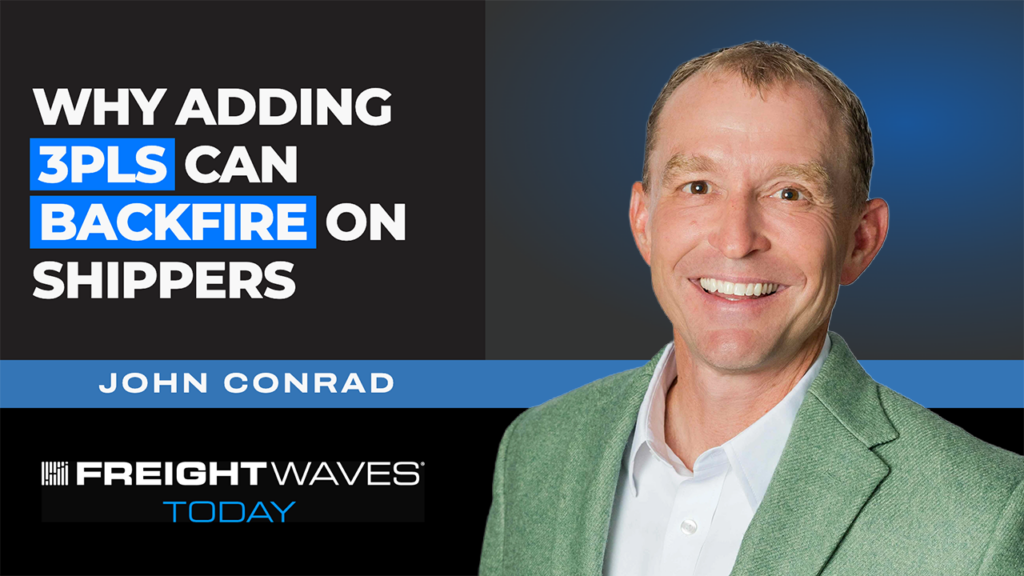
Shippers chasing lower freight rates by spreading loads across multiple third-party logistics providers (3PLs) may be shooting themselves in the foot. John Conrad, Chief Revenue Officer at Evans Transportation Services, warns that flooding the same lane with too many 3PLs can backfire, driving rates up instead of down, a phenomenon he calls “broker poker.”
Load-to-truck ratios have soared to “hundreds and hundreds of loads to one truck,” he said, with carriers exploiting the bidding frenzy to delay accepting loads in hopes of securing higher rates. “Those brokers who are going out to the marketplace over and over again on the same lane are driving the rate up,” Conrad explained. “The carriers get smart and say, I’m going to wait because you’re all bidding on it. At the end of the day, I’ll get a higher rate if I wait.".
When More 3PLs Mean Higher Costs: Too Many
“Sometimes what can happen is when you flood the marketplace with too many bidders and too many 3PLs, you can actually do the opposite of what you’re intending to do,” he said.
Evans Transportation, a privately held, family-owned 3PL founded in 1985, takes a different approach. The company, which serves roughly 300 customers, prioritizes long-term relationships over rate arbitrage. “There are legitimate cases for using more than one 3PL,” Conrad noted, “but the bar should be a pre-existing, trusted relationship in a specific segment of a shipper’s business.” Rather than displacing established partnerships, Evans integrates other vetted 3PLs into its managed transportation solutions when necessary.
The firm’s strategy reflects a broader caution about the freight market. Even when fuel prices dipped briefly, Conrad observed that average per-mile rates failed to follow suit. When fuel costs rebounded, rates climbed again, squeezing shippers already grappling with tight capacity. A looming tropical storm in the Gulf Coast could exacerbate the situation, pushing fuel costs and spot rates even higher.
The Most Volatile Freight Segment: Heavy Haul and AI Demand
Conrad flagged heavy-haul and open-equipment freight as the most unpredictable segment in today’s market. Unlike dry van or LTL, this mode is experiencing extreme volatility driven by a single, insatiable demand source: AI data center construction. Large equipment orders arrive in concentrated bursts, absorbing available capacity and leaving little room for other shippers.
“The demand isn’t going to slow down as long as consumers and businesses keep requiring faster data processing,” Conrad said.
Evans Transportation, an early player in the 3PL space with an MC number beginning with 1, combines proprietary technology with off-the-shelf tools to navigate these challenges. The company recently introduced an agentic AI voice system to handle initial inbound call volume, streamlining operations while maintaining human oversight for complex inquiries.
Con estas dinámicas, Evans Transportation mantendrá su enfoque en optimizar la capacidad disponible mediante su sistema de IA, con una revisión de resultados prevista para el próximo trimestre. La compañía confirmará ajustes operativos en su reunión de planificación del 15 de octubre, donde se evaluarán también las proyecciones de demanda para el primer semestre de 2025.


Sign up free to ask CAMAL AI for a summary, the key points or anything else about this story.
Related stories
CAMAL AI
 Financial Ports Newsletter
The maritime economy, every morning
Ports, shipping and freight markets in one short email. Free.
Financial Ports Newsletter
The maritime economy, every morning
Ports, shipping and freight markets in one short email. Free.



