

Iran Strikes US-Linked Ship with Drones and Missile—What Happens Next?
Four drones and at least one missile hit a US-contracted vessel near the Strait of Hormuz, injuring crew members.
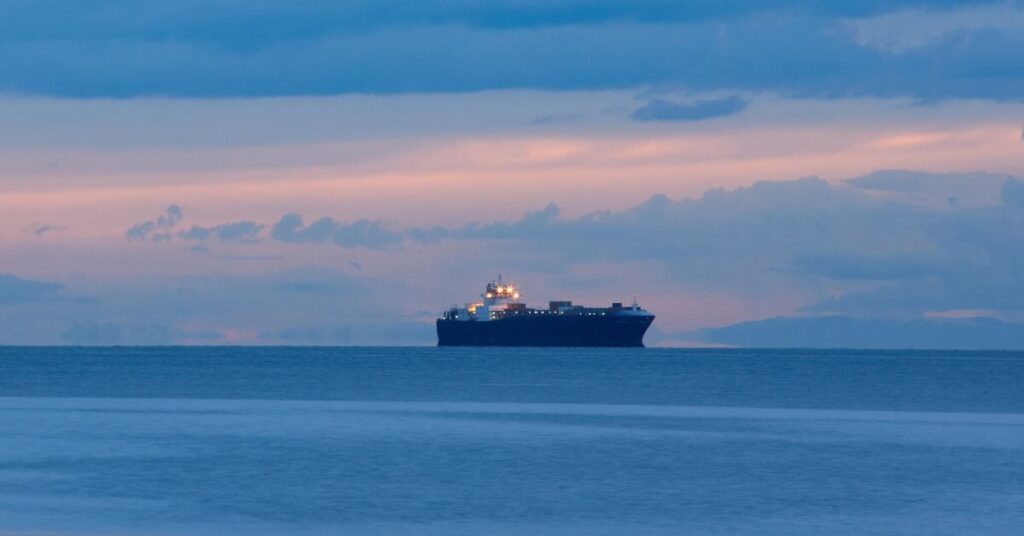
A US-contracted vessel came under attack near the Strait of Hormuz earlier this week, struck by four Iranian drones and at least one missile.
The attack, reported by US media on Wednesday, involved four drones and one missile, with one projectile hitting the vessel. While the extent of the damage remains unclear, minor injuries, including smoke inhalation, were reported among the crew. The injured were treated in an unspecified Gulf country, and several US personnel were also on board at the time of the strike.
Normally, about one-fifth of the world’s oil and liquefied natural gas shipments pass through this a narrow waterway. However, the ongoing conflict between the US and Iran has drastically reduced traffic, with preliminary tracking data showing only four vessels crossed the strait on Tuesday, a fraction of its usual volume. The strategic importance of the strait cannot be overstated.
Natural Gas
The US military has been actively escorting commercial vessels to mitigate risks.
For energy markets, the instability in the Strait of Hormuz has had a ripple effect.
Escalation and Uncertainty: What Comes Next?: strait of hormuz
The conflict, which began on February February 28, 2026, has taken a heavy toll on both sides. More than 800 American servicemembers have been injured, and 18 have been killed in the past year. An estimated two-thirds of the US missile interceptor stockpile has been expended, raising concerns about the sustainability of current defense measures.
The damage to US military infrastructure has been extensive. Hundreds of military sites have been damaged or destroyed, and roughly 20 aircraft have been lost to incoming fire. These losses have prompted a debate within the US government about whether to rebuild damaged bases in the region or pull back to more secure locations. The decision carries significant geopolitical implications, as a withdrawal could be interpreted as a sign of weakness by Iran and its allies.
Iran has also targeted US drone assets, capturing an Anduril Dive-LD drone sub last week and attempting to seize a Saildrone surveillance vessel in 2022. The Anduril Dive-LD, a cutting-edge autonomous underwater vehicle, was unveiled by Iran as a trophy of its operations against US forces. The US military has responded by destroying Iranian small craft attempting to intercept American drones, though Iran has dismissed these as fishing vessels and claimed fishermen are missing.
The capture of the Anduril Dive-LD highlights the evolving nature of maritime warfare in the region. Drones and autonomous vessels have become increasingly important tools for surveillance and reconnaissance, and their loss can provide adversaries with valuable intelligence. For the US, the incident underscores the need for improved countermeasures to protect its unmanned assets.
the US administration is weighing his next steps, with options ranging from military action to economic pressure or negotiations. He has expressed openness to meeting Iranian President Masoud Pezeshkian at the UN General Assembly in New York next week, though the prospects for dialogue remain uncertain. The meeting, if it occurs, would mark the first high-level contact between the two countries since the conflict began in February.
In a recent interview with Fox News, the US administration hinted at the gravity of the situation, stating, “It’s a big decision. Anything could happen with me.” He later added, “My question is, if and when do I blow the entire nation up? They better behave.” These remarks reflect the high stakes of the conflict and the limited options available to the US administration.
Meanwhile, CIA Director John Ratcliffe met with Egyptian President Abdel Fattah al-Sisi and Egypt’s spy chief, Hassan Rashad, in Cairo to discuss regional security and maritime threats. The meeting underscores the broader geopolitical dimensions of the conflict, as neighbouring countries seek to navigate the instability while protecting their own interests. Egypt, a key US ally in the region, has a vested interest in maintaining stability in the Red Sea and the Suez Canal, another critical chokepoint for global trade.
The attack on the US-contracted vessel underscores the fragility of maritime security in the Gulf. With neither Washington nor Tehran confirming the incident, the vessel’s current status remains unknown. What is clear, however, is that the Strait of Hormuz, a vital artery for global trade, remains a flashpoint in a conflict with far-reaching implications for energy markets and international stability.
For commercial shipping, the risks are significant. The Houthi militia in Yemen, backed by Iran, has expanded its attacks on Saudi oil facilities, targeting storage sites and refineries. Last Saturday, Saudi officials reported intercepting a Houthi ballistic missile fired at Riyadh’s international airport, while another missile targeted Aramco’s oil facilities in Yanbu. These attacks have disrupted Saudi Arabia’s oil production and raised concerns about the security of energy infrastructure in the region.
The coming days may prove decisive. As the US considers whether to rebuild its damaged bases or pull back, the region braces for further escalation. The planned meeting between Persian Gulf leaders next week could offer a rare opportunity for dialogue, though expectations remain low. For now, the Strait of Hormuz remains a powder keg, with every vessel that passes through its waters a potential target in a conflict that shows no signs of abating.
For businesses and governments reliant on Gulf energy exports, the situation demands heightened vigilance. The US military’s escort missions provide some protection, but the risks of further attacks remain high. Companies operating in the region are advised to monitor updates from the US Central Command and the International Maritime Security Construct, which coordinates maritime security efforts in the Gulf.
“This is major damage to our bases that hasn’t been communicated to the American public. We’re standing there with our eyes closed getting punched in the face.”
A servicemember·US military personnel
The conflict’s impact extends beyond the immediate region. The disruption of energy shipments through the Strait of Hormuz has contributed to volatility in global oil markets, with prices reacting to each new development. For countries dependent on Gulf oil, such as China, India, and Japan, the instability has prompted efforts to diversify energy sources and reduce reliance on the region.
As the situation evolves, the international community will be watching closely. The UN General Assembly in New York next week could provide a platform for diplomatic efforts, though the deep mistrust between the US and Iran makes any breakthrough unlikely. For now, the focus remains on managing the immediate risks to maritime security and preventing further escalation in a conflict that has already reshaped the geopolitical landscape of the Middle East.


Sign up free to ask CAMAL AI for a summary, the key points or anything else about this story.
Related stories
CAMAL AI
 Financial Ports Newsletter
The maritime economy, every morning
Ports, shipping and freight markets in one short email. Free.
Financial Ports Newsletter
The maritime economy, every morning
Ports, shipping and freight markets in one short email. Free.



