

Iran Strikes Fourth Tanker in Hormuz as US Claims Oil Flow Unbroken
Two crew injured as LR Stephanie hit; CENTCOM insists 1 billion barrels exported despite blockade
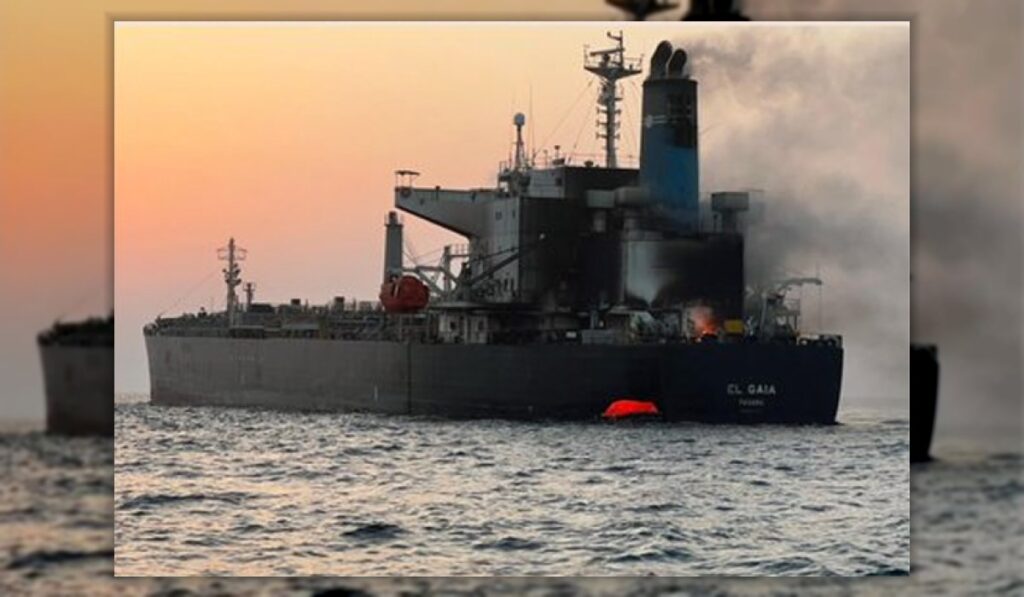
The LR Stephanie, registered in the Isle of Man, was hit while transiting inbound to the Persian Gulf. Despite the strike, the vessel continued its journey, though two crewmembers sustained minor injuries. The incident follows attacks on three other tankers, MT Trend (7,119 dwt), STI Steadfast (109,999 dwt), and Al Maryah (54,474 dwt), an LPG carrier working for ADNOC, since September 17, according to UKMTO reports.
The Islamic Revolutionary Guard Corps (IRGC) has intensified its activities in the Strait of Hormuz, employing drones, targeted surveillance, and radio hailing to disrupt merchant shipping. The Joint Maritime Information Center (JMIC) stated in its weekly report that these actions “continue to demonstrate Iran’s intent to assert presence along key transit lanes and maintain pressure on transiting vessels.”
“IRGC attacks, attempted attacks, and/or harassment activity persisted, including UAV overflight, targeted surveillance of merchant shipping, and occasional VHF hailing. These actions continue to demonstrate Iran’s intent to assert presence along key transit lanes and maintain pressure on transiting vessels.”
Joint Maritime Information Center·Joint Maritime Information Center
IRGC Navy leaders have repeatedly threatened to destroy any vessel attempting to transit the strait without explicit permission.
Iran’s Tactics: Harassment, Surveillance, and Blockade Threats: strait of hormuz
Admiral Brad Cooper, who heads CENTCOM, offered a starkly different narrative in a video update on September 19. He declared that the US had facilitated the export of 1 billion barrels of oil over the past two months, assisting more than 2,000 commercial ships in safely navigating the strait. Cooper also asserted that oil volumes in the past two weeks were “higher than any point in the past six months.”
“We have just surpassed the 1 billion barrel mark for oil exports over the last couple of months. CENTCOM has assisted over 2,000 commercial ships in making the transit, providing coordinated protection. Furthermore, volume in the past two weeks was higher than any point in the past six months.”
Admiral Brad Cooper·Commander, US Central Command
However, independent tracking data paints a less optimistic picture. Kpler, a leading energy analytics firm, reported that only 17 vessels transited the Strait of Hormuz over the weekend of September 20-21, down from 37 the previous week. For the week ending September 21, Kpler recorded just 22 tanker transits, carrying a total of 42 million barrels of crude, a fraction of the strait’s typical throughput. JMIC’s data further underscores the volatility, showing days with as few as zero or one vessel transiting the strait in mid-September.
Many producers have resorted to shuttle operations, delivering oil to tankers waiting in the Arabian Sea rather than risking passage through the strait. since March 1 1, JMIC has tracked 116 confirmed incidents in the area, including attacks, harassment, and attempted blockades.
US Claims Oil Flows Strong, But Independent Data Tells a Different Story
For shipping companies and energy traders, the risks are clear. Vessels transiting the strait must now contend with not only the threat of physical attacks but also the psychological pressure of Iran’s blockade rhetoric. The LR Stephanie incident serves as a stark reminder that even minor strikes can result in injuries and operational delays. Industry analysts warn that insurers may soon hike premiums for ships passing through the region, further increasing costs for carriers and, ultimately, consumers.
As tensions escalate, the international community faces a dilemma. Diplomatic efforts to de-escalate have so far yielded little progress, while military options remain fraught with risk. For now, the strait remains technically open, but for how long? With 110 vessels redirected since Iran resumed its blockade tactics, the clock is ticking on a crisis that could reshape global energy security. What’s next? Observers will be watching for three key developments.
- CENTCOM’s next update: Will the US military provide further evidence to support its claims of robust oil flows, or will independent data continue to contradict the narrative?
- Iran’s next move: Will Tehran escalate its tactics, or will it seek to de-escalate amid growing international pressure?
- Market reaction: Will energy prices spike in response to the latest attacks, or will traders remain sanguine, betting on continued US protection?
One thing is certain: the Strait of Hormuz is no longer just a shipping lane. It is a battleground, one where the rules of engagement are being rewritten in real time.


Sign up free to ask CAMAL AI for a summary, the key points or anything else about this story.
Related stories
CAMAL AI
 Financial Ports Newsletter
The maritime economy, every morning
Ports, shipping and freight markets in one short email. Free.
Financial Ports Newsletter
The maritime economy, every morning
Ports, shipping and freight markets in one short email. Free.