

Korea-U.S. Shipbuilding Pact: ABS Leads $1bn Tech Push for Next-Gen Vessels
ABS joins KRISO, KIAT and Texas A&M to fast-track smart shipbuilding and workforce certification under a new bilateral.
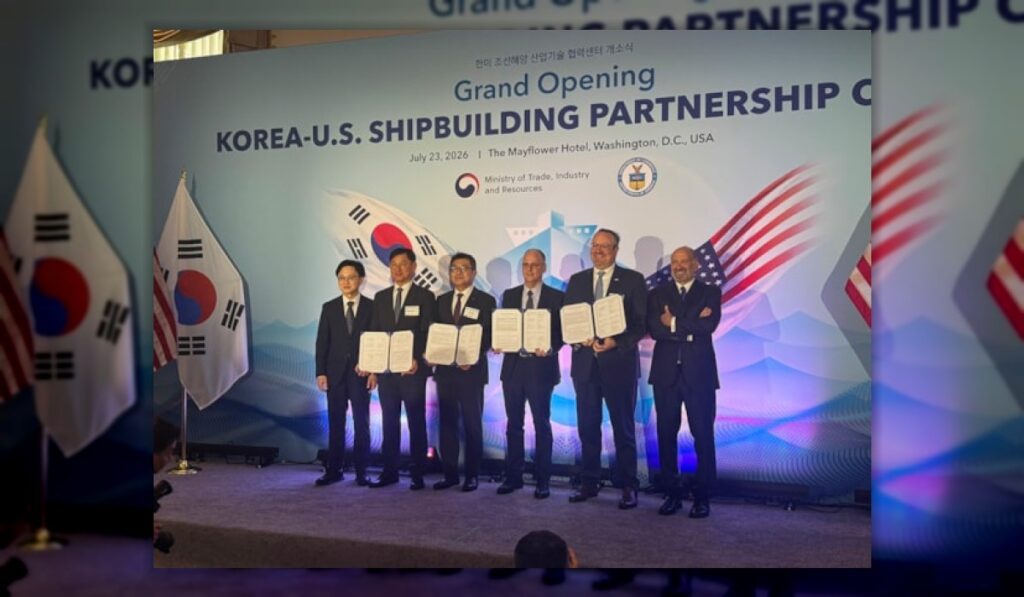
The agreement, announced on July 24, 2026, establishes the Korea-U.S. Shipbuilding Partnership Center (KUSPC), a hub designed to connect industry, academia, and research institutions from both nations. The initiative aims to foster innovation in next-generation shipbuilding, with a focus on safer, smarter, and more sustainable maritime technologies.
Under the MOU, each institution brings a unique strength to the table. Meanwhile, KIAT will support industrial technology innovation and facilitate international cooperation, ensuring that the partnership aligns with broader economic and strategic goals.
Texas A&M University, a leading academic institution in engineering and maritime studies, will provide research and education capabilities, including workforce development programmes tailored to the demands of modern shipbuilding. ABS, the American Bureau of Shipping, will play a pivotal role by offering its expertise in classification, certification, verification, maritime safety, and international regulatory frameworks. This ensures that the technologies developed under the partnership meet the highest industry standards and comply with global regulations.
John McDonald, ABS Chairman and CEO, emphasised the significance of the collaboration:
“Strengthening the connection between leading institutions in Korea and the United States is an important step in advancing the next generation of shipbuilding and maritime technology. Innovation succeeds when research, industry insight and practical application come together. By bringing together world-class partners across research and technology, this initiative creates a strong foundation for collaboration that can support safer, smarter shipbuilding in both countries.”
John McDonald·ABS Chairman and CEO
Workforce development and regulatory cooperation at the core: Shipbuilding
This agreement focuses on building a skilled workforce capable of meeting the demanding standards of modern naval and commercial shipbuilding, particularly in the U.S.
KRISO will contribute its expertise in advanced ship engineering and smart manufacturing, while KOSHIPA, representing Korea’s shipbuilding industry, will support workforce training and production capabilities through its extensive industrial network. The KUSPC will act as the bilateral coordination hub, connecting governments, industry, and research institutions to ensure seamless collaboration.
ABS will provide guidance on classification, certification, and regulatory standards, including U.S. naval technical frameworks.
This MOU creates the framework needed to develop that capability, and ABS is proud to support it through our deep domain experience in classification, certification and regulatory standards.".
The partnership is expected to have far-reaching implications for the global maritime industry. By combining Korea’s shipbuilding prowess with the U.S.’s naval and commercial expertise, the initiative aims to set new benchmarks in technological innovation, safety, and sustainability. For shipbuilders, this means access to cutting-edge research and development, while for maritime operators, it promises vessels that are more efficient, environmentally friendly, and compliant with evolving regulatory requirements.
The KUSPC will serve as the central platform for this collaboration, facilitating knowledge exchange, joint research projects, and industry-academia partnerships. The centre is poised to become a key driver of maritime innovation, with potential applications in autonomous shipping, green fuels, and digitalisation.
For stakeholders in the maritime sector, this partnership offers a glimpse into the future of shipbuilding. As the industry continues to evolve, initiatives like the KUSPC will play a crucial role in shaping the next generation of vessels and maritime technologies. The collaboration between Korea and the U.S. is not just about strengthening bilateral ties, it is about securing a competitive edge in an increasingly complex and demanding global market.
The next steps for the partnership include the development of specific research projects, workforce training programmes, and regulatory frameworks. Industry observers will be watching closely as the KUSPC takes shape, with expectations that it will deliver tangible results in the coming years. For now, the MOU marks a significant milestone in the journey toward safer, smarter, and more sustainable shipbuilding.


Sign up free to ask CAMAL AI for a summary, the key points or anything else about this story.
Related stories
CAMAL AI
 Financial Ports Newsletter
The maritime economy, every morning
Ports, shipping and freight markets in one short email. Free.
Financial Ports Newsletter
The maritime economy, every morning
Ports, shipping and freight markets in one short email. Free.