

Electric Seaglider Soars: The 180-Mph Vessel That Could Replace Ferries
Regent’s Viceroy prototype completes first crewed flight, promising 180-mile range at 180 mph with zero emissions.
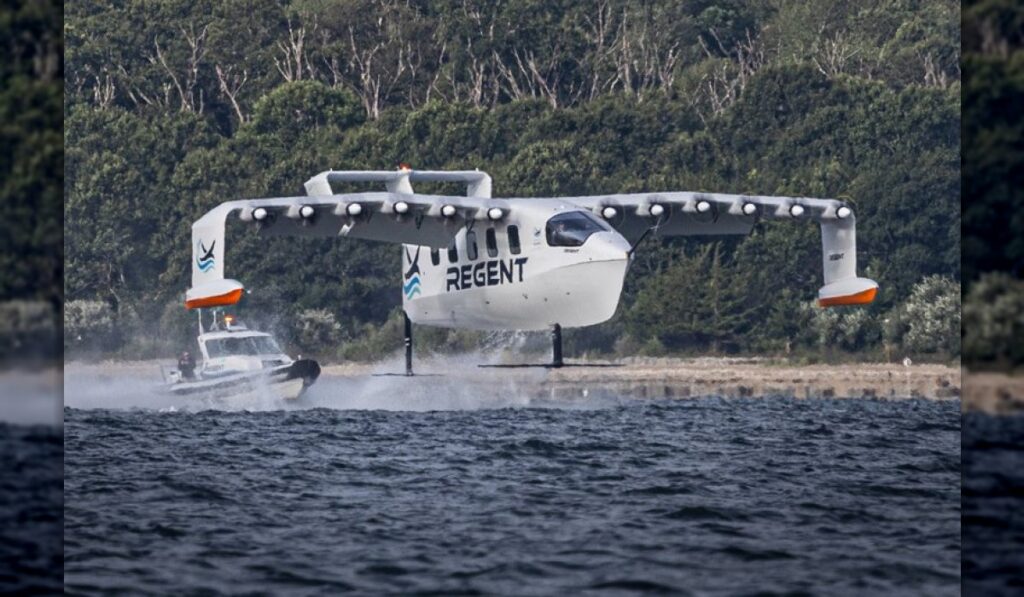
Regent Craft has achieved a milestone in maritime innovation with the first human-crewed flight of its Viceroy Seaglider, an all-electric wing-in-ground effect (WIG) vessel designed to revolutionise passenger and cargo transport. The prototype flew 1,956 ft (596 m) at a height of 33 ft (10 m) above Narragansett Bay, Rhode Island, for 30 seconds on September 2, 2026, marking the largest such craft to carry people.
The Viceroy Seaglider, developed over 5.5 years, combines the speed of an aircraft with the operational simplicity of a boat. It operates in three modes: floating at low speeds, hydrofoiling once clear of the dock, and flying within one wingspan of the water’s surface. This design allows it to navigate harbours and coastlines with wave tolerance and manoeuvrability, managed by a triple-redundant digital control system that ensures stability.
Regent’s co-founder and CEO, Billy Thalheimer, hailed the flight as a turning point for maritime mobility. “This is the moment we have been envisioning and tirelessly pursuing for the past five and a half years,” he said. “Regent has successfully proven safe, efficient ground-effect flight.”
Royal Caribbean
“The Viceroy Seaglider flight marks the start of a new era in mobility, unlocking opportunities across passenger travel, defense missions, and cargo transport.”
Billy Thalheimer·Co-founder and CEO at Regent
How the Seaglider Redefines Maritime Transport
The Viceroy is designed to seat 12 passengers and two crew, with a maximum speed of 180 mph and a range of 180 miles. Its hydrofoiling capability allows it to transition seamlessly from water to flight, reducing drag and energy consumption. The vessel is operated by certified mariners and regulated as a maritime vessel by the eliminar referencia, ensuring compliance with existing safety standards.
By flying just above the water’s surface, the craft reduces aerodynamic drag while maintaining lift, achieving greater efficiency than conventional aircraft or ships.
Regent’s chief technology officer, Mike Klinker, emphasised the significance of the flight test. “Completing this flight test validates years of rigorous engineering and operational work,” he said. “We showed today that flying a Seaglider is every bit as smooth and safe as we designed it to be.”
“I can’t wait to get onboard and to share the experience with others as we make our vision for the future of maritime mobility a reality.”
Mike Klinker·Co-founder and CTO at Regent
Military and Commercial Interest in the Seaglider
The Seaglider’s potential extends beyond commercial passenger transport. Regent has already secured a $15 million contract with the U.S. Marine Corps Warfighting Lab and a Cooperative Research and Development Agreement (CRADA) with U.S. Special Operations Command (USSOCOM). These partnerships highlight the vessel’s applications in contested logistics, medical evacuation (MEDEVAC), intelligence, surveillance, and reconnaissance (ISR).
Earlier in 2026, Regent’s autonomous Seaglider drone, Squire, completed its first defense-specific wing-in-ground effect flight, further demonstrating the technology’s versatility.
Ferry operators, shipping companies, and regional airlines have expressed strong interest in the Seaglider, attracted by its zero-emission operation and high-speed capabilities. For commercial operators, the Viceroy offers a compelling alternative to diesel-powered ferries, which are subject to increasingly stringent environmental regulations. Its all-electric design aligns with global decarbonisation targets, while its speed, comparable to that of a turboprop aircraft, could reduce travel times on routes where conventional ferries are the only option.
For passengers, the Seaglider promises a smoother, faster, and more sustainable way to travel between coastal cities and islands. Unlike traditional ferries, which are often delayed by rough seas, the Viceroy’s hydrofoiling and ground-effect flight modes provide a stable ride even in choppy conditions. Its quiet, electric propulsion also reduces noise pollution, a common complaint in densely populated port areas.
With the successful crewed flight of the Viceroy, Regent is now focused on the final stage of sea trials, refining vehicle performance and preparing for commercial service. The next phase will involve extended flight tests to validate the Seaglider’s range, reliability, and operational limits. Once certified, the Viceroy could enter service on routes such as Boston to Provincetown, San Francisco to Oakland, or even inter-island connections in Hawaii and the Caribbean.
Regent has already begun discussions with potential customers, including ferry operators in Europe and Asia, where high-speed maritime transport is in high demand. The company’s manufacturing facility in Rhode Island is equipped to produce up to 100 Seagliders per year, with plans to expand capacity as orders increase. For now, the focus remains on proving the technology’s viability and scaling production to meet both military and commercial needs.
The Seaglider’s success could mark a turning point for the maritime industry, offering a glimpse of a future where electric, high-speed vessels replace fossil-fuel-dependent ferries and short-haul flights. As Billy Thalheimer put it, the vision is no longer a distant dream but an imminent reality, one that could redefine how people and goods move across the world’s waterways.


Sign up free to ask CAMAL AI for a summary, the key points or anything else about this story.
Related stories
CAMAL AI
 Financial Ports Newsletter
The maritime economy, every morning
Ports, shipping and freight markets in one short email. Free.
Financial Ports Newsletter
The maritime economy, every morning
Ports, shipping and freight markets in one short email. Free.



