

USS Robert Smalls ends Pacific tour with 40,000-mile homecoming
The Ticonderoga-class cruiser returns to San Diego after seven months supporting two carrier strike groups across the.
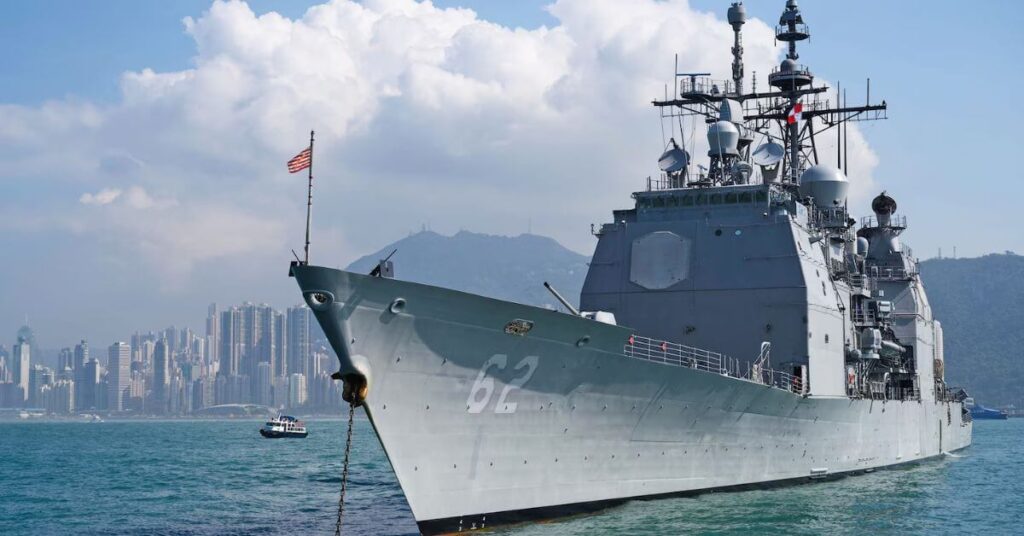
The USS Robert Smalls, a Ticonderoga-class guided-missile cruiser, spent more than days at sea, traversing over 40,000 nautical miles across the US 3rd and 7th Fleet areas of responsibility.
The cruiser’s primary mission was to support two US carrier strike groups, the Abraham Lincoln and George Washington, as well as the Tripoli Amphibious Ready Group and the 31st Marine Expeditionary Unit. In these operations, the USS Robert Smalls served in critical command and control roles, including alternate composite warfare commander, air and missile defence commander, and aircraft control unit.
One of the most demanding aspects of the deployment was the ship’s role as the sole escort for a carrier during sea trials, workups, and certification. According to Capt. Francisco X. Garza, the commanding officer of the USS Robert Smalls, this responsibility required the crew to maintain peak operational readiness while ensuring the safety and effectiveness of the carrier’s operations. “The crew of Robert Smalls performed with distinction throughout this deployment and homeport shift,” Garza stated. “I am incredibly proud of what this team accomplished.”
The ship also conducted 14 underway replenishments, a logistically intensive operation that allows naval vessels to refuel and resupply without returning to port. These included two replenishments with an Australian oiler and one with a US commercial tanker, highlighting the collaborative nature of modern naval operations. Such exercises are essential for extending the endurance of warships during prolonged deployments, particularly in the vast expanse of the Pacific.
The USS Robert Smalls was replaced in Japan by the USS Mustin, an Arleigh Burke-class guided-missile destroyer. The rotation is part of a broader US Navy strategy to comply with a federal law limiting forward deployments to 10 years.
The Navy intends to replace the cruisers with next-generation guided-missile destroyers, which are designed to be more versatile, fuel-efficient, and capable of integrating with advanced missile defence systems.
The deployment in numbers: Robert Smalls
The decommissioning of the Ticonderoga-class fleet reflects a broader shift in naval warfare, where the focus is increasingly on distributed lethality and networked operations. Unlike the cruisers, which were designed during the Cold War to operate as standalone air defence platforms, the new destroyers are built to work as part of a larger, interconnected fleet. This shift is particularly relevant in the Indo-Pacific, where the US Navy faces growing challenges from near-peer competitors such as China, which has rapidly expanded its naval capabilities in recent years.
Despite the impending retirement of the Ticonderoga-class, the legacy of these ships will endure. The USS Robert Smalls, in particular, played a pivotal role in strengthening US alliances in the region. During its deployment, the cruiser worked alongside three Australian warships and one Japanese warship, underscoring the importance of multinational cooperation in maintaining maritime security.
The ship also made a port call in Da Nang, Vietnam, where it supported the US-Vietnam Comprehensive Strategic Partnership, a relationship that has grown increasingly important as both nations seek to counterbalance China’s assertiveness in the South China Sea.
As the USS Robert Smalls prepares for its final decommissioning, the focus of the US Navy’s surface fleet will shift to the Arleigh Burke-class destroyers and the forthcoming DDG(X) next-generation guided-missile destroyer. These platforms are expected to form the backbone of the Navy’s surface combatant force for decades to come, with enhanced capabilities in anti-air, anti-surface, and anti-submarine warfare.
The transition also reflects the Navy’s commitment to modernising its fleet in response to evolving threats, particularly in the Indo-Pacific region, where the strategic competition with China continues to intensify.
For the crew of the USS Robert Smalls, the return to San Diego is bittersweet. Many have served on the ship for years, and the vessel has been a home away from home during its deployments. Capt. Garza reflected on the significance of the moment, stating, “This is our sayonara, leaving Japan for the last time. This crew, and the crews that came before us on this hull, earned the trust of our Japanese partners and of the strike group. We leave proud of that record and grateful for the time we had in Yokosuka.”
The USS Robert Smalls will now undergo a period of maintenance and preparation for decommissioning. While the Navy has not yet announced the exact date of its retirement, the ship’s return to San Diego marks the beginning of the end for one of the most storied classes of warships in modern naval history.


Sign up free to ask CAMAL AI for a summary, the key points or anything else about this story.
Related stories
CAMAL AI
 Financial Ports Newsletter
The maritime economy, every morning
Ports, shipping and freight markets in one short email. Free.



