

Red diesel tax break: will US truckers save 24 cents a gallon?
US diesel prices drop 18.3 cents per gallon as Trump signs executive order allowing red-dyed fuel on highways.
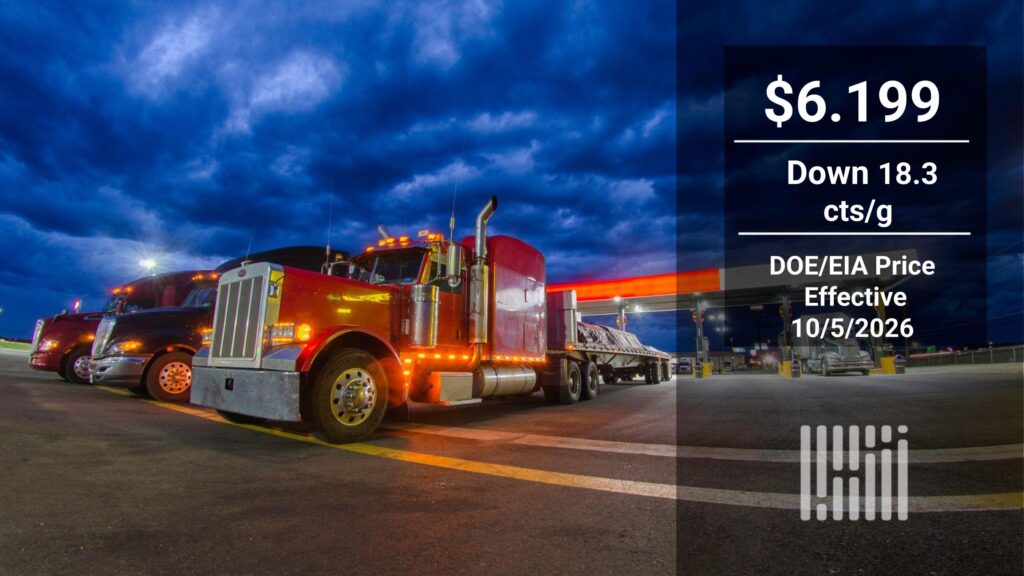
The U.S. diesel market has seen a second consecutive weekly decline in retail prices, according to the latest data from the Department of Energy’s Energy Information Administration (DOE/EIA). The average price dropped by 18.3 cents per gallon, settling at $6.199/g—a notable decrease from the record high of $6.529/g recorded just two weeks earlier.
The downward trend aligns with broader weakness in ultra-low sulfur diesel (ULSD) futures. On the CME commodity exchange, the November ULSD contract closed at $4.5452/g on Monday, down from $4.6336/g on September 23. The decline follows a six-week period in which prices rose five times, with each increase exceeding 10 cents per gallon.
Federal tax change adds uncertainty: red diesel tax break
A recent executive order signed by President Trump could further influence diesel prices by expanding the use of red-dye diesel for over-the-road trucking. The fuel, traditionally reserved for off-road applications like agriculture, is exempt from the federal excise tax of 24.3 cents per gallon. The dye itself does not alter the fuel’s chemical properties, meaning it can be used in standard diesel engines without modification.
The administration’s order allows for a deferral of the excise tax on red-dye diesel used in trucking and suggests a potential future elimination of the tax obligation entirely. However, such a move would require congressional approval, leaving the long-term impact uncertain. Industry analysts, including Patrick DeHaan of GasBuddy, have noted that the change could provide immediate relief to truckers facing high fuel costs, though its effectiveness depends on how quickly states adapt their regulations.
Adding to the downward pressure on diesel prices, the International Energy Agency (IEA) announced the release of 100 million barrels of crude, diesel, and other refined products from strategic reserves in the U.S. and Europe. The coordinated effort aims to stabilize global energy markets, though its effects on retail prices remain to be seen.
For now, the DOE/EIA’s next weekly price update, expected Tuesday, will offer the first indication of whether the tax change has begun to influence retail costs. Until then, trucking companies are advised to monitor state-level regulations, as the executive order’s benefits may vary depending on local enforcement.


Sign up free to ask CAMAL AI for a summary, the key points or anything else about this story.
Related stories
CAMAL AI
 Financial Ports Newsletter
The maritime economy, every morning
Ports, shipping and freight markets in one short email. Free.
Financial Ports Newsletter
The maritime economy, every morning
Ports, shipping and freight markets in one short email. Free.



