

Persian Gulf oil surge slashes diesel prices: How low can they go?
Retail diesel prices fall 14.7 cents per gallon as Persian Gulf crude flows near pre-war levels.
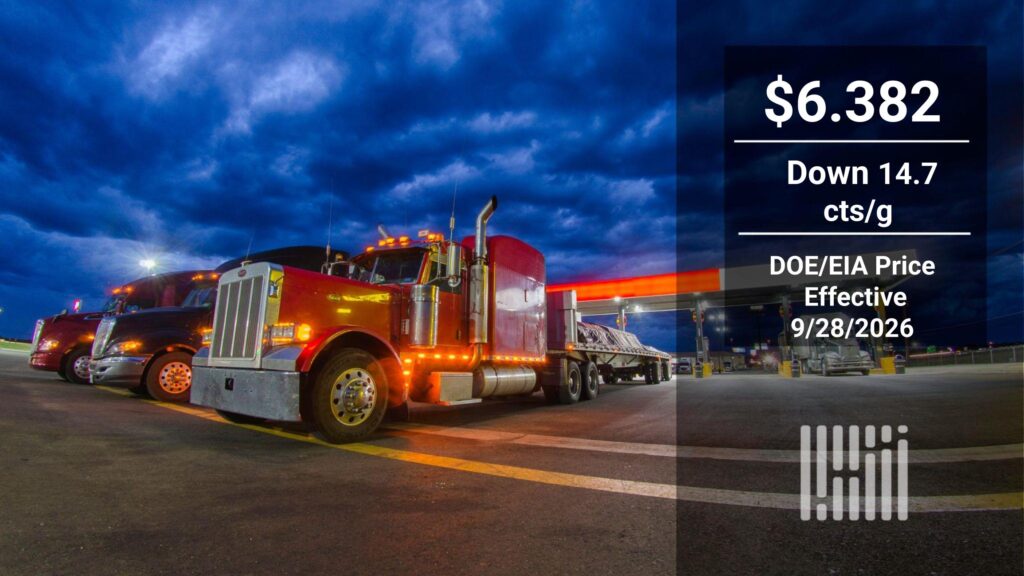
Retail diesel prices have plunged by 14.7 cents per gallon, marking the first decline in four weeks as crude flows from the Persian Gulf surge closer to pre-war levels. The drop, confirmed by the U.S.
The latest average weekly retail diesel price settled at $6.382 per gallon, effective Monday but published Tuesday. The decline follows increasing reports that crude exports from the Persian Gulf are nearing pre-war volumes, easing fears of prolonged supply disruptions. However, not all players in the region are contributing equally to the rebound.
Why the Persian Gulf’s oil surge is reshaping diesel markets: persian gulf oil
Recent developments suggest Iran’s ability to disrupt these flows, once a major geopolitical lever, is weakening. As The Wall Street Journal reported, “Iran’s ability to choke off oil flowing through the Strait of Hormuz, and use that as leverage in talks with the U.S., is breaking down, raising the risk it will resort to military escalation to bolster its position.".
Brent Crude
The strait, a narrow waterway separating Iran from Oman and the United Arab Emirates, has historically been a flashpoint for tensions.
“Iran’s ability to choke off oil flowing through the Strait of Hormuz, and use that as leverage in talks with the U.S., is breaking down, raising the risk it will resort to military escalation to bolster its position.”
The Wall Street Journal·Financial news outlet
While crude exports from the region are approaching pre-war norms, refined product flows remain sluggish. According to J.P. Morgan, product exports from the Persian Gulf are still only slightly above 50% of pre-war levels. Iran, in particular, has seen its exports effectively halted by a U.S. blockade, leaving other Gulf nations to fill the gap.
Diesel futures rebound, but for how long?
The futures market for ultra low sulfur diesel (ULSD) has mirrored the volatility in physical markets. After peaking at $5.262 per gallon on September 16, the highest settlement since the Iran war began, ULSD prices on the CME tumbled to $4.6847 per gallon last Friday. The contract’s expiration on Wednesday triggered a short-term rebound, with prices climbing more than 20 cents per gallon on Monday and Tuesday as traders covered short positions.
However, the rally appears disconnected from broader market trends. Both international benchmark Brent crude and U.S. benchmark West Texas Intermediate continued their decline on Tuesday, suggesting the ULSD spike may be temporary. The divergence between crude and diesel prices underscores the complexity of the current market, where geopolitical risks and refining margins interact in unpredictable ways.
Meanwhile, in the U.S., Texas Governor Greg Abbott signed a disaster proclamation allowing dyed diesel, a lower-tax fuel typically restricted to agricultural use, to be used on public roads. The move aims to ease supply constraints, though its impact may be limited. Most U.S. refiners have already shifted production to ultra low sulfur diesel (ULSD), leaving little high-sulfur fuel available even if the EPA grants a temporary waiver of Clean Air Act rules.
EPA (EPA), the federal agency responsible for enforcing air quality standards, has yet to respond to Abbott’s request for a waiver. Such waivers are rare and typically granted only in emergencies, such as natural disasters or severe supply disruptions. The delay suggests the EPA is weighing the environmental trade-offs of relaxing sulfur standards against the immediate need for fuel availability.
The decline in diesel prices offers a rare respite for shipping and logistics firms, which have faced soaring fuel costs over the past year. Diesel is the lifeblood of the global supply chain, powering everything from container ships to long-haul trucks. For maritime operators, even a modest drop in fuel costs can translate into significant savings, particularly for vessels burning thousands of tonnes of diesel per voyage.
However, the relief may be short-lived. The current price dip hinges on the Persian Gulf’s ability to sustain higher export volumes, a prospect clouded by Iran’s exclusion from the market. If tensions escalate, shipping routes through the Strait of Hormuz could once again become a flashpoint, disrupting the flow of both crude and refined products. Firms with exposure to Middle Eastern routes may need to hedge against renewed volatility, either through futures contracts or alternative supply chains.
For trucking and rail operators, the price decline could ease pressure on freight rates, which have been inflated by fuel surcharges. The benchmark diesel price used for most fuel surcharges fell after three straight increases, providing a potential tailwind for shippers negotiating contracts. However, the long-term outlook remains uncertain, as refining margins and geopolitical risks could reverse the trend at any moment.
Market participants and policymakers will be closely monitoring several key developments in the coming weeks. The expiration of the October ULSD contract on Wednesday could trigger further volatility, particularly if open interest remains high. Traders will also be watching for updates from the U.S. Energy Information Administration, which publishes its next weekly diesel price report on Tuesday.
Texas, the EPA’s decision on Governor Abbott’s waiver request will be a critical factor in determining fuel availability. Stakeholders can track updates on the EPA’s website (www.epa.gov) or through official state channels. Meanwhile, the Department of Energy’s Energy Information Administration provides real-time data on diesel prices and supply trends (www.eia.gov).
The broader geopolitical landscape will also shape the market’s trajectory. Any signs of escalation in the Persian Gulf, particularly involving Iran, could trigger a fresh round of price spikes. Shipping firms and refiners are advised to stay abreast of developments through official sources, such as the U.S. State Department or the International Energy Agency.
The question now is whether the Persian Gulf’s oil surge will translate into sustained price relief for diesel consumers. With Iran sidelined and other Gulf producers ramping up output, the market appears poised for further declines, but geopolitical risks could still upend the trend. For now, the industry will be watching closely, ready to adapt to whatever comes next.


Sign up free to ask CAMAL AI for a summary, the key points or anything else about this story.
Related stories
CAMAL AI
 Financial Ports Newsletter
The maritime economy, every morning
Ports, shipping and freight markets in one short email. Free.
Financial Ports Newsletter
The maritime economy, every morning
Ports, shipping and freight markets in one short email. Free.