

Tug Name Mix-Up Leaves Tanker Pierced and Pier Damaged
A pilot’s simple transposition of two tug names led to a 1.9-knot current driving a tanker into a pier corner at 0400.
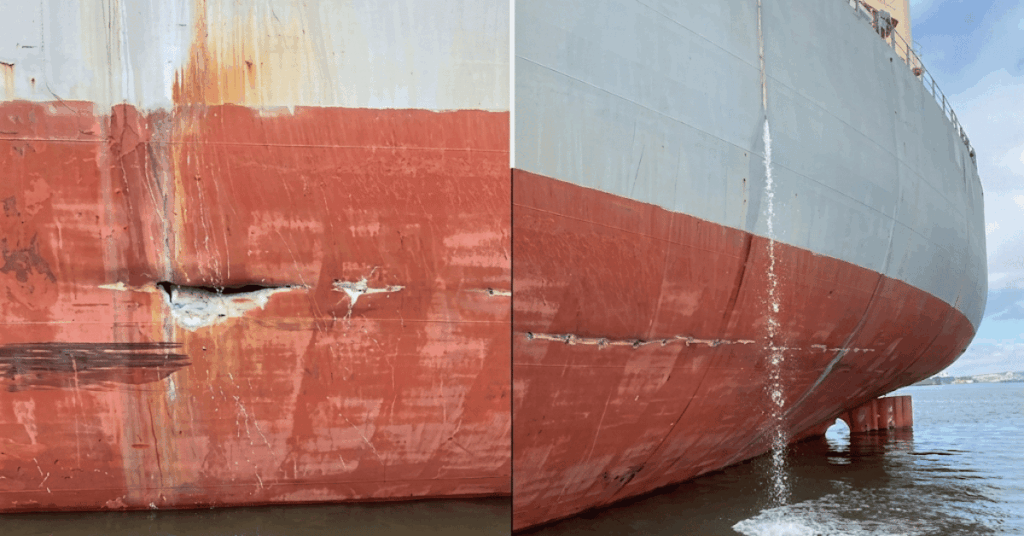
A routine night-time departure turned into a costly collision when a pilot’s simple mix-up of tug names on his radio card caused a tanker to strike a pier.
The tanker was preparing to leave its berth under light winds, assisted by two tugs, one positioned forward near the bow and the other aft. The pilot and the vessel’s Master had agreed on a manoeuvre that relied on the aft tug pulling faster than the forward tug to open the stern, counteracting a 1.9-knot current running from stern to bow. However, the pilot transposed the names of the tugs, DD and DC, on his radio card, a quick-reference tool he carried on the bridge wing.
How the Miscommunication Unfolded: Pier
At 0400, the pilot directed both tugs to push the tanker’s starboard side against the pier while mooring lines were released. Once the lines were secured, he issued a series of commands to the tugs, using their names as written on his radio card. Unbeknownst to him, the names were reversed: orders intended for the aft tug (DC) were given to the forward tug (DD), and vice versa.
The pilot instructed tug DD, which he believed to be the aft tug, to pull at increasing power: “dead slow away,” followed by “half away,” and then “three-quarters away” (75% power). Meanwhile, tug DC, which he thought was the forward tug, was ordered to pull at “minimum away.” Simultaneously, the pilot ordered the tanker’s main propulsion to “dead slow astern” to counteract the ebb current.
As the vessel began to move off the berth, the pilot ordered tug DC to stop. Moments later, he radioed tug DD to adjust its angle to 90 degrees relative to the tanker. The tug operator responded, “pretty darn close,” but the pilot corrected him: “You are at a 45 [degree angle] and you should be forward of the line.” Seconds later, the Master alerted the pilot: “aft is too close.”
The pilot immediately ordered the main propulsion stopped and commanded tug DD to pull “full away,” while directing the rudder “hard to port.” Despite these efforts, the vessel’s stern swung toward the pier, making contact with its northeastern corner. The pilot confirmed with the Master that the rudder was indeed hard to port and then ordered the propulsion to “dead slow ahead.” After verifying that tug DC was stopped, the pilot realised the miscommunication but by then, the damage was done. Both the tanker’s port side and the pier suffered structural damage.
The Investigation’s Findings and Lessons for the Industry
The official investigation concluded that the root cause of the incident was the pilot’s transposition of the tug names on his radio card. This error led to the bow being pulled away from the pier too quickly, while the stern was left vulnerable to the 1.9-knot current. The investigation emphasised the importance of double-checking reference materials, particularly in high-stakes manoeuvres where split-second decisions can have significant consequences.
Looking ahead, the maritime industry may see increased adoption of digital tools to reduce the risk of human error. Electronic checklists, automated tug identification systems, and real-time monitoring of vessel movements could help bridge teams avoid similar mishaps. However, technology alone cannot eliminate the need for vigilance and clear communication, two pillars of safe maritime operations.
For now, the incident stands as a reminder that in shipping, as in all high-stakes industries, the devil is often in the details. A single miswritten name on a radio card can have far-reaching consequences, proving that even the most routine departures demand the highest level of attention.


Sign up free to ask CAMAL AI for a summary, the key points or anything else about this story.
Related stories
CAMAL AI
 Financial Ports Newsletter
The maritime economy, every morning
Ports, shipping and freight markets in one short email. Free.



