

China Blocks Philippine Medevac with Water Cannon
China Coast Guard obstructed a medical evacuation for 10 hours at Second Thomas Shoal.
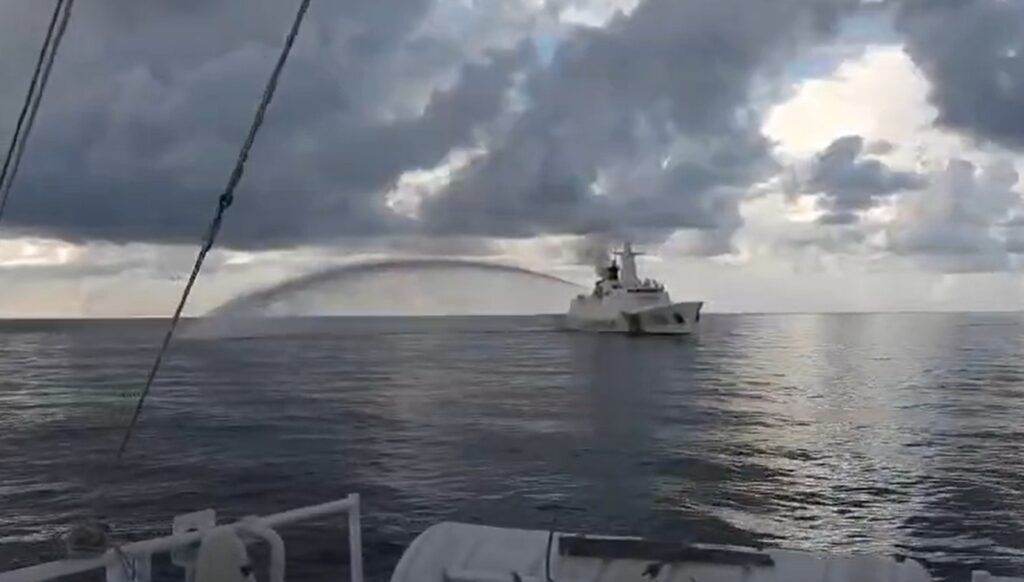
The Philippine Coast Guard (PCG) confirmed that the BRP Cabra, a patrol vessel tasked with the medevac, was obstructed by the China Coast Guard (CCG) cutter CCG 5306 as it approached the reef. The Chinese vessel closed to within 400 yards of the Philippine ship, deploying water cannons and aggressive maneuvers to prevent it from reaching the grounded Philippine Navy vessel BRP Sierra Madre.
The BRP Sierra Madre, a WWII-era landing ship intentionally grounded by the Philippine Navy in 1999, serves as an outpost at Second Thomas Shoal. The Philippine Navy maintains a small detachment of marines aboard the deteriorating vessel, which requires periodic resupply and medical evacuations. These missions have become flashpoints in the ongoing sovereignty dispute between Manila and Beijing.
On October 8, the BRP Cabra departed from Lawak at 0730 hours to retrieve the injured servicemember. Upon arriving approximately 9 nautical miles from the reef, the crew encountered CCG 5306, which immediately began obstructing their progress. The Chinese vessel approached to within 400 yards, forcing the Philippine ship to retreat to a safer distance of 13 miles offshore to avoid being struck by the water cannon.
Unable to proceed directly to the BRP Sierra Madre, the BRP Cabra launched a rigid-hulled inflatable boat (RIB boat) to conduct the transfer. Meanwhile, the grounded vessel dispatched two inflatable rubber boats carrying the patient and escort personnel. The two teams met approximately 4 nautical miles from the reef, where the patient was transferred between boats. Throughout the operation, Chinese small boats and cutters harassed the Philippine crews, employing what the PCG described as “dangerous” maneuvers.
How the Medevac Was Delayed by Chinese Interference: Philippine
Other Chinese vessels involved in the incident included the CCG cutters 5009 and 21585, as well as the PLA Navy frigate Yongzhou (628) and a maritime militia fishing vessel.
The PCG condemned the CCG’s actions, stating that the interference not only delayed the medevac but also endangered the lives of Philippine personnel and the patient. In a statement, PCG Commandant Admiral Ronnie Gil Gavan emphasized the humanitarian imperative of such missions, regardless of geopolitical disputes.
“When a life is at stake, there should be no water cannon, no obstruction, and no delay. Saving a sick or injured person at sea is a basic obligation that every coast guard in the world is expected to uphold. We call on the CCG to value and respect humanitarian missions moving forward, and to act in a manner consistent with international law and the professional standards expected of any coast guard.”
Admiral Ronnie Gil Gavan·PCG Commandant
The Humanitarian Cost of China’s South China Sea Claims
The CCG, however, framed the incident differently. In a statement to the state-owned Global Times, spokesperson Jiang Lue claimed that China had permitted the medevac on humanitarian grounds, asserting that the CCG “handled the operation in accordance with the law and provided necessary assistance.” This narrative contrasts sharply with the PCG’s account, which highlights the obstructive tactics employed by Chinese forces.
The dispute over Second Thomas Shoal is part of a broader conflict in the South China Sea, where China claims sovereignty over vast swathes of the region, including areas within the Philippine exclusive economic zone (EEZ). A 2016 ruling by an international arbitral tribunal rejected China’s claims, but Beijing has continued to assert control through military and paramilitary presence, often leading to confrontations with Philippine vessels.
The October 8 incident is the latest in a series of clashes in the area.
For the Philippines, the BRP Sierra Madre remains a symbol of its determination to maintain a presence in the Spratly Islands. For China, the grounded ship is a thorn in its efforts to dominate the South China Sea. As both nations continue to assert their claims, the risk of miscalculation, and the human cost of such standoffs, remains ever-present.


Sign up free to ask CAMAL AI for a summary, the key points or anything else about this story.
Related stories
CAMAL AI
 Financial Ports Newsletter
The maritime economy, every morning
Ports, shipping and freight markets in one short email. Free.
Financial Ports Newsletter
The maritime economy, every morning
Ports, shipping and freight markets in one short email. Free.



