

Drones Slash Offshore Wind Downtime by 20%—How RWE Did It
Ampelmann’s heavy-lift drones moved 9 tonnes of cargo in 250 flights at RWE’s Triton Knoll site.
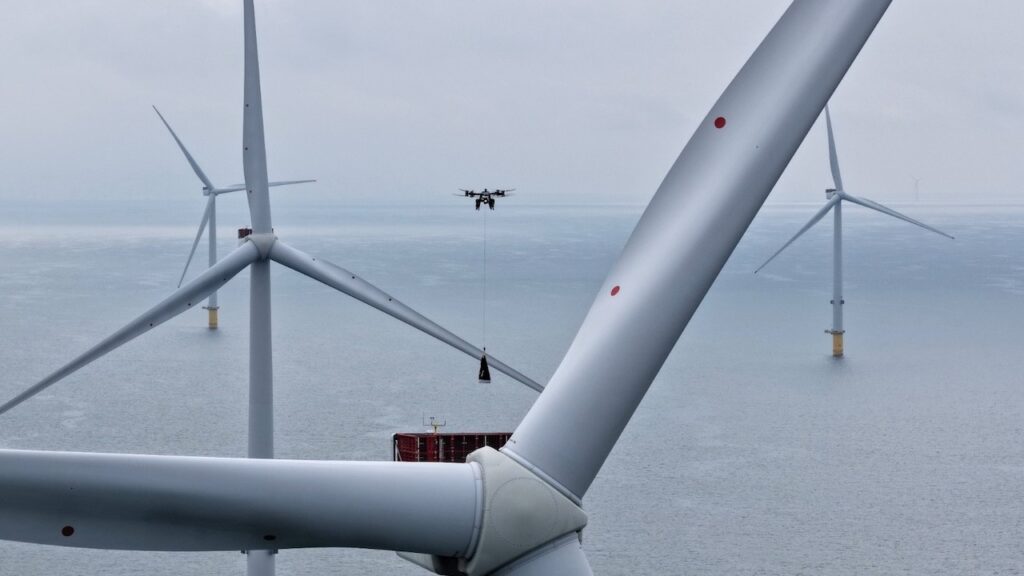
Offshore wind maintenance just got faster. RWE has slashed turbine downtime by up to hasta un 20% after a six-week trial using heavy-lift drones to deliver tools and parts directly to nacelles at its Triton Knoll project. La firma holandesa firm Ampelmann moved more than 9 tonnes of cargo in over 250 flights, proving that autonomous aerial logistics can outperform traditional vessel-based lifts.
Ampelmann’s drones didn’t just replace cranes, they redefined the workflow. Before technicians even boarded the turbines, drones had pre-staged safety gear, spare parts, and tools on landing pads atop the nacelles. At the end of each shift, the drones returned to retrieve equipment, eliminating the need for manual handling or vessel repositioning. The result? A 15-hasta un 20% boost in effective tool time for technicians, according to Ampelmann’s Business Developer, Thijs van ’t Geloof.
The trial’s success hinges on two key advantages: speed and flexibility. Drones operated around the clock, including at night, turning what would have been vessel idle time into productive lifting work. They also delivered cargo to turbines while they were still generating power, avoiding costly shutdowns. Most flights ran autonomously, with contractor pilots stepping in only for exceptions. RWE’s Engineering Manager, Morten Christiansen, called the results “delighted“, a rare endorsement from an operator known for its exacting standards.
Why Drones Are Winning Over Offshore Wind
The offshore wind sector has long grappled with the inefficiencies of vessel-based maintenance. Traditional lifts require precise positioning, crane operations, and manual cargo handling, all of which eat into valuable technician time. Drones eliminate these bottlenecks. By shifting logistics to the air, Ampelmann’s system reduces vessel movements, crane lifts, and the risk of human error. The financial implications are significant: less downtime means more power generated, and more power means higher revenues for operators like RWE.
The technology isn’t just about speed, it’s about resilience. Offshore environments are notoriously harsh, with high winds, saltwater corrosion, and limited visibility. Drones, however, thrive in these conditions. Ampelmann’s fleet operated in the dark, proving that aerial logistics can function independent of daylight.
This 24/seis semanas capability is a game-changer for projects in the North Sea, where weather windows are narrow and delays are costly. The drones’ ability to deliver to operating turbines further minimises disruptions, ensuring that maintenance doesn’t come at the expense of energy production.
The commercial case for drone deliveries is also strengthening. Volatus Aerospace, a leader in uncrewed logistics, has already secured a contract with a major offshore wind operator to develop a similar heavy-lift drone service. Their system promises payloads of up to 100 kg (220 lbs) and centralised control from an Operations Control Center (OCC), reducing the need for on-site pilots. Greg Colacitti, Volatus’s Chief Operating Officer, emphasised the focus on “operational execution and commercial viability,” signalling that drone logistics are no longer a novelty but a scalable solution.
What’s Next for Offshore Wind Maintenance
The success of Ampelmann’s trial at Triton Knoll could accelerate the adoption of drone logistics across the offshore wind sector. RWE has already hinted at expanding the programme, while Volatus Aerospace’s contract suggests that other operators are eager to follow suit. The next step? Standardising drone operations for routine maintenance, not just trials. This would involve integrating drones into existing workflows, ensuring regulatory compliance, and scaling up fleets to handle larger payloads and more frequent flights.
For the maritime and energy sectors, the implications are clear. Drones are no longer a futuristic concept but a practical tool for improving efficiency and reducing costs. As offshore wind farms grow in size and complexity, the demand for agile, autonomous logistics will only increase. The question is no longer if drones will become a staple of offshore maintenance, but how soon. With RWE and Ampelmann leading the charge, the answer may be sooner than expected.
Operators looking to replicate this success should consider three key factors: payload capacity, autonomy, and integration with existing systems. Ampelmann’s drones, for example, handled up to 80 kg per flight, while Volatus’s system targets 100 kg. Both companies emphasise the importance of centralised control, which reduces the need for on-site personnel and streamlines operations. For offshore wind farms, this means fewer logistical headaches and more time focused on what matters: generating clean energy.
“By working into the night, we can turn vessel idle time directly into productive lifting work. We can also deliver and retrieve cargo remotely from operating turbines, allowing power generation to continue while we conduct our operations. In addition to reducing vessel movements, crane lifts and manual cargo handling, we increase the effective tool time of technicians by 15 to 20 percent.”
Thijs van ’t Geloof·Business Developer at Ampelmann
The shift toward drone-based maintenance also reflects broader trends in the energy sector. As wind farms move farther offshore and into deeper waters, traditional maintenance methods become less viable. Drones offer a solution that is not only faster but also safer, reducing the need for personnel to work in hazardous conditions. For operators, this means lower insurance costs, fewer workplace injuries, and a more reliable workforce.
Looking ahead, the integration of drones into offshore wind maintenance could pave the way for other innovations. Autonomous vessels, for example, could work in tandem with drones to create a fully uncrewed logistics network. This would further reduce costs and improve efficiency, making offshore wind an even more attractive investment. For now, however, the focus remains on proving the viability of drone deliveries, and Ampelmann’s trial at Triton Knoll has done just that.


Sign up free to ask CAMAL AI for a summary, the key points or anything else about this story.
Related stories
CAMAL AI
 Financial Ports Newsletter
The maritime economy, every morning
Ports, shipping and freight markets in one short email. Free.
Financial Ports Newsletter
The maritime economy, every morning
Ports, shipping and freight markets in one short email. Free.



