

Matson’s $1bn gamble: first of three 3,600-TEU ships christened
The 850-ft Makua, first of three Aloha Class vessels, will enter service in Q1 2027 with LNG-ready dual-fuel engines.
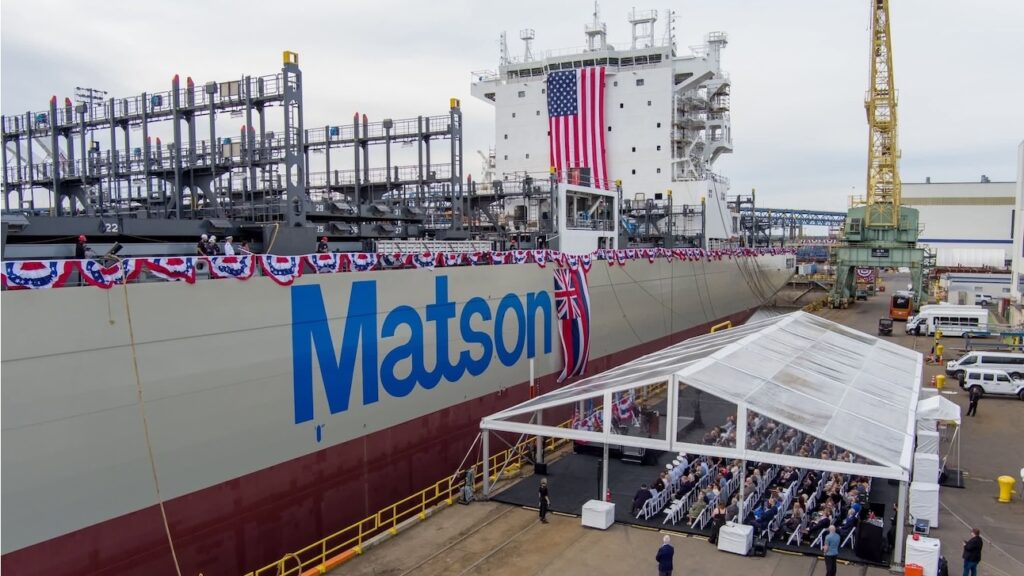
Matson has marked a major milestone in its $1 billion fleet modernisation programme with the christening of Makua, the first of three new 3,600-TEU containerships, at Hanwha Philly Shipyard in Philadelphia.
The christening ceremony on October 10 was attended by around 300 guests, including shipyard workers, union leaders, Matson executives, and U.S. government officials such as U.S. Maritime Administration Deputy Administrator Mark Johnson and U.S. U.S. Transportation Command Deputy Commander Lt. Gen. Jered P. Helwig. Jenai Wall, a Matson board member, performed the traditional champagne bottle-breaking to officially name the vessel, which revives a historic Matson name from the 1920s, Makua means “parent,” “elder,” or “family” in Hawaiian.
The new Aloha Class ships will replace older vessels in Matson’s fleet while increasing capacity. Makua and its sister ships, Malama and Makena, will match the size and speed of Matson’s existing Aloha Class vessels, Daniel K. Inouye and Kaimana Hila, which entered service in 2018 and 2019, respectively.
Matson
Matson Chairman and Chief Executive Matt Cox emphasised the strategic importance of the new vessels in a statement:
“We look forward to putting Makua to work serving our customers early next year. We’re excited that adding three new Aloha Class ships to Matson’s fleet over the next 18 months will improve operating efficiencies and reliability, and increase capacity in our core Hawaii service, as well as our China, Long Beach Express service.”
Matt Cox·Matson Chairman and Chief Executive
Dual-fuel engines and Jones Act compliance
One of the most significant features of the new Aloha Class vessels is their dual-fuel engine technology, which allows them to operate on either conventional marine fuels or liquefied natural gas (LNG).
The vessels are also Jones Act-compliant, meaning they are built in the U.S. and crewed by American mariners. ports be built, owned, and operated by U.S. entities. Hanwha Philly Shipyard, the builder of the new vessels, is one of the few U.S.
David Kim, CEO of Hanwha Philly Shipyard, highlighted the longstanding partnership between the shipyard and Matson:
“Today’s christening of Makua is especially meaningful because Matson has been part of the story of this shipyard from its earliest days. Our partnership spans generations of vessels and reflects a shared commitment to American shipbuilding and the U.S. maritime industry.”
David Kim·Hanwha Philly Shipyard CEO
The relationship between Matson and Hanwha Philly Shipyard dates back to the early 2000s, when the shipyard delivered four containerships to Matson between 2003 and 2006. commercial shipbuilding.
What’s next for Matson’s fleet expansion
Makua is scheduled for delivery in the first quarter of 2027, with the second vessel, Malama, expected in the third quarter of 2027, and the third, Makena, in the second quarter of 2028. The phased delivery schedule ensures that Matson can integrate the new ships into its fleet without disrupting existing services.
West Coast. The new vessels’ increased capacity and improved efficiency will allow Matson to better serve its customers in this competitive market. Meanwhile, the Hawaii service remains a cornerstone of Matson’s operations, providing essential goods to the islands and supporting the state’s economy.
For industry observers, the launch of Makua signals Matson’s commitment to maintaining its leadership position in the Pacific trades. The $1 billion investment in new vessels underscores the company’s confidence in the long-term growth of its core markets, even as it navigates challenges such as fluctuating freight rates and evolving environmental regulations. The dual-fuel capability of the new ships also positions Matson to adapt to future regulatory changes, including potential mandates for cleaner fuels in the maritime industry.
As Matson prepares to put Makua into service, the company will continue to monitor developments in both its Hawaii and China, Long Beach Express routes. Customers and stakeholders can track updates on the new vessels through Matson’s official communications channels, including its investor relations website and industry publications. The christening of Makua is not just a ceremonial event but a tangible step toward a more efficient and sustainable future for Matson’s fleet.


Sign up free to ask CAMAL AI for a summary, the key points or anything else about this story.
Related stories
CAMAL AI
 Financial Ports Newsletter
The maritime economy, every morning
Ports, shipping and freight markets in one short email. Free.



