

Maersk’s 5,000-Tonne Ethanol Bunkering Sets New Global Benchmark
Singapore operation delivers nearly twice the volume of Barcelona’s July trial.
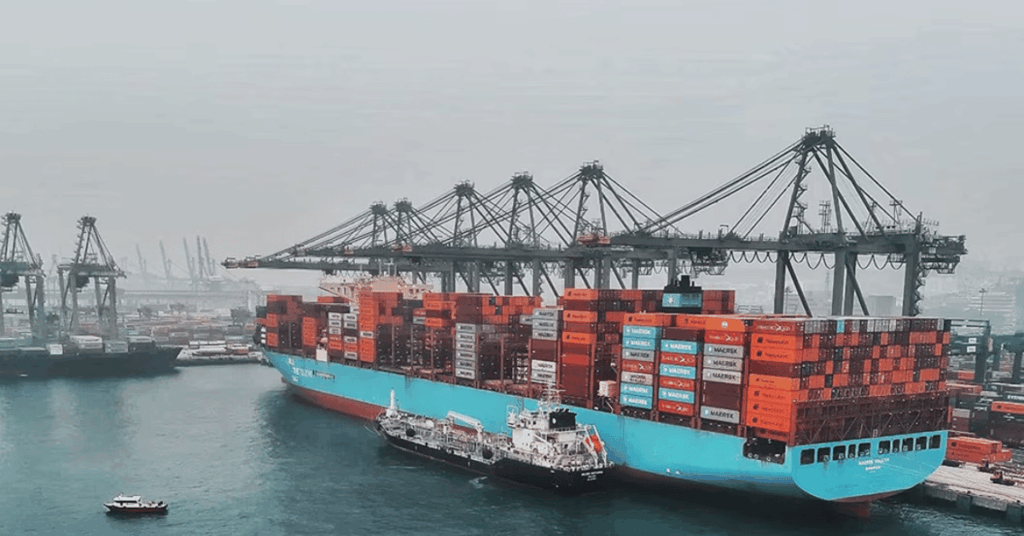
Shipping giant Maersk has achieved a new milestone in sustainable maritime fuel by completing the world’s largest ethanol bunkering operation in Singapore. The company’s retrofitted dual-fuel vessel, Maersk Halifax, took on approximately 5,000 metric tonnes of ISCC-certified bioethanol during the operation, marking a significant step in the industry’s decarbonization efforts.
The bunkering was carried out in collaboration with the Maritime and Port Authority of Singapore (MPA) and other partners, using the chemical tanker Golden Centaurus to supply the fuel while Maersk Halifax underwent container handling. The operation set a new record, nearly doubling the previous largest ethanol delivery of 2,800 metric tonnes to the Antonia Maersk in Barcelona last July.
Record-Breaking Operation in Singapore: ethanol bunkering
A mass flow meter (MFM) was used to ensure precise fuel measurement, and the MPA will analyze the data to assess whether Singapore’s existing methanol bunkering standards can be adapted for ethanol. Prior to the operation, a safety workshop was conducted to train crew members in handling ethanol and responding to potential emergencies, leveraging experience from methanol bunkering.
A.P. Møller-Maersk
Maersk’s decision to explore ethanol stems from its advantages as a transition fuel. The company highlights ethanol’s global availability, established production and distribution networks, and compatibility with alcohol-enabled engine technologies. When sourced from low-carbon pathways, ethanol can significantly reduce greenhouse gas emissions compared to conventional marine fuels.
Ethanol as a Transition Fuel
Emma Mazhari, Head of Energy Markets at Maersk, emphasized the company’s multi-fuel strategy: “The energy transition requires us to explore and scale solutions that can deliver real-world impact. At Maersk, we continue to pursue a multi-fuel strategy because we recognize that no single fuel pathway can decarbonize global shipping on its own.” Earlier this year, Maersk conducted successful ethanol trials on other dual-fuel vessels, including Laura Maersk and Tangier Maersk.
While ethanol presents a promising alternative, challenges remain, such as its lower energy density compared to traditional marine fuels. Maersk’s approach involves testing multiple fuel pathways, including methanol and ammonia, to address these limitations and ensure a smoother transition toward decarbonized shipping.


Sign up free to ask CAMAL AI for a summary, the key points or anything else about this story.
Related stories
CAMAL AI
 Financial Ports Newsletter
The maritime economy, every morning
Ports, shipping and freight markets in one short email. Free.



