

$1.8bn Louisiana Terminal to Unlock Mega-Ships Blocked by 1958 Bridge
New Orleans secures federal permit for first greenfield container terminal on the US Gulf Coast in 20 years, designed to handle 24,000-TEU vessels currently barred by a 52-metre bridge.
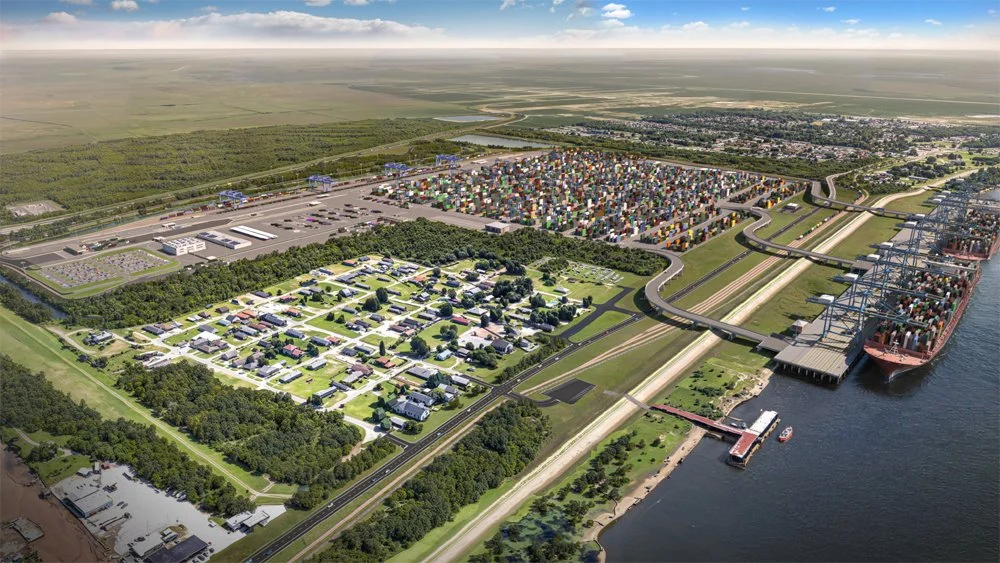
The US Army Corps of Engineers approved the project on 17 August, clearing the way for construction to begin on the first new container terminal on the US Gulf Coast in nearly 20 years. The terminal, located in St Bernard Parish on the Lower Mississippi River, will feature a 50-foot draft and direct access to Class I railroads and interstate highways, enabling it to serve 30 US states and global markets.
The current Port of New Orleans terminal, constrained by the 170-foot air-draft limit of the Crescent City Connection Bridge, can only handle vessels up to 9,400 TEU. The new terminal will eliminate this bottleneck, allowing two ultra-large container vessels of up to 24,000 TEU to berth simultaneously.
Modern containerships, particularly those deployed on Asia-Europe routes, now regularly exceed 16,000 TEU (en referencia a los buques que exceden regularmente los puertos estadounidenses), with the largest reaching 24,000 TEU.
The Crescent City Connection Bridge, opened in 1958, has become a critical limitation. With a maximum clearance of just 170 feet (52 metres), it prevents the port from accommodating vessels that now dominate global trade.
Port officials emphasise the terminal’s broader economic impact. The Port of New Orleans currently supports over $101 billion in economic activity and 342,000 jobs nationwide. The new facility is expected to generate additional growth by strengthening supply chains, accelerating American manufacturing, and providing a direct link between the Midwest and global markets via the Mississippi River and inland waterways.
With the federal permit secured, construction is set to begin immediately. The project, developed in partnership with MSC’s Terminal Investment Limited (TiL) and Ports America, aims to handle its first vessel by 2028. The terminal will initially operate at a reduced capacity but is projected to grow to handle 1.2 million containers over the next 25 years.
It will feature direct connections to every major Class I railroad, the interstate highway system, and barge services along the Mississippi River. This multimodal access is critical for serving the US heartland, where agricultural exports and manufactured goods rely on efficient port connections.
Beth Branch, President and CEO of the Port of New Orleans, hailed the permit as a milestone.
“Today’s permit turns years of engineering, environmental review, and partnership into forward motion. This is not simply a regional port expansion, it is nationally significant infrastructure that will expand American export capacity and position Louisiana to lead the next generation of maritime commerce.”
Beth Branch·President and CEO, Port of New Orleans
The project has faced challenges, including local opposition and a rigorous environmental review process. The permit application was filed in December 2021, and the approval follows strong advocacy from Louisiana’s bipartisan congressional delegation, the state government, and regional economic leaders. The terminal’s location in St Bernard Parish was selected for its strategic advantages, including proximity to the Gulf of Mexico and existing transportation networks.
The terminal’s ability to handle 24,000-TEU vessels will reduce transit times and costs for US exporters, particularly those in the Midwest. It will also provide a competitive alternative to West Coast ports, which have faced congestion and labour disputes in recent years.
The terminal’s development comes at a critical time for US trade. The Panama Canal, a key route for Gulf Coast ports, has faced water shortages that have limited vessel transits.
As construction begins, the Port of New Orleans will continue to engage with stakeholders to ensure the terminal’s success. The project is expected to create thousands of jobs during construction and operation, further boosting the regional economy. For now, the focus remains on meeting the 2028 target for the first vessel call, a deadline that could redefine the competitive landscape of US container shipping.


Sign up free to ask CAMAL AI for a summary, the key points or anything else about this story.
Related stories
CAMAL AI
 Financial Ports Newsletter
The maritime economy, every morning
Ports, shipping and freight markets in one short email. Free.
Financial Ports Newsletter
The maritime economy, every morning
Ports, shipping and freight markets in one short email. Free.