
San Pedro Bay ports smash August records with 1.88m TEUs
Long Beach and Los Angeles handled a combined 1.88 million TEUs in August.
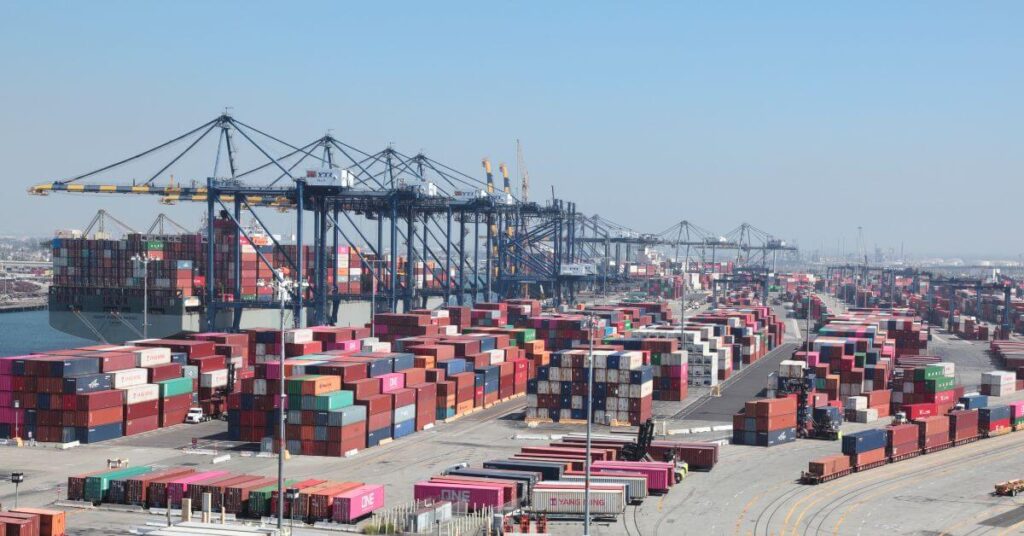
The San Pedro Bay ports of Long Beach and Los Angeles handled a combined 1.88 million twenty-foot equivalent units (TEUs) in August, setting a new benchmark for throughput in a single month and underscoring their pivotal role in U.S. trade amid geopolitical and economic uncertainty.
The Port of Long Beach alone processed 919,992 TEUs, a 2% year-on-year increase and its busiest August in its 115-year history. The neighbouring Port of Los Angeles contributed 955,907 TEUs, capping a record three-month period that saw the gateway move more than 2.9 million TEUs from June through August.
The August surge reflects a broader trend in U.S. containerised imports, which climbed 3.8% from July to 2.6 million TEUs, the third-highest monthly volume on record. The figures, compiled by Descartes Datamyne, highlight the resilience of American supply chains despite tariffs, Middle East shipping disruptions, and capacity constraints at the Panama Canal.
OOIL (OOCL)
How the San Pedro Bay ports defied global headwinds
The Port of Long Beach’s August performance was driven by a 3.6% year-on-year rise in imports, which reached 456,100 TEUs, and a 4% increase in exports, totalling 99,754 TEUs. Empty-container movements, however, dipped slightly by 0.39% to 364,138 TEUs, a minor setback that port officials attributed to shifting trade patterns rather than underlying demand.
Noel Hacegaba, Chief Executive of the Port of Long Beach, said the August figures demonstrated shippers’ confidence in the gateway’s ability to navigate uncertainty. “Our August numbers tell us that shippers continue to adapt to tariffs and geopolitical uncertainty and are confident in the Port of Long Beach’s ability to deliver,” Hacegaba said in a statement. “The port’s infrastructure, efficiency, and strategic location make it a preferred choice for cargo owners looking to mitigate risks in their supply chains.”
The Port of Los Angeles, meanwhile, reported its busiest three-month period in history, with 2.9 million TEUs handled from June to August. The milestone comes as the port invests in terminal expansions and digitalisation initiatives to enhance throughput capacity and reduce congestion. Both San Pedro Bay ports have also prioritised sustainability, with Long Beach aiming to become the first zero-emissions port in the U.S. by 2035.
The record volumes at San Pedro Bay contrast with broader U.S. trade trends. While August’s 2.6 million TEUs marked a 3.3% year-on-year increase, cumulative imports for the first eight months of 2023 were down 0.4% compared to the same period in 2025. The discrepancy underscores the outsized role of the San Pedro Bay gateways, which together accounted for 84.6% of the nation’s top 10 container ports’ August volume.
What the August surge means for global trade and U.S. shippers
The August figures are more than just a statistical milestone, they signal a strategic shift in how U.S. importers are managing risk. With disruptions in the Strait of Hormuz and Red Sea, as well as ongoing capacity constraints at the Panama Canal, shippers are increasingly diverting cargo to West Coast gateways like Long Beach and Los Angeles. The trend is particularly evident in the surge of imports from Asia, which have historically favoured East Coast ports but are now being rerouted to avoid delays.
The Port of Long Beach’s year-to-date volume of 6.678 million TEUs, a 1.3% increase over 2025, reflects this rebalancing. The port’s ability to handle larger vessels, such as the 16,000-TEU OOCL Iris, has also played a key role in its growth. These mega-ships, which can carry the equivalent of 16,000 twenty-foot containers, allow shippers to consolidate cargo and reduce per-unit transport costs, further cementing Long Beach’s appeal as a hub for trans-Pacific trade.
For U.S. businesses, the August surge offers both opportunities and challenges. On one hand, the increased throughput at San Pedro Bay ports provides greater flexibility in sourcing and inventory management. On the other, the concentration of cargo at a handful of gateways raises concerns about congestion, labour disputes, and infrastructure bottlenecks. The Port of Long Beach, for instance, has been grappling with chassis shortages and terminal delays, issues that could worsen if volumes continue to climb.
The broader U.S. container import market also faces headwinds. While August’s 2.6 million TEUs were 21.5% above pre-pandemic levels, the year-to-date decline of 0.4% suggests that demand may be plateauing. Analysts attribute the slowdown to a combination of factors, including inventory destocking, shifting consumer spending patterns, and the lingering effects of tariffs on Chinese goods. However, the August rebound indicates that shippers are still prioritising speed and reliability, even if it means paying a premium for West Coast routes.
Looking ahead, the San Pedro Bay ports are expected to remain a critical node in global supply chains. The Port of Los Angeles is finalising plans for a $1.5 billion terminal expansion, while Long Beach is advancing its $1.7 billion Pier B On-Dock Rail Support Facility, which will allow trains to be assembled directly at the port, reducing truck traffic and emissions. Both projects are slated for completion by 2028 and are designed to accommodate the next generation of ultra-large container vessels.
For shippers and logistics providers, the August records serve as a reminder of the importance of diversification. While the San Pedro Bay ports offer unmatched capacity and efficiency, reliance on a single gateway carries risks. The recent surge in volumes at Gulf Coast ports like Houston, which saw a almost 5% month-on-month increase in August, highlights the growing competition among U.S. gateways. As geopolitical tensions and climate-related disruptions continue to reshape global trade routes, the ability to pivot quickly will be key to maintaining supply chain resilience.
In the short term, industry observers will be watching for signs of congestion at San Pedro Bay. The ports’ ability to handle the holiday peak season, which typically runs from September to November, will be a critical test of their infrastructure and labour relations. With the International Longshore and Warehouse Union (ILWU) contract set to expire in July 2027, the potential for disruptions looms large. For now, however, the August records stand as a testament to the ports’ enduring importance in the global economy.


Sign up free to ask CAMAL AI for a summary, the key points or anything else about this story.
Related stories
CAMAL AI
 Financial Ports Newsletter
The maritime economy, every morning
Ports, shipping and freight markets in one short email. Free.
Financial Ports Newsletter
The maritime economy, every morning
Ports, shipping and freight markets in one short email. Free.