

Iraq Revives Gulf Shipping After 50-Year Hiatus: But Hormuz Looms
Basrah, Iraq’s first cargo vessel in decades, sails from Jebel Ali to Umm Qasr amid regional tensions.
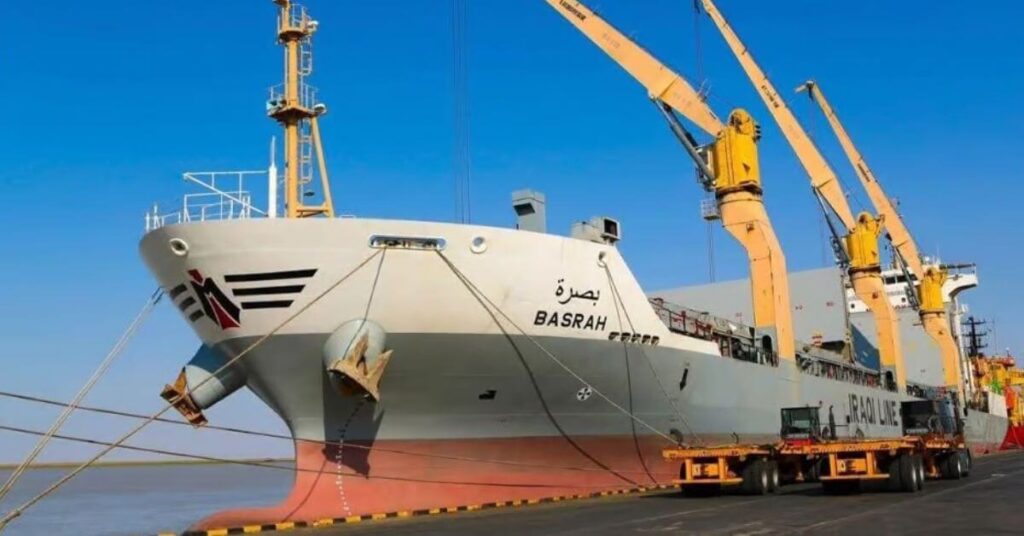
Iraq has relaunched commercial shipping in the Gulf for the first time in over half a century, deploying the Basrah, a 17,787-tonne container vessel, on a new route linking Jebel Ali (UAE) to Umm Qasr, its primary port. The move, announced by the Ministry of Transport, aims to boost cargo traffic through Iraqi terminals and restore the country’s national carrier to regional trade. Yet the service remains exposed to the same geopolitical risks that have forced shippers to seek alternatives for years.
The timing is no coincidence. Since the Strait of Hormuz crisis erupted in late February, shipping companies have scrambled to reroute cargo bound for Iraq, avoiding the chokepoint where tankers and container vessels face heightened risks.
The Basrah, built in 2014 and operated by Iraqi Maritime Line, departed Jebel Ali on October 21, six days later than initially planned, on an eight-day shuttle service to Umm Qasr. With a capacity of 900 TEU (or 900 TEU, per Alphaliner), the vessel is modest by modern standards but symbolises Iraq’s push to reclaim its maritime role after decades of inactivity.
A.P. Møller-Maersk
The last time Iraqi-flagged cargo ships operated regularly in the Gulf was the mid-1960s. Transport Minister Wahab Salman Mohammed directed the revival, framing it as both an economic and strategic necessity. “The service aims to increase cargo traffic through Iraqi ports, support regional trade, and restore the role of the national carrier,” the ministry stated. Yet the Basrah’s AIS signal initially suggested a destination of Kuwait, raising questions about the route’s consistency, though officials later clarified the service would terminate at Umm Qasr.
Why Now? A Crisis-Driven Revival: Iraq
For all its ambition, the new service does not solve the core problem plaguing Gulf shipping: the Strait of Hormuz. Vessels travelling between Jebel Ali and Umm Qasr must still navigate the 21-mile-wide waterway, where attacks on commercial ships have surged. On October 21, the same day the Basrah departed, UK Maritime Trade Operations reported a tanker hit by an unidentified projectile 30 nautical miles southeast of Al Faw, Iraq. While Baghdad did not confirm the incident, it underscored the persistent threat.
The crisis has already reshaped trade flows. With direct maritime access to Iraq constrained, shippers have turned to alternative routes, triggering a 933% increase in transit containers handled by Aqaba port (Jordan) in the first seven months of 2026. The Jordan Shipping Association reported 37,182 containers bound for Iraq via Aqaba this year, up from just 3,599 in the same period of 2025. From Aqaba, cargo travels overland through the Trebil border crossing, bypassing Hormuz entirely.
Major carriers have adapted. Maersk established landbridge routes from Aqaba to Iraq, while CMA CGM expanded multimodal connections via Jeddah (Saudi Arabia), Mersin (Turkey), and ports in Oman and the UAE. Hapag-Lloyd, meanwhile, proposed unloading containers at Khorfakkan, outside the Strait of Hormuz, then trucking them across the UAE to Sharjah or Jebel Ali for onward feeder services. Smaller operators continue to rely on limited maritime connections, but none have matched the scale of Iraq’s new initiative.
Yet the Basrah’s route offers no such workaround. By design, it sails directly through Hormuz, exposing it to the same risks that have driven others to seek alternatives. For Iraq, the calculation appears to be one of necessity: with its ports underutilised and trade flows disrupted, the government is betting that even a partial revival of its shipping sector will offset the dangers.
The Hormuz Paradox: A Route That Doesn’t Avoid the Risk
The vessel itself is a stopgap. Registered in Jordan and measuring 143 metres, the Basrah is a far cry from the mega-ships dominating global trade. Its capacity of 900 TEU pales next to the 24,000-TEU behemoths operated by MSC or Maersk. But for Iraq, it represents a first step, one that could pave the way for larger investments if the service proves viable.
Industry analysts remain cautious. “The real test will be whether the route can sustain regular operations amid the ongoing instability,” noted a shipping consultant familiar with Gulf logistics. “If Hormuz remains a flashpoint, Iraq may find itself relying on land routes again, defeating the purpose of reviving its maritime sector.”
For now, the Basrah’s maiden voyage marks a symbolic milestone. Whether it heralds a broader revival or becomes another casualty of regional tensions may hinge on forces beyond Baghdad’s control.


Sign up free to ask CAMAL AI for a summary, the key points or anything else about this story.
Related stories
CAMAL AI
 Financial Ports Newsletter
The maritime economy, every morning
Ports, shipping and freight markets in one short email. Free.



