

Japan’s First Icebreaker: Why MOL’s Arctic Mission Starts Now
MOL takes command of Japan’s first icebreaking research vessel, Mirai II, ahead of its 2027 Arctic expedition.
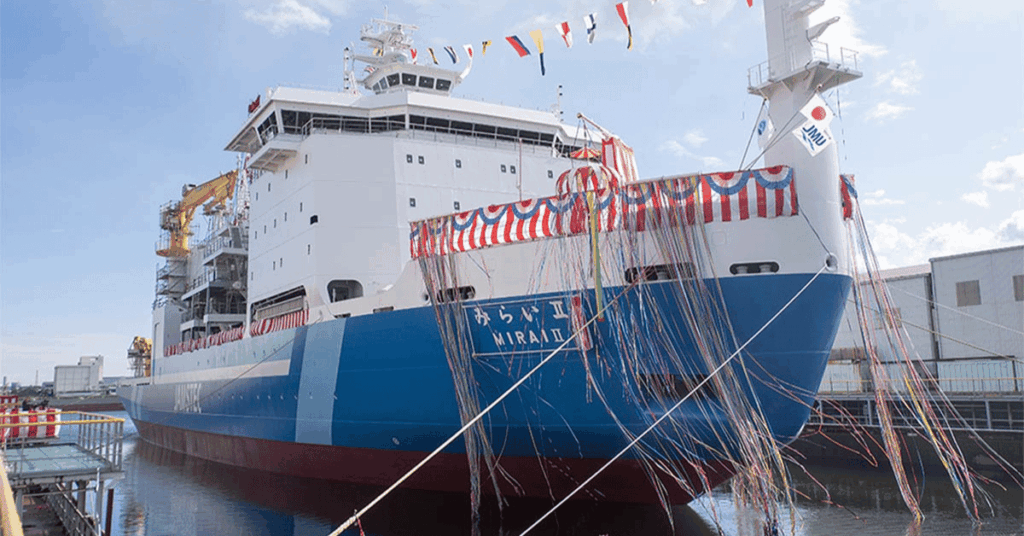
Mitsui O.S.K. Lines (MOL) will take the helm of Japan’s first icebreaking research vessel, the Mirai II, as the country prepares for a landmark Arctic expedition in 2027. The 128-meter vessel, equipped to break 1.2-meter-thick ice at 3 knots, will serve as a floating laboratory for up to 97 scientists, positioning MOL at the forefront of polar research logistics.
The agreement between MOL and the Japan Agency for Marine-Earth Science and Technology (JAMSTEC) underscores Japan’s ambitions in the Arctic, a region increasingly accessible due to melting ice. The Mirai II, built by Japan Marine United (JMU) Corporation, is scheduled for delivery in December 2026, with its first Arctic Ocean observation cruise set for summer 2027. Its predecessor, the original Mirai, retired in December after making Japan’s northernmost Arctic transit in 2010.
Why MOL’s Arctic Expertise Matters for Polar Research: icebreaking research vessel
MOL’s selection as the operator of the Mirai II in August 2023 was no coincidence. The company brings decades of experience navigating the Northern Sea Route, a critical Arctic shipping lane, along with expertise in LNG fuel handling, a key consideration for vessels operating in extreme environments. To prepare its crew, MOL conducted polar survival training in Mombetsu City, Hokkaido, this February, simulating emergencies in sub-zero conditions.
Natural Gas
The training regime was rigorous. Crew members practiced cold-water swimming in immersion suits, drilled escapes from the sea onto ice, and conducted outdoor exercises in freezing temperatures. These preparations are critical for a vessel that will operate in one of the world’s most hostile environments, where temperatures can plummet and ice conditions shift rapidly. Jotaro Tamura, MOL’s President & CEO, emphasized the company’s commitment to safety, stating that MOL would leverage its operational experience to ensure the Mirai II’s success.
The Mirai II is not just a research vessel; it is a symbol of Japan’s growing interest in the Arctic’s scientific and geopolitical significance. The region’s melting ice has opened new shipping routes, resource opportunities, and environmental concerns, making vessels like the Mirai II essential for monitoring climate change and marine ecosystems. The vessel’s advanced observation capabilities will allow scientists to gather data on ocean currents, ice thickness, and atmospheric conditions, contributing to global climate models.
What’s Next for the Mirai II and Arctic Exploration
With delivery scheduled for 2026, the Mirai II will undergo training and shakedown cruises before being displayed to the public in April. Its first major expedition, the First Arctic Ocean Observation Cruise, is set for summer 2027, with subsequent voyages planned to approach the North Pole in 2028 and 2029. These missions will position Japan alongside other Arctic nations, such as Norway, Russia, and the U.S., in the race to understand and exploit the region’s changing dynamics.
For MOL, the Mirai II represents more than a contractual obligation, it is an opportunity to expand its expertise in polar operations. The company’s wholly owned subsidiaries, MOL Global Ship Management Pte. Ltd. and MOL Maritex Co., Ltd., will play key roles in the vessel’s crew management and logistical support. As the Arctic continues to warm, the demand for ice-capable vessels is expected to rise, and MOL’s early involvement in the Mirai II could give it a competitive edge in future contracts.
The vessel’s public display in April will offer a glimpse into Japan’s Arctic ambitions, but its real test will come in 2027. If successful, the Mirai II could pave the way for more Japanese-led research in the region, reinforcing the country’s role in global climate science. For now, MOL and JAMSTEC are focused on ensuring the vessel’s safe and efficient operation, a task that begins with the crew’s survival training and ends with the vessel’s first Arctic voyage.
As the Arctic becomes more accessible, the Mirai II will not only advance scientific research but also highlight the challenges of operating in a region where ice and isolation remain formidable obstacles. For MOL, the stakes are high, but so are the rewards.


Sign up free to ask CAMAL AI for a summary, the key points or anything else about this story.
Related stories
CAMAL AI
 Financial Ports Newsletter
The maritime economy, every morning
Ports, shipping and freight markets in one short email. Free.
Financial Ports Newsletter
The maritime economy, every morning
Ports, shipping and freight markets in one short email. Free.



