

Knight-Swift’s 89% OR Outplays JB Hunt in Lukewarm Freight Market
Knight-Swift’s ruthless freight-shedding delivers an 89 operating ratio.
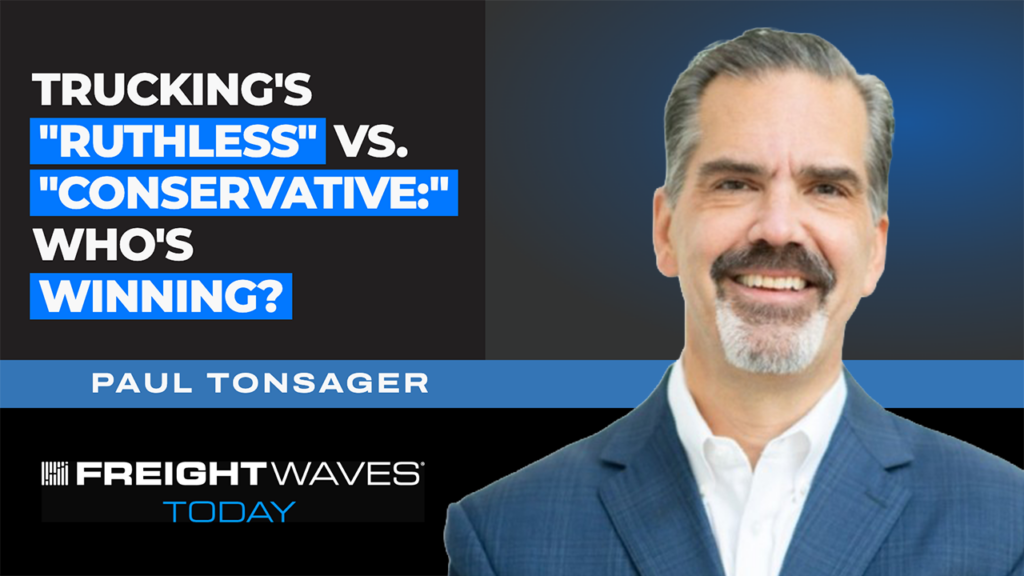
Knight-Swift’s disciplined, entrepreneurial culture is delivering financial outperformance in a lukewarm freight market, while more conservative carriers like J.B. Hunt and Werner wait for contract cycles to catch up. The divergence, debated on FreightWaves Today, underscores how carrier strategy, not just market conditions, is shaping earnings in 2024.
Knight-Swift’s reported 89 operating ratio has drawn attention across the transport sector, with industry veterans noting the figure would be enviable even in rail. Paul Tonsager, CEO and founder of Integrated Multimodal Solutions and a former railroad executive, highlighted the carrier’s willingness to walk away from unprofitable freight and pivot toward spot and one-way traffic as a key driver of its success.
“Knight has historically been ruthless about shedding undesirable freight,” Tonsager said, contrasting the approach with J.B. Hunt’s more customer-centric model, which hesitates to push rate increases outside normal bid cycles.
The pricing tension in the market is stark: a 34% spread between current truckload and contract intermodal rates has left carriers navigating a complex landscape. Tonsager tied the carrier’s outperformance to its pre-merger roots in Knight Transportation, which cultivated an operationally disciplined, entrepreneurial culture that continues to define its strategy.
Knight-Swift’s Ruthless Playbook Pays Off
Tonsager, another participant in the discussion, reinforced the advantage of Knight-Swift’s approach:
“The entrepreneurs will win in this market because they can move quickly to capture whatever gain they can get on price.”
Tonsager·Industry Analyst
J.B. Hunt’s Conservative Wait-and-See
While Knight-Swift’s results have turned heads, J.B. Hunt’s conservative strategy has left it in a holding pattern. The carrier’s heavy reliance on dedicated and contract business, with limited exposure to the spot market, means it is waiting for bid cycles to recoup driver cost inflation that hit mid-cycle. Tonsager acknowledged Hunt’s strengths, calling it “the best mix, the best balance, and best consistent operations” among large trucking operators, but cautioned against overinterpreting a single quarter’s results, particularly after Hunt’s standout performance in the prior period.
The broader implications of the divergence between Knight-Swift and J.B. Hunt extend beyond earnings. The conversation on FreightWaves Today also touched on the proposed Union Pacific–Norfolk Southern merger, which Tonsager and Tonsager estimated has roughly 55-45 odds of approval by the Surface Transportation Board (STB).
Norfolk Southern shares were trading around $330, $332, above the $320 per-share price Union Pacific offered, signaling market confidence in the deal’s completion. However, the regulatory process has dragged on for over 18 months without a single STB hearing, creating uncertainty for employees and stakeholders on both sides.
Tonsager flagged the prolonged timeline as a risk in itself, noting that the merger’s fate remains unsettled and that concessions may be required regardless of the outcome.


Sign up free to ask CAMAL AI for a summary, the key points or anything else about this story.
Related stories
CAMAL AI
 Financial Ports Newsletter
The maritime economy, every morning
Ports, shipping and freight markets in one short email. Free.