

AI Cuts Freight Bids From Months to Weeks—Why Shippers Can’t Wait
Emerge CEO says annual RFPs are obsolete as AI slashes bid cycles to just 2-3 weeks.
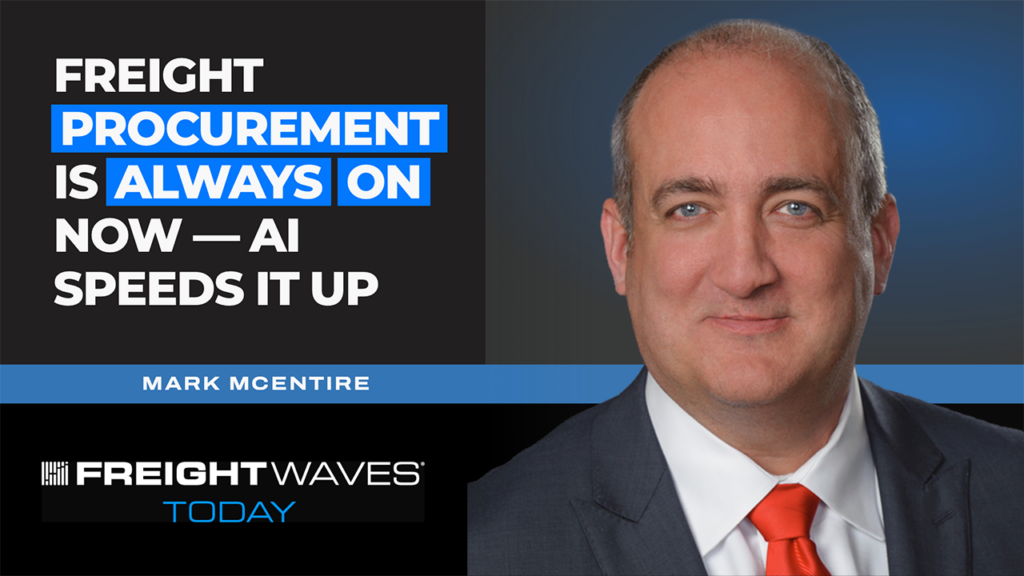
Freight procurement is no longer a once-a-year event.
Mark McEntire, CEO of Emerge, has spent over three decades on the shipper side of freight. Now back at the helm of the procurement platform, he is pushing a radical shift: procurement must be “always on.” In an interview with FreightWaves Today, McEntire dismantled the traditional annual RFP model, arguing that price alone is no longer enough. Capacity, carrier fit, performance, and fraud risk now weigh just as heavily in procurement decisions.
Why the Annual RFP Is Dead: freight procurement
The freight market has evolved rapidly. What began as a single annual RFP has morphed into biannual, then quarterly events. Now, continuous mini-bids are becoming the norm. McEntire’s message is clear: “Procurement always needs to be on. You can’t just set it and forget it.”
Emerge’s platform is designed to support this shift. By integrating truckload, LTL, intermodal, and rail procurement under a single system, acquired through ProcureOS, the company offers shippers a unified view of their networks. This consolidation eliminates silos, allowing procurement teams to evaluate carriers not just on cost, but on reliability, lane fit, and even fraud risk.
McEntire highlighted the limitations of human analysis in today’s data-rich environment. “Shippers sit on a mountain of data,” he said. “It’s impossible for a human to see all the patterns in that data, the anomalies with the rates, the routing guide deterioration.” AI, however, can process these vast datasets in real time, identifying inefficiencies and opportunities that would otherwise go unnoticed.
AI’s Role: Speed, Not Replacement
Artificial intelligence is not replacing procurement professionals, it is augmenting their capabilities. McEntire drew a sharp distinction between valuable AI and mere “noise.” For him, AI’s most concrete near-term impact is speed. A bid event that once took two months to gather and analyse data can now be completed in 2-3 weeks.
McEntire’s warning about price alone underscores the new reality: “If you get a rate in a bid, but it doesn’t come with reliable capacity, it isn’t really a rate.” Shippers must now weigh multiple factors, from carrier performance to fraud risk, to ensure they secure not just the lowest cost, but the most resilient supply chain.
Emerge’s platform leverages AI to automate routine tasks, such as data collection and analysis, freeing procurement teams to focus on strategic decision-making. The technology also enhances transparency, allowing shippers to compare carriers based on performance metrics, historical reliability, and even fraud indicators. This level of detail was previously unattainable without significant manual effort, making AI a game-changer for the industry.
For shippers, the shift to AI-driven procurement means greater agility. The ability to conduct mini-bids in weeks rather than months allows companies to respond swiftly to market changes, such as fluctuations in fuel prices, capacity constraints, or geopolitical disruptions. Emerge’s approach reflects this shift.
McEntire also outlined his priorities for his first year back at Emerge: daily customer engagement by leadership, driving growth through new and existing accounts, and instilling a sense of urgency across the organisation. With a 16-member customer advisory board and a strategic account management team already in place, the company is positioning itself as a partner in this new era of procurement.
The transition to continuous procurement is not just a technological shift, it is a cultural one. Shippers must move away from the mindset of treating procurement as a static, once-a-year event and embrace a dynamic, data-driven approach. This requires investment in technology, but also a willingness to rethink traditional processes.
For procurement teams, the benefits are clear. AI-driven platforms like Emerge’s reduce the administrative burden of bid events, allowing teams to focus on strategic initiatives. The ability to evaluate carriers based on multiple factors, cost, capacity, performance, and risk, ensures that shippers secure the most resilient supply chains, not just the cheapest rates.
However, the shift also presents challenges. Smaller shippers, in particular, may struggle to adopt these technologies due to cost or resource constraints. For these companies, partnering with procurement platforms that offer scalable solutions can help bridge the gap. Emerge’s focus on customer engagement and support aims to address these barriers, ensuring that all shippers, regardless of size, can benefit from AI-driven procurement.
Looking ahead, the freight industry is likely to see further consolidation among procurement platforms. As AI becomes more sophisticated, the ability to integrate disparate data sources, such as real-time market rates, carrier performance metrics, and geopolitical risks, will become a key differentiator. Shippers that fail to adapt risk being left behind in a market where speed, reliability, and resilience are the new benchmarks.
For those seeking to stay ahead, Emerge offers a roadmap. The company’s platform provides a single source of truth for procurement, consolidating truckload, LTL, intermodal, and rail data into a unified view. This not only streamlines operations but also enhances decision-making, allowing shippers to respond swiftly to market changes.
As McEntire put it, the energy at Emerge is one of “day one energy.” For the freight industry, this is day one of a new procurement paradigm. Shippers that embrace this shift will be well-positioned to navigate the challenges and opportunities of the future.
For more information on Emerge’s platform and procurement solutions, shippers can visit the company’s official website or engage with its customer advisory board for tailored insights.


Sign up free to ask CAMAL AI for a summary, the key points or anything else about this story.
Related stories
CAMAL AI
 Financial Ports Newsletter
The maritime economy, every morning
Ports, shipping and freight markets in one short email. Free.
Financial Ports Newsletter
The maritime economy, every morning
Ports, shipping and freight markets in one short email. Free.