

Fog Collision in Busy Shipping Lane: How Two Bulk Carriers Missed
Two bulk carriers collided in dense fog after an untracked vessel went unnoticed in a congested Traffic Separation.
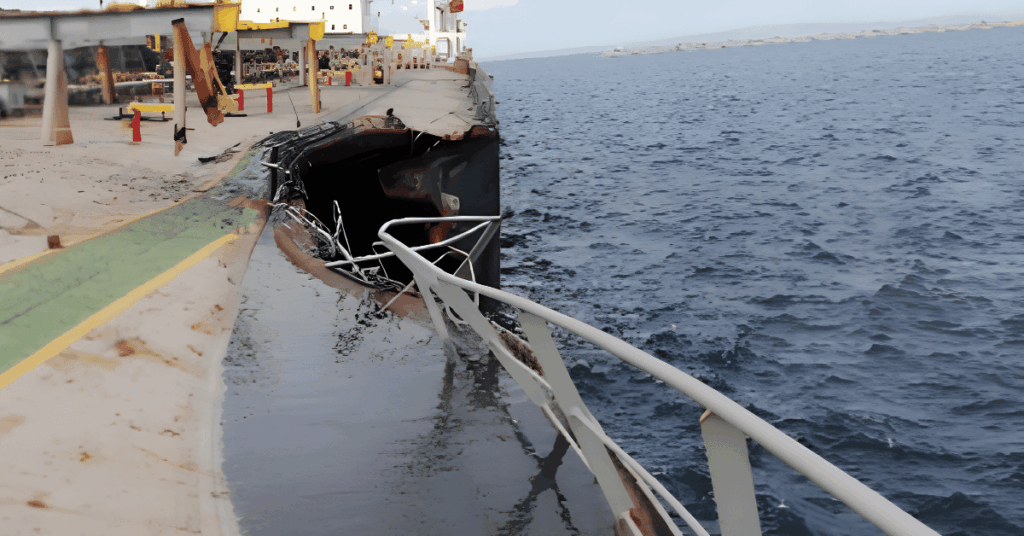
The incident, which left both vessels with significant damage, occurred after Vessel B, travelling at 11.8 knots without an active AIS signal, overtook Vessel A, which had not plotted the approaching ship as a radar target.
Despite a heightened bridge watch regime, including two navigation officers and a helmsman, the crew of Vessel A remained unaware of Vessel B’s approach. The overtaking vessel, meanwhile, was operating on autopilot with only an Officer of the Watch (OOW) and a lookout on duty, neither of whom had alerted the Master to the deteriorating visibility.
The incident highlights a dangerous overreliance on automated systems in restricted visibility. While Vessel A had taken precautionary measures, including a reinforced bridge team, its crew failed to track Vessel B on radar, despite its intermittent returns. The absence of an AIS signal from Vessel B further compounded the risk, as the vessel remained effectively invisible to both the bridge team and Vessel Traffic Services (VTS).
The oversight proved costly when VTS instructed Vessel A to alter course to avoid suspended traffic. The Master, believing the opposite lane was clear, ordered a port helm manoeuvre, directly into the path of the overtaking Vessel B. The VTS operator, unaware of Vessel B’s exact position due to its missing AIS signal, approved the move, setting the stage for the collision.
Seconds before impact, the OOW on Vessel B attempted a VHF call to Vessel A, but the warning came too late. The Master of Vessel A ordered a hard starboard turn, while Vessel B’s OOW responded with a hard port helm, both actions insufficient to prevent the collision. Vessel B struck Vessel A on its port side, causing structural damage to both ships.
Lessons from the Fog: How Bridge Teams Can Prevent Future Collisions
The incident underscores the limitations of AIS as a sole watchkeeping tool. While AIS provides critical data on vessel movements, it cannot replace active radar plotting, particularly in congested or low-visibility conditions.
Speed management also played a decisive role in the collision. Vessel B’s 11.8-knot speed in dense fog left minimal reaction time when the close-quarters situation developed. COLREGs require vessels to proceed at a safe speed relative to visibility, yet the overtaking vessel’s velocity far exceeded what was prudent given the conditions.
Bridge Resource Management (BRM) emerged as another critical failure point. Despite Vessel A’s reinforced watch, situational awareness remained inadequate. The Master’s decision to alter course without confirming the position of all nearby vessels, particularly those not emitting AIS, violated core BRM principles.
For the shipping industry, the collision raises broader questions about the effectiveness of VTS in managing untracked vessels. While VTS provides invaluable guidance in high-risk areas, its reliance on AIS and radar data means it cannot detect vessels operating without active transponders.
The aftermath of the collision leaves both vessels facing costly repairs and potential delays in their schedules. As maritime traffic continues to grow in congested lanes, the need for rigorous adherence to COLREGs, dynamic bridge management, and proactive radar surveillance has never been more urgent.


Sign up free to ask CAMAL AI for a summary, the key points or anything else about this story.
Related stories
CAMAL AI
 Financial Ports Newsletter
The maritime economy, every morning
Ports, shipping and freight markets in one short email. Free.
Financial Ports Newsletter
The maritime economy, every morning
Ports, shipping and freight markets in one short email. Free.