

40MWh Ferry Smashes Maritime Battery Record
The 130-metre China Zorrilla arrives in Uruguay with 4 times the battery capacity of any previous vessel.
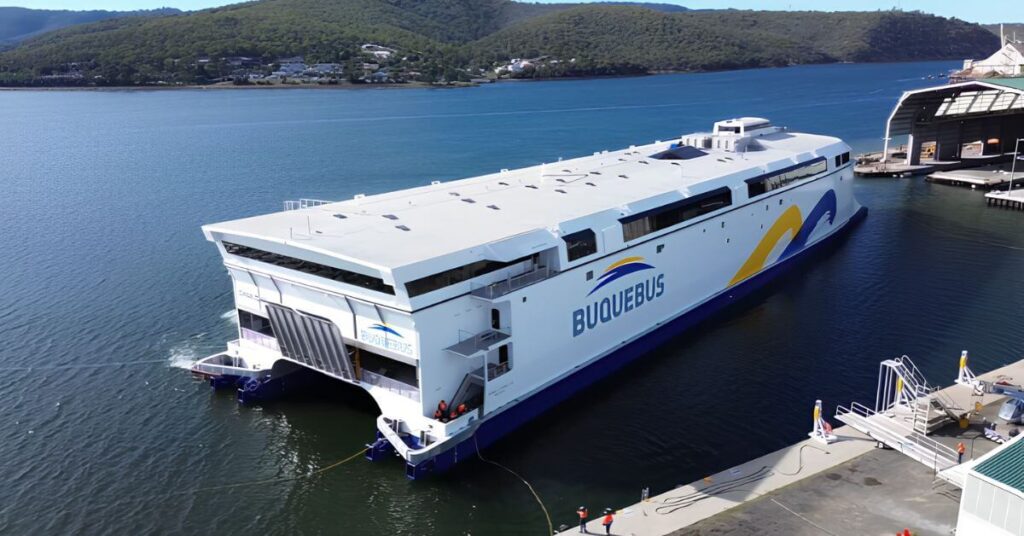
The 130-metre ferry, Hull 096, now known as China Zorrilla, arrived in Nueva Palmira aboard the heavy-lift vessel MV Black Marlin on September 11, ready for commissioning and testing.
With a 40-megawatt-hour (MWh) battery capacity, four times larger than any previous maritime vessel, it will operate three daily crossings across the 30-nautical-mile Rio de la Plata, each taking approximately one hour.
The China Zorrilla is powered by more than 5,000 battery modules, giving it a runtime of about 90 minutes on a single charge. This aligns perfectly with its planned route between Colonia del Sacramento and Buenos Aires, where the crossing takes roughly one hour. The vessel’s aluminium construction reduces weight, enhancing the efficiency of its battery-electric propulsion system.
Equipped with eight electric waterjets, the ferry underwent rigorous harbour trials in Tasmania to test its propulsion, handling, and manoeuvrability.
The loading operation in Tasmania was described as one of the most complex marine operations in the state’s history.
Why This Ferry Could Change Short-Sea Shipping
Incat Chairman Robert Clifford hailed the arrival as a “major step forward in the transition to cleaner, more sustainable maritime transport.” The China Zorrilla, named after the late Uruguayan actress, can carry up to 2,100 passengers and 225 vehicles, making it a viable alternative to diesel-powered ferries on high-traffic routes.
Buquebus, the South American ferry operator, first ordered the vessel in 202019, but construction was paused during the COVID-2019 pandemic. The ferry was launched into Tasmania’s River Derwent in May and underwent extensive testing before its trans-Pacific journey.
Incat’s achievement has already been recognised with the 2026 Tasmanian Exporter of the Year award, further cementing its reputation as a leader in innovative shipbuilding. The award, presented at the 32nd Tasmanian Export Awards Gala Dinner, celebrates the company’s contribution to the state’s economy and its role in advancing sustainable maritime technology. Incat’s success has also drawn attention to Tasmania’s broader export capabilities, with the state positioning itself as a centre for high-value manufacturing and clean energy solutions.
The company currently has three more large electric ferries and two smaller hybrid-electric vessels under construction, signalling a broader shift toward electrification in the maritime industry. These projects include vessels for both domestic and international clients, reinforcing Incat’s position as a pioneer in zero-emission shipbuilding. The demand for such vessels is expected to grow as regulators and operators seek to comply with stricter environmental standards.
For Uruguay and Argentina, the China Zorrilla represents more than just a new ferry, it’s a test case for the viability of battery-electric vessels on high-frequency routes. The Rio de la Plata crossing between Colonia del Sacramento and Buenos Aires is one of the busiest ferry routes in South America, with thousands of passengers and vehicles transported daily. The introduction of a zero-emission vessel could significantly reduce the route’s carbon footprint while maintaining the same level of service.
The ferry’s arrival also coincides with a broader push for sustainable infrastructure in the region. In July, Uruguay hosted a summit with more than 100 leaders to discuss a 24-page plan aimed at boosting connectivity and green transport in the northern part of the country. The China Zorrilla aligns with these goals, offering a tangible example of how innovation can drive environmental and economic progress.
The next phase for the vessel involves final commissioning and testing in Colonia del Sacramento before it begins commercial operations. Passengers and operators will be able to track the ferry’s performance through Buquebus’s official channels, which are expected to provide updates on its efficiency, reliability, and environmental impact. With its record-breaking battery capacity and zero-emission design, the China Zorrilla is poised to set a new standard for sustainable maritime travel, proving that large-scale electric ferries are not just a concept but a reality.
For the maritime industry, the success of the China Zorrilla could accelerate the adoption of battery-electric vessels worldwide. As more operators recognise the economic and environmental benefits of zero-emission ferries, projects like this one may become the norm rather than the exception. The journey from Tasmania to Uruguay is just the beginning, what comes next could redefine short-sea shipping for decades to come.


Sign up free to ask CAMAL AI for a summary, the key points or anything else about this story.
Related stories
CAMAL AI
 Financial Ports Newsletter
The maritime economy, every morning
Ports, shipping and freight markets in one short email. Free.
Financial Ports Newsletter
The maritime economy, every morning
Ports, shipping and freight markets in one short email. Free.



