

Drones slash offshore wind downtime by 20%
Ampelmann’s six-week campaign at Triton Knoll moved over nine tonnes of cargo.
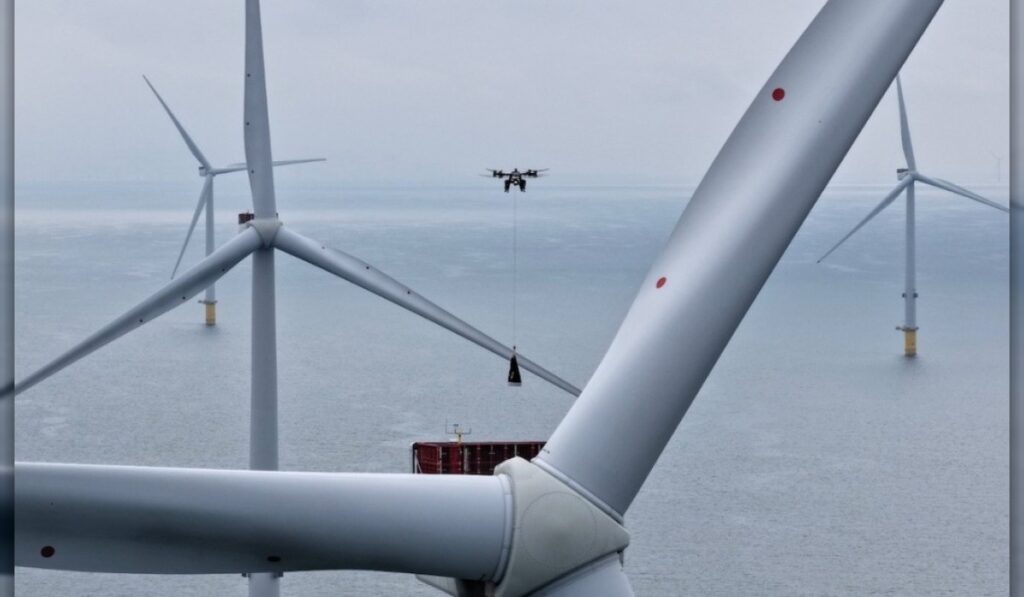
The result? A 15-20% boost in technician productivity and a glimpse of the future for offshore logistics.
Ampelmann, the Dutch walk-to-work gangway specialist, partnered with RWE to integrate its Cargo Drone Services into daily operations at the 857 MW Triton Knoll project off the UK coast. The campaign, running through August and September, saw drones pre-position equipment before technicians arrived and retrieve tools remotely after maintenance was completed, all while turbines continued generating power.
The drones, capable of carrying up to 80 kg per flight, operated autonomously for most of the journey, with pilots intervening only when necessary. Ampelmann’s software automated routine flights between the service operation vessel (SOV) and turbines, eliminating the need for manual crane operations and reducing vessel movements.
Thijs van ’t Geloof, Ampelmann’s Business Developer, highlighted the efficiency gains: “By working into the night, we can turn vessel idle time directly into productive lifting work. We can also deliver and retrieve cargo remotely from operating turbines, allowing power generation to continue while we conduct our operations.”
“By working into the night, we can turn vessel idle time directly into productive lifting work. We can also deliver and retrieve cargo remotely from operating turbines, allowing power generation to continue while we conduct our operations. In addition to reducing vessel movements, crane lifts and manual cargo handling, we increase the effective tool time of technicians by 15 to 20 percent.”
Thijs van ’t Geloof·Business Developer at Ampelmann
Why drones are changing offshore wind logistics
Triton Knoll campaign marks a shift from short-term drone demonstrations to sustained, day-to-day operations. Unlike traditional crane-based logistics, which require precise vessel positioning and manual handling, drones offer a faster, more flexible alternative.
They can operate in the dark, reducing downtime and enabling round-the-clock maintenance. Morten Christiansen, RWE’s Engineering Manager at Triton Knoll, called the trial a success: “We were delighted to work with Ampelmann on this trial because we believe cargo drones can significantly enhance the Service Operation Vessel-based logistics model.”
The integration of drones complements this capability by addressing a critical bottleneck: the time-consuming and weather-dependent process of lifting equipment using cranes. By automating cargo transport, Ampelmann aims to reduce operational delays and improve the overall efficiency of offshore wind farm maintenance.
The drones used at Triton Knoll are equipped with an unmanned pick-up system, allowing them to handle cargo without manual intervention during the transfer process. This automation not only speeds up operations but also enhances safety by minimising human exposure to hazardous conditions. The system is designed to work seamlessly with Ampelmann’s existing flight control software, which automates routine flights between the SOV and turbines, further reducing the need for human oversight.
“We were delighted to work with Ampelmann on this trial at Triton Knoll because we believe cargo drones can significantly enhance the Service Operation Vessel-based logistics model. By reducing reliance on conventional craning operations, this technology can improve safety, efficiency and productivity, while optimising vessel utilisation and enabling more transfers each day.”
Morten Christiansen·RWE Engineering Manager at Triton Knoll Offshore Wind Farm
Ampelmann claims the technology can save more than an hour of lifting time per turbine, a critical advantage as offshore wind farms grow larger and more complex. With RWE set to take full maintenance responsibility for Triton Knoll in 2027, the company is evaluating how to scale drone logistics across its fleet.
For offshore wind operators, the implications of drone logistics extend beyond efficiency gains. The technology could reduce the need for large, fuel-intensive vessels, lowering operational costs and carbon emissions. Additionally, the ability to pre-position equipment and retrieve tools remotely means technicians can focus on maintenance tasks rather than logistics, further improving productivity.
What’s next for offshore drone logistics?
The success at Triton Knoll builds on Ampelmann’s broader experience with cargo drones across Europe. Launched in 2024, the company’s Cargo Drone Services have already demonstrated their potential to streamline offshore operations. The next step? Expanding the technology to other wind farms and integrating it with existing walk-to-work systems. For operators, the benefits are clear: faster maintenance, reduced costs, and improved safety for technicians working in challenging offshore environments.
RWE’s evaluation of drone logistics at Triton Knoll is part of a broader industry trend toward automation and digitalisation. As offshore wind farms expand in size and complexity, traditional maintenance methods are becoming increasingly inefficient. Drones offer a scalable solution that can adapt to the growing demands of the sector. The company’s plans to take full maintenance responsibility for Triton Knoll in 2027 suggest that drone logistics could become a standard feature of its operations in the coming years.
Ampelmann, meanwhile, is positioning itself as a leader in offshore logistics innovation. The company’s experience with walk-to-work systems and cargo drones gives it a unique advantage in the market. Its software-driven approach ensures that drones can operate efficiently and safely, even in challenging conditions, making them a reliable tool for operators.
For the offshore wind industry, the adoption of drone logistics represents a significant step forward. As projects like Triton Knoll continue to push the boundaries of what is possible, innovations like this will be essential to maintaining efficiency and reliability. The ability to transport tools and equipment quickly and safely, without disrupting power generation, could become a game-changer for the sector. For now, the message from Triton Knoll is unmistakable: the future of offshore maintenance is airborne, and it is already taking flight.
Similarly, RWE’s plans for Triton Knoll and its broader offshore wind strategy are available through its corporate channels, offering insights into the future of renewable energy logistics.


Sign up free to ask CAMAL AI for a summary, the key points or anything else about this story.
Related stories
CAMAL AI
 Financial Ports Newsletter
The maritime economy, every morning
Ports, shipping and freight markets in one short email. Free.
Financial Ports Newsletter
The maritime economy, every morning
Ports, shipping and freight markets in one short email. Free.