

Will Cheaper Cars Revive US Truck Freight? The CAFE Reset’s Hidden Impact
US regulators slash fuel economy targets, cutting new-vehicle costs by $1,300.
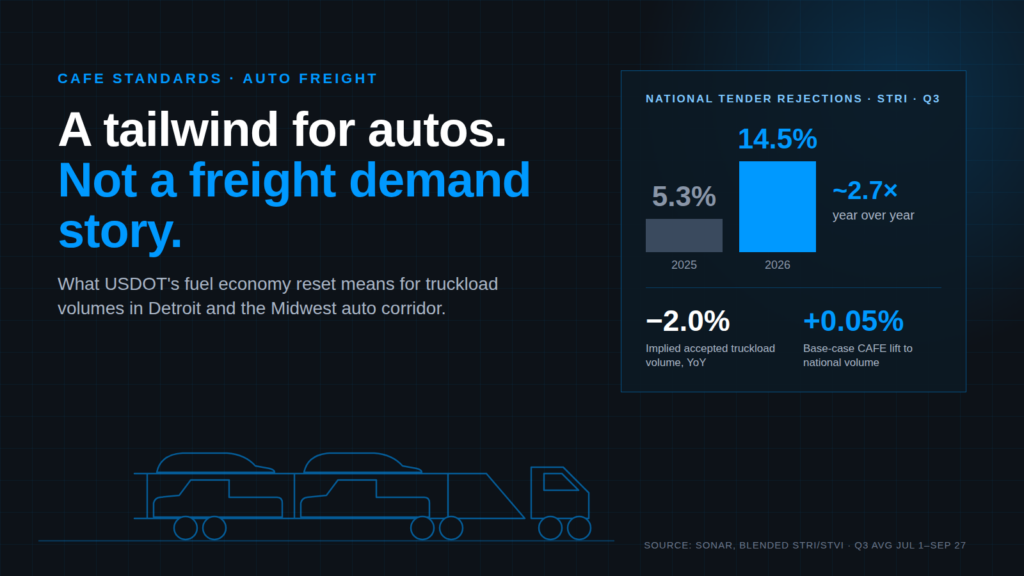
The US Department of Transportation (USDOT) has finalised its “Freedom Means Affordable Cars” rule, slashing Corporate Average Fuel Economy (CAFE) standards in a move designed to cut new-vehicle prices by $1,300 and save consumers $138 billion over five years. Yet despite Detroit’s pivot toward truck-heavy production, freight markets show little sign of a demand surge, SONAR data reveals accepted truckload volumes are flat or declining, while tender rejections have nearly tripled.
The CAFE reset, announced on 28 September, lowers fuel economy targets for model years 2022, 2031, capping the fleet average at 34.5 mpg by 2031, a sharp reduction from the previous 50.4 mpg target. The rule eliminates assumptions about electric vehicle (EV) production and credit trading, granting automakers greater flexibility to prioritise trucks, SUVs, and internal combustion engine (ICE) models.
Why the CAFE Reset Isn’t Moving the Freight Needle
Despite the regulatory tailwind, the freight market’s stagnation is rooted in deeper structural issues.
Detroit’s auto corridor, spanning Michigan, Ohio, Indiana, and the Southeast, remains a critical hub for truckload freight, yet even here, the impact of the CAFE reset is muted. The USDOT’s own estimates suggest a 0.5%, 2% lift in light-vehicle output by 2027, 2028, a marginal increase that translates to less than 0.1% of national truckload volume.
The regulatory design further complicates the outlook. The footprint-based CAFE standards and the 25% Chicken Tax on imported light trucks favour domestic production of larger vehicles, but these advantages are offset by persistent macroeconomic pressures. Consumer sentiment, measured at 48.1 by the University of Michigan, remains weighed down by high diesel prices, rising interest rates, and stagnant wages.
The Real Story: Capacity, Not Cars, Dictates Freight Flows
The CAFE reset’s limited impact on freight markets is evident in the data. While the rule may encourage automakers to ramp up production of trucks and SUVs, vehicles that generate more freight volume per unit than sedans, the broader freight environment is shaped by factors beyond regulatory tweaks. Industry forecasts reinforce the disconnect.
The regulatory landscape itself is far from static. Statutory mandates, such as the 2007 biofuel targets, have repeatedly been waived or adjusted, casting doubt on the durability of the CAFE reset’s provisions. The 25% Chicken Tax, which protects domestic truck production, and the 2.5% tariff on passenger cars further distort the market, favouring larger vehicles over fuel-efficient models. As one USDOT official acknowledged, “A rule on paper is not a volume forecast.”
For freight operators, the CAFE reset offers little immediate relief. The estimated 0.1% lift in national truckload volume is a drop in the ocean compared to the 5% share of auto-linked freight in overall truckload movements. In core auto markets, where auto-linked freight accounts for up to 25% of outbound volumes, the projected 0.3% increase is similarly negligible. As the freight market grapples with capacity shortages and rising rejection rates, the CAFE reset’s promise of cheaper, more flexible car production appears unlikely to move the needle in the near term.
The next 12 months will test whether the regulatory easing can stimulate enough production to offset broader economic headwinds. For now, the data suggests that capacity, not cars, remains the defining factor in US truck freight.
“The ‘Freedom Means Affordable Cars’ rule is designed to put money back in the pockets of American families while maintaining safety and environmental standards. However, its impact on freight markets will depend on broader economic conditions.”
USDOT Spokesperson·Regulatory Affairs


Sign up free to ask CAMAL AI for a summary, the key points or anything else about this story.
Related stories
CAMAL AI
 Financial Ports Newsletter
The maritime economy, every morning
Ports, shipping and freight markets in one short email. Free.
Financial Ports Newsletter
The maritime economy, every morning
Ports, shipping and freight markets in one short email. Free.