

World’s First Battery Bulker Cuts Diesel by 500,000 Litres a Year
The 125-metre MV Yampu replaces a diesel vessel and boosts Adbri’s limestone capacity by 35%.
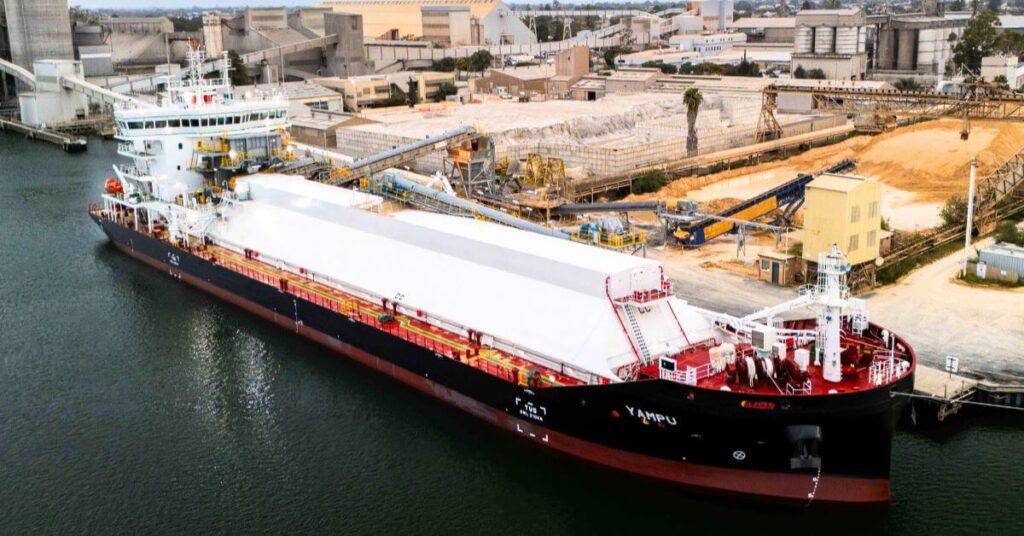
The world’s first battery-powered self-unloading bulk carrier, MV Yampu, has begun commercial operations in Australia, marking a milestone in maritime decarbonisation. The 125-metre vessel, equipped with a 6,758-kilowatt-hour battery system, is expected to slash diesel consumption by more than 500,000 litres a year while cutting Scope 1 emissions by 40%.
MV Yampu, owned and operated by CSL Group, replaces the MV Accolade II and serves Adbri’s limestone route between Klein Point quarry on South Australia’s Yorke Peninsula and the company’s Birkenhead cement manufacturing facility in Adelaide. The vessel can carry 11,900 deadweight tonnes and is projected to transport around 2.7 million tonnes of limestone annually, a 35% increase in Adbri’s carrying capacity.
How MV Yampu is powering Australia’s cement supply chain: World First
The vessel’s batteries are charged while docked at Adbri’s Birkenhead facility, allowing it to operate on electric power for approximately 40% of its journey. This hybrid approach not only reduces fuel consumption but also sets the stage for a fully electric future.
The limestone transported by MV Yampu will be used to produce cement for critical infrastructure projects across South Australia and Victoria, including homes, hospitals, schools, and roads. Paul Headd, Adbri’s Chief Executive Officer, emphasised the vessel’s dual role in supporting local manufacturing while advancing sustainability:
“Every day, the limestone carried by MV Yampu will help produce the cement used to build homes, hospitals, schools, roads and major infrastructure projects across South Australia and Victoria. Being able to do that while further reducing emissions helps Adbri remains at the forefront of lower-carbon cement manufacturing in Australia.”
Paul Headd·Adbri Chief Executive Officer
Louis Martel, CSL’s Chief Executive Officer, highlighted the operational and environmental benefits of the vessel:
“MV Yampu represents a significant step forward in our decarbonisation journey and demonstrates how practical innovation can deliver real environmental benefits while meeting the demands of commercial operations.”
Louis Martel·CSL Chief Executive Officer
The technology behind the world’s first electric bulk carrier
MV Yampu’s design incorporates several innovations to maximise efficiency and sustainability. The vessel’s self-unloading system, combined with its battery-powered operations, reduces reliance on diesel engines, which traditionally power bulk carriers. The ship’s hybrid system allows it to switch between battery and diesel power seamlessly, ensuring operational flexibility while minimising emissions.
It is part of CSL’s broader strategy to modernise its fleet with low-emission vessels.
The company’s fleet plays a crucial role in global bulk cargo transportation, and MV Yampu represents a significant leap forward in reducing the maritime industry’s carbon footprint.
The vessel’s name, Yampu, holds cultural significance, meaning “dolphin” in the Narungga and Kaurna languages of South Australia. The name was chosen through an Adbri naming process to reflect the vessel’s connection to the region’s marine environment and heritage.
For the maritime industry, MV Yampu sets a new benchmark for sustainable bulk shipping.
Looking ahead, Adbri and CSL plan to continue monitoring MV Yampu’s performance, with a focus on expanding its electric capabilities. For now, the ship’s hybrid operations provide a practical and scalable model for decarbonising bulk shipping.
As the maritime industry grapples with the need to reduce emissions, MV Yampu offers a glimpse into the future of sustainable shipping. Its success could pave the way for more electric and hybrid vessels, transforming how bulk cargo is transported globally. For Australia’s cement supply chain, the vessel represents not just a technological achievement but a commitment to a greener, more efficient future.


Sign up free to ask CAMAL AI for a summary, the key points or anything else about this story.
Related stories
CAMAL AI
 Financial Ports Newsletter
The maritime economy, every morning
Ports, shipping and freight markets in one short email. Free.
Financial Ports Newsletter
The maritime economy, every morning
Ports, shipping and freight markets in one short email. Free.