

Whale Strike Leaves Four Sailors Adrift 250 Miles from Safety
A Malta-flagged containership diverted 250 nautical miles to pluck four Australians from a life raft.
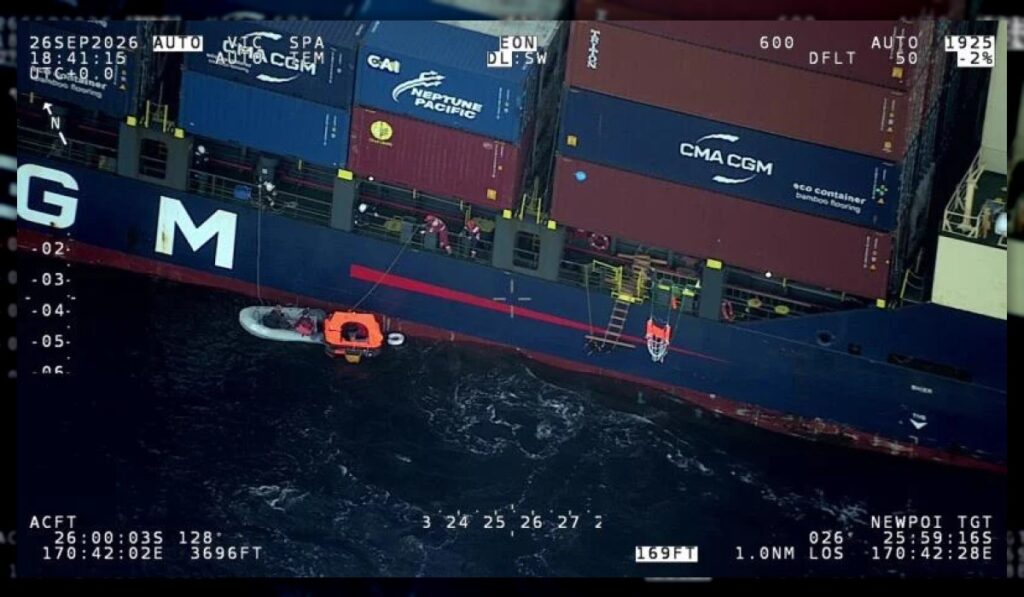
A Malta-flagged containership diverted from its route to pluck the crew from the water at dawn, ending a rescue operation that officials called “well-coordinated and executed".
The incident unfolded around 1:00 pm on Saturday, when the Tai Tam, a 51-foot yacht sailing under the Australian flag, collided with a whale approximately 250 nautical miles north of Norfolk Island.
Maritime New Zealand’s Rescue Coordination Center received the distress signal and sprang into action, dispatching a Royal New Zealand Air Force Force P-8A surveillance aircraft to locate the sailors.
Containership Diverts to Rescue Stranded Sailors: Whale
The Sofrana Surville, a 12,500 dwt containership flagged in Malta and operated by ANL Singapore, responded to the distress call. The vessel altered its course and steamed toward the last known position of the life raft, arriving at approximately 0600 the following morning.
Mike Clulow, Operations Manager at the Rescue Coordination Centre, commended the sailors’ preparedness and the swift response of the rescue teams. “This was a well-coordinated and executed rescue,” he said. “The crew of the yacht did all the right things, and it was unfortunate to have struck a whale in open water. They were well prepared and the early activation of their EPIRB was key to helping get them to safety.”
“This was a well-coordinated and executed rescue. The crew of the yacht did all the right things, and it was unfortunate to have struck a whale in open water. They were well prepared and the early activation of their EPIRB was key to helping get them to safety.”
Mike Clulow·Rescue Coordination Centre Operations Manager Mike Clulow
The Sofrana Surville transported the survivors to the nearest port for disembarkation. According to its Automatic Identification System (AIS) data, the vessel made a stop in Noumea, New Caledonia, before continuing its voyage to Brisbane, Australia.
Norfolk Island, the nearest landmass to the collision site, is a remote volcanic island in the South Pacific and an external territory of Australia. The successful outcome of this rescue operation reflects the effectiveness of international maritime cooperation and the critical role of commercial vessels in responding to emergencies at sea.
Royal New Zealand Air Force Air Force Force’s P-8A Poseidon aircraft, a long-range maritime patrol plane, played a pivotal role in locating the sailors and coordinating the rescue effort. The aircraft’s advanced sensors and communication systems allowed it to maintain contact with the life raft throughout the night, ensuring that the crew remained safe until the Sofrana Surville arrived.
For the shipping industry, the incident serves as a reminder of the unpredictable nature of maritime operations. While whales are protected under international law, their presence in busy shipping lanes poses a risk to both the animals and vessels. The International Whaling Commission and other maritime organizations continue to study ways to mitigate these risks, including the use of real-time whale tracking systems and adjusted shipping routes during migration seasons.
The Sofrana Surville’s diversion to rescue the Tai Tam’s crew is not an isolated incident. Commercial vessels frequently assist in search-and-rescue operations, particularly in remote regions where naval or coast guard assets may be hours or even days away. The willingness of shipping companies to prioritize human life over schedule and cost is a testament to the maritime community’s commitment to safety at sea.
As the survivors make their way to Brisbane, the incident leaves behind a tale of survival and the enduring challenges of navigating the world’s oceans. For the crew of the Tai Tam, the rescue is a stark reminder of the sea’s unpredictability, and the importance of being prepared for the unexpected.


Sign up free to ask CAMAL AI for a summary, the key points or anything else about this story.
Related stories
CAMAL AI
 Financial Ports Newsletter
The maritime economy, every morning
Ports, shipping and freight markets in one short email. Free.
Financial Ports Newsletter
The maritime economy, every morning
Ports, shipping and freight markets in one short email. Free.