

Ukraine Charges Russian Captain for War Crimes
Ukraine’s Security Service accuses Mykola Telagin of transporting stolen grain from Crimea to Syria under false.
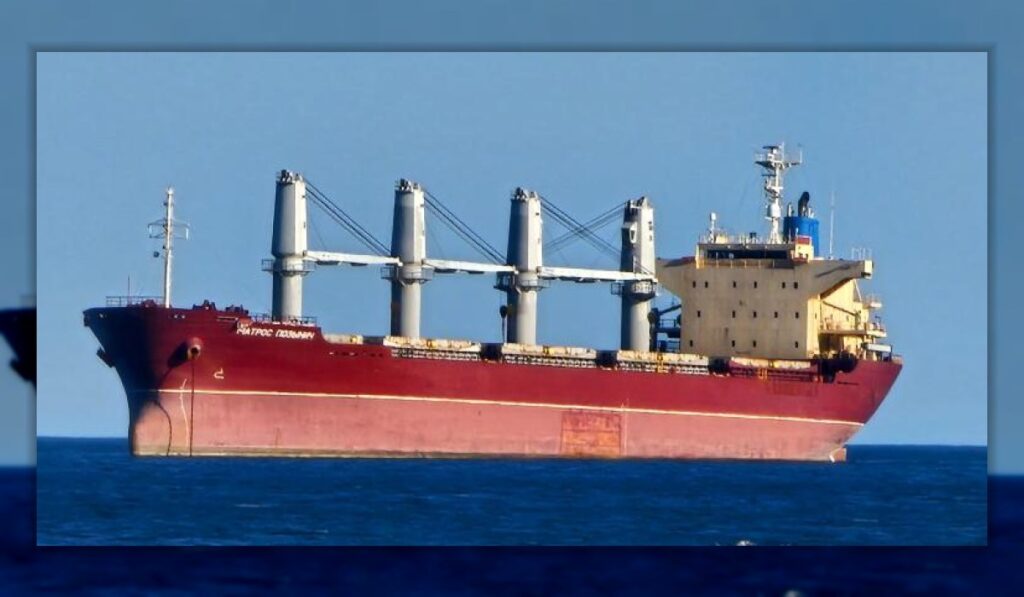
Ukraine has charged a Russian ship captain in absentia for war crimes after he allegedly transported more than 54,000 tons of stolen Ukrainian grain from occupied Crimea to Syria. Mykola Telagin, 54, master of the bulk carrier Matros Pozynich, faces prosecution for violating the laws of war, following an investigation by Ukraine’s Ukraine’s Security Service (SBU) (SBU) and Prosecutor General’s Office’s Office.
The case marks the first time Kyiv has targeted a vessel’s captain for war crimes linked to grain exports. The SBU confirmed that Telagin, a Russian citizen, controlled the Matros Pozynich during two shipments in November 2022 and January 2023, totalling 54,300 tons of grain.
How the Grain Was Stolen and Smuggled: War Crimes
The SBU’s investigation revealed a systematic effort to conceal the grain’s origins. Telagin allegedly disabled the vessel’s Automatic Identification System (AIS) during voyages and transmitted false location data to mask the ship’s movements.
“According to the investigation, the grain export was carried out by the decision of the top political leadership of the aggressor country,” the SBU stated. “Such actions violate the Geneva Conventions, which prohibit the theft of property in occupied territories.”
The Matros Pozynich, a 28,351 dwt bulker built in 2010, was reflagged from the Marshall Islands to Russia in 2022 after being sold to a Russian company.
The case against Telagin is part of a wider Ukrainian effort to disrupt Russia’s exploitation of occupied agricultural lands. In a separate operation on October 19, the SBU arrested two individuals in Odesa for facilitating the transport of stolen grain worth over $1.3 million. The suspects allegedly loaded 7,857 tons of Ukrainian wheat onto the sanctioned vessel Alpha M at the Port of Mariupol in 2024, before shipping it to Temryuk in Russia’s Krasnodar Territory. There, fictitious documents were issued to falsely label the grain as Russian, enabling its onward sale to the Middle East.
During raids on the suspects’ homes and offices, authorities seized computer equipment, mobile phones, and forged laboratory reports that allegedly proved the grain’s Ukrainian origin. The two individuals now face up to 12 years in prison with confiscation of property if convicted.
In another development, Ukraine seized a foreign-flagged cargo ship in the Black Sea off Odesa in October, detaining its captain for allegedly exporting stolen grain. The vessel, which sailed under the flag of a central African country, had repeatedly docked at Sevastopol between 2023 and 2024 to load agricultural products.
Legal and Geopolitical Implications
Russia’s blockade of Ukrainian ports in the Black Sea and its occupation of key farming regions, including Crimea and parts of southern Ukraine, have crippled Kyiv’s ability to export grain through traditional routes. The United Nations’ Black Sea Grain Initiative, which facilitated the export of Ukrainian grain via a safe corridor, collapsed in 2023 after Russia withdrew, further exacerbating the crisis.
For shipowners and maritime operators, the case serves as a stark warning. The SBU has made it clear that vessels involved in transporting stolen Ukrainian goods, whether through occupied ports or under false documentation, will be targeted. The agency is actively pursuing accomplices in the Matros Pozynich case and has urged international partners to assist in tracking the vessel’s movements and those of similar ships.
As the war enters its fourth year, Ukraine’s legal strategy appears to be evolving. By prosecuting individuals for war crimes tied to economic exploitation, Kyiv is sending a message that even those not directly involved in combat can be held accountable. The outcome of Telagin’s case, though likely symbolic given his absence, could set a precedent for future prosecutions of maritime actors complicit in Russia’s occupation policies.
For now, the SBU continues its investigations, with a focus on identifying additional accomplices and disrupting the networks that enable grain smuggling. The agency has not ruled out further seizures of vessels or arrests of crew members found to be involved in similar operations. As the conflict grinds on, the battle over Ukraine’s stolen grain remains a critical front in the broader struggle for economic and legal justice.


Sign up free to ask CAMAL AI for a summary, the key points or anything else about this story.
Related stories
CAMAL AI
 Financial Ports Newsletter
The maritime economy, every morning
Ports, shipping and freight markets in one short email. Free.



