

South Korea’s Shipping Giants Bet Big on Next-Gen Maritime Connectivity
Inmarsat Maritime and SK telink partner to roll out NexusWave across car carriers.
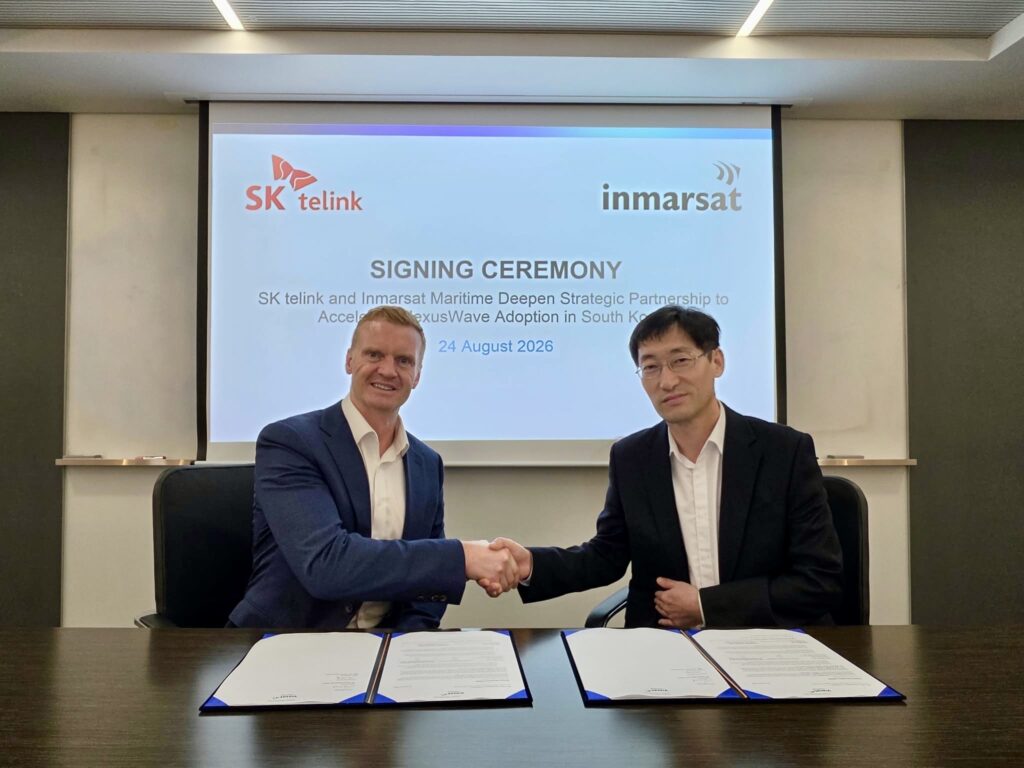
South Korea’s shipping industry is set to adopt advanced satellite connectivity through a new agreement between Inmarsat Maritime, a Viasat subsidiary, and local telecommunications provider SK telink. The partnership will deploy NexusWave—a next-generation maritime connectivity service—across key vessel types, including car carriers, container ships, and very large crude carriers (VLCCs) operated by major companies such as HMM and SINOKOR.
NexusWave is designed to serve as a digital foundation for modern maritime operations, supporting cloud-based applications, remote technical assistance, cybersecurity measures, and vessel performance optimization. The service also aims to improve crew welfare by enabling better communication and access to digital resources during voyages.
Addressing Industry Challenges: South Korea
The collaboration builds on a nearly two-decade relationship between the two companies, dating back to 2007. By combining Inmarsat Maritime’s global satellite network and managed services with SK telink’s local market expertise, the partnership seeks to accelerate digital transformation in South Korea’s maritime sector.
HMM
One of the key advantages of NexusWave is its ability to navigate complex regulatory environments, particularly in Asia’s busy shipping routes. The service dynamically adjusts network availability based on local requirements while maintaining seamless connectivity. Additionally, the upcoming integration of ViaSat-3 is expected to significantly boost capacity, enhancing performance for vessels operating in high-traffic regions.
Shin-Yong Lee, Head of Satellite Business Division at SK telink, highlighted the importance of reliable connectivity: “Modern fleets depend on resilient digital platforms to support operational efficiency, cybersecurity, and crew well-being. NexusWave is engineered to meet these demands, and we’re eager to bring its capabilities to more South Korean operators, helping them maximize the benefits of data-driven operations.”
Justin Yi, Inmarsat Maritime’s Regional Director for APAC, emphasized the broader impact: “South Korea remains a leader in maritime innovation, with operators adopting technologies that enhance competitiveness and resilience. This agreement reinforces our long-standing partnership with SK telink and underscores the growing momentum behind maritime digitalization. Together, we’re laying the groundwork for a more connected and data-driven future for South Korean shipowners.”
The rollout of NexusWave is expected to begin in the near future, with ViaSat-3 integration following later. As the maritime industry increasingly relies on data-driven operations, initiatives like this will be critical in maintaining competitiveness amid evolving global challenges.


Sign up free to ask CAMAL AI for a summary, the key points or anything else about this story.
Related stories
CAMAL AI
 Financial Ports Newsletter
The maritime economy, every morning
Ports, shipping and freight markets in one short email. Free.
Financial Ports Newsletter
The maritime economy, every morning
Ports, shipping and freight markets in one short email. Free.