

Six missing as tug capsizes in Busan: What went wrong off South Korea’s
A 286-tonne tug sank within minutes while assisting a 5,576 TEU containership, leaving six crew unaccounted for.
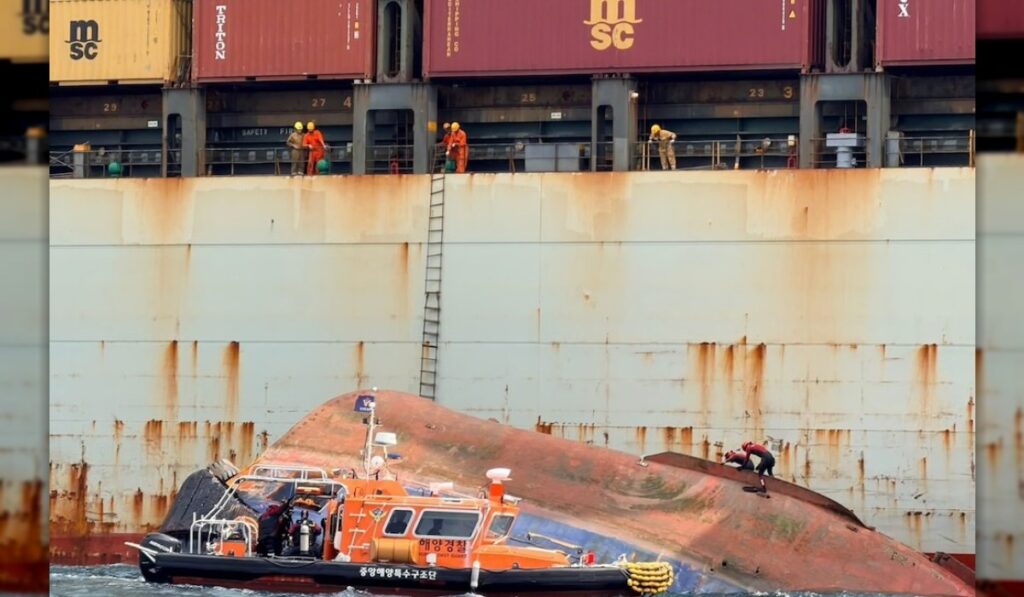
The 286-tonne tug TNS Catcher overturned at 1:29 PM, approximately 9 km east of Oryukdo, while working alongside two other tugs to manoeuvre the Liberia-flagged MSC Ikaria VI, a 5,576 TEU containership. Of the eight people onboard, only one Indonesian crewmember was rescued, while a South Korean seafarer was recovered unconscious and later pronounced dead in hospital.
Investigators believe the TNS Catcher may have been overwhelmed by towline tension while executing a sharp turn. The tug, positioned on the starboard bow of the MSC Ikaria VI, was turning to starboard when it rolled abruptly to port and capsized. CCTV footage from the containership shows the vessel beginning its turn before flipping over entirely.
A collision with the containership has been ruled out, but authorities are examining whether the tug became snagged on its towline.
The TNS Catcher was one of three tugs assisting the MSC Ikaria VI, with two pulling from either side of the containership’s bow while a third pushed from the stern.
Rescue operations have been severely hampered by poor underwater visibility, 1.5-metre waves, and strong northwesterly winds blowing at 4 to 6 metres per second. The Navy’s ROV search has struggled to locate the sunken vessel, prompting the Coast Guard to expand the search area to 66 km by 40 km, deploying 24 vessels and seven aircraft.
For the shipping industry, the incident serves as a stark reminder of the human cost of maritime operations. Tug crews, often working in close proximity to massive vessels, face significant risks, and the loss of life in such incidents underscores the need for stricter safety measures. Industry analysts suggest that the accident could accelerate the adoption of remote-controlled or autonomous tugs, which are already being tested in some ports to reduce human exposure to high-risk manoeuvres.
What happens next in the search and investigation?: Busan
A 41-strong investigation team has secured AIS, VDR, and CCTV data to determine the exact cause of the capsizing. The investigation will likely focus on whether the tug’s equipment, such as its towline or winch system, malfunctioned during the turn, or if human error contributed to the accident.
President Lee Jae Myung has ordered authorities to “mobilise all available resources” for rescue and recovery efforts, according to chief presidential spokesperson Kang Yu-jung-jung. The Busan metropolitan government has activated its disaster response headquarters, while districts Nam-gu, Haeundae-gu, and Dong-gu have established on-site support centres for affected families. These centres will coordinate psychological counselling, emergency interpretation services, and logistical support for the families of the missing crewmembers.
Dedicated teams will provide psychological counselling and emergency interpretation services for the families of the missing crewmembers. The 53-year-old Indonesian cook who survived recounted his escape: “I had been in the galley and ran when I realised the vessel was in trouble.
I was able to climb on top of the stern of the overturned tugboat, and the containership saw me and lowered a ladder for me to climb up.” The cook’s testimony, along with CCTV footage and data from the tug’s voyage data recorder (VDR), will be critical in reconstructing the sequence of events leading to the capsizing.
The second engineer reportedly followed the cook’s escape but fell into the water. The 57-year-old South Korean crewmember who died was found unconscious inside the capsized tug and transported to hospital by a Coast Guard rescue vessel. The recovery of his body, along with the ongoing search for the six missing crewmembers, remains a priority for authorities, who are working against the clock amid deteriorating weather conditions.
For maritime stakeholders, the incident has reignited debates about the adequacy of safety measures for tug operations. The International Maritime Organization (IMO), the UN agency responsible for regulating global shipping safety, has previously issued guidelines for tug operations, including recommendations for crew training, equipment maintenance, and emergency response protocols. However, compliance with these guidelines varies by region, and the Busan accident may prompt calls for stricter enforcement.
With the TNS Catcher now resting at a depth of 87 metres, authorities face a race against time to recover the missing crewmembers amid challenging weather conditions. The incident has underscored the risks faced by tug crews in one of Asia’s most critical shipping hubs, and its aftermath will likely shape future safety regulations for maritime operations in the region. For now, the focus remains on the search and recovery efforts, as families and colleagues await news of the missing crewmembers.
Those seeking updates on the rescue and investigation can follow official announcements from the Busan Coast Guard or the Korea Coast Guard, which will provide real-time information as the situation develops.


Sign up free to ask CAMAL AI for a summary, the key points or anything else about this story.
Related stories
CAMAL AI
 Financial Ports Newsletter
The maritime economy, every morning
Ports, shipping and freight markets in one short email. Free.
Financial Ports Newsletter
The maritime economy, every morning
Ports, shipping and freight markets in one short email. Free.