

USS Charleston Defies China’s South China Sea Claims in High-Stakes Passage
The U.S. Navy vessel’s transit near Sabina Shoal triggers Beijing’s sovereignty claims and a diplomatic rebuke from.
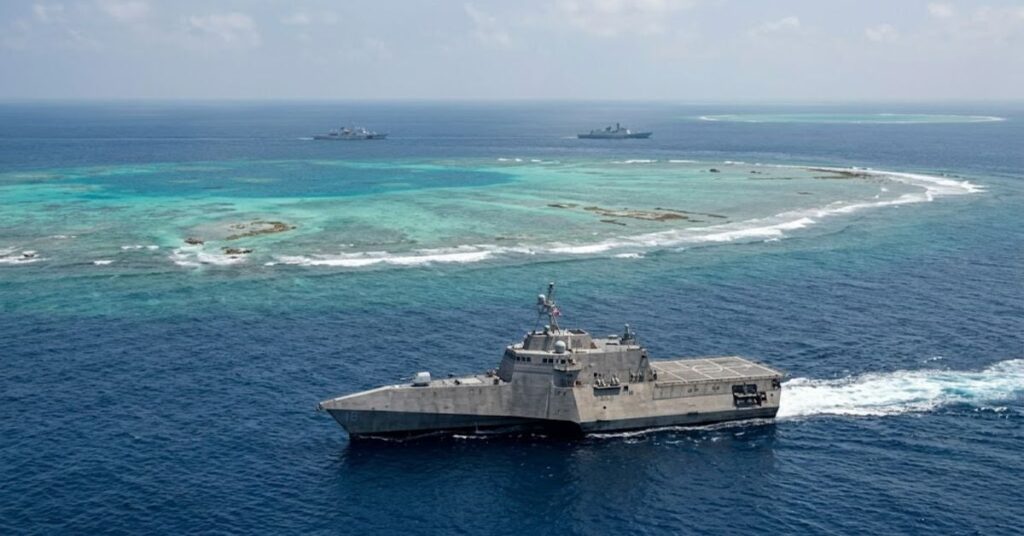
The U.S. Navy’s USS Charleston has sailed near the disputed Sabina Shoal in the South China Sea, triggering a sharp rebuke from Beijing and a firm rejection of China’s sovereignty claims by Washington. China immediately dispatched naval warships to monitor the vessel’s movements, accusing the U.S. of infringing on its territorial waters, a charge the U.S. dismissed as legally groundless.
China’s military spokesperson condemned the USS Charleston’s passage as “infringing upon China’s sovereignty rights and interests,” a claim the U.S. State Department swiftly rejected.
Beijing’s response was not merely rhetorical. Chinese naval warships shadowed the USS Charleston throughout its transit near Sabina Shoal, a coral formation in the Spratly Islands. The shoal, known as Escoda Shoal to the Philippines and Xianbin Reef to China, lies approximately 75 nautical miles west of Palawan, an island under Philippine control. Manila asserts the area falls within its 200-nautical-mile Exclusive Economic Zone (EEZ), a claim disputed by Beijing.
China’s Sovereignty Claims and the U.S. Response
The incident highlights the deepening legal and diplomatic rift over the South China Sea, where China’s expansive territorial claims overlap with those of neighbouring countries, including the Philippines, Malaysia, and Brunei. The U.S. has consistently challenged Beijing’s assertions, citing a 2016 Arbitral Tribunal ruling in The Hague, which declared China’s maritime claims in the region legally baseless. In a joint statement, the U.S., the Philippines, and 12 other countries affirmed the ruling as “final and legally binding.”
China, however, rejects the tribunal’s authority and maintains its own legal framework. Under its Law on the Territorial Sea and the Contiguous Zone, foreign naval vessels must seek prior permission before entering what Beijing considers its territorial waters. This stance directly conflicts with international norms, which recognise the right of warships to conduct innocent passage or freedom of navigation in international waters, including areas within a country’s EEZ.
The U.S. State Department spokesperson emphasised the broader implications of China’s actions, stating, “Freedom of the seas and adherence to the international law of the sea is vital for the entire international community.” Washington has called on Beijing to cease its “risky and unlawful behaviour” and align its claims with UNCLOS and the 2016 arbitral ruling. The spokesperson added that China’s enforcement of its “unlawful maritime claims” undermines regional stability and threatens the legal rights of other nations.
For its part, China has doubled down on its position, arguing that the South China Sea does not comprise international waters and that naval activities within its EEZ require consent.
The Legal Battle Over the South China Sea
The Philippine military has backed the U.S. position, with officials describing the USS Charleston’s passage as a legitimate exercise of freedom of navigation.
The stakes in the South China Sea are high, with both the U.S. and China viewing the region as critical to their strategic interests.
As tensions simmer, the international community remains divided. While the U.S. and its allies push for a rules-based order, China continues to assert its claims through a combination of military presence, legal arguments, and diplomatic pressure. The USS Charleston’s passage near Sabina Shoal is unlikely to be the last such incident, with both sides dug in and unwilling to cede ground. The next moves will be closely watched, as the dispute over the South China Sea shows no signs of abating.


Sign up free to ask CAMAL AI for a summary, the key points or anything else about this story.
Related stories
CAMAL AI
 Financial Ports Newsletter
The maritime economy, every morning
Ports, shipping and freight markets in one short email. Free.



