

China’s South China Sea Tactics Exposed: Why Transparency Isn’t Enough
Philippines documents 101 Chinese military vessels in disputed waters, nearly double August’s count.
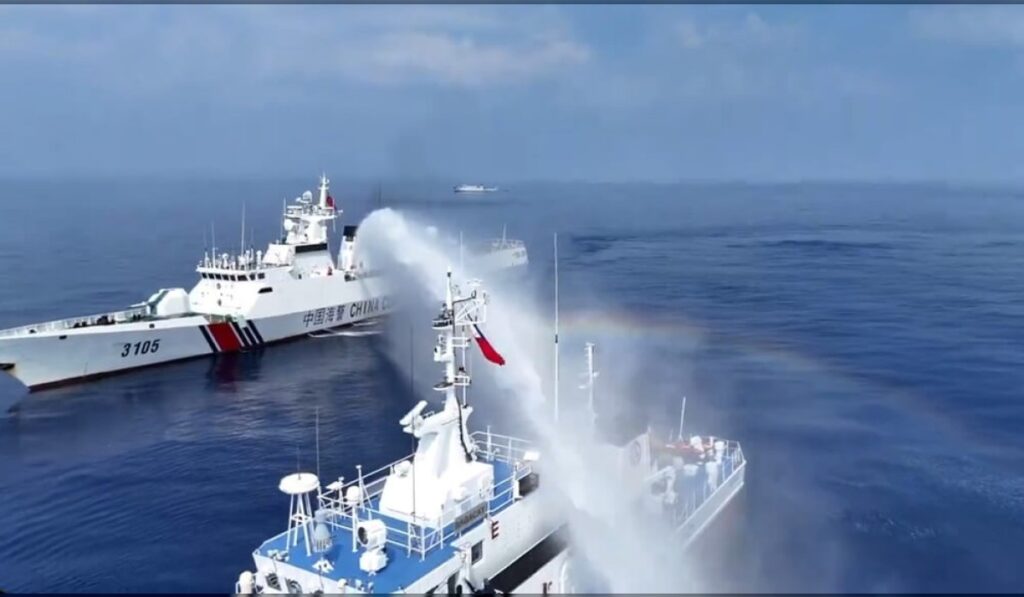
The Philippines’ strategy of publicly exposing China’s coercive actions in the South China Sea has rallied domestic support, but Beijing’s maritime militia and coast guard are still expanding their presence, undeterred.
The latest incidents underscore the limits of Manila’s transparency approach. On 8 October, a China Coast Guard (CCG) vessel used water cannons on a Philippine medical mission attempting to evacuate a soldier from the BRP Sierra Madre, a Philippine ship deliberately grounded in Ayungin Shoal since 1999.
Days later, the NTF-WPS reported that 22 vessels from China’s maritime militia had returned to Kota Island, Palawan, engaging in unauthorised fishing and dumping waste at sea. These actions follow a pattern of obstruction: in September alone, Chinese forces rammed a Philippine resupply vessel and blocked a rotation mission to the BRP Sierra Madre.
Since taking office, Philippine President Ferdinand Marcos Jr. has abandoned the previous administration’s policy of quiet diplomacy in favour of public exposure.
Despite this, Beijing has continued to reject the ruling, expanding its military and coast guard presence in the region. The Philippines, as a signatory to UNCLOS, has used the award as a cornerstone of its legal and diplomatic strategy, though enforcement remains a challenge without broader international backing.
Yet, as Marcos himself acknowledged at the Forbes Global CEO Conference in Singapore, the Philippines is “resigned to managing tensions with China and avoiding escalation”, hardly a sign of deterrence. This cautious stance reflects the broader geopolitical realities facing Manila.
The recent surge in PLAN and CCG vessels, monitored around Pag-Pag-Asa Island, Ayungin Shoal, Escoda Shoal, and Chinese-controlled Scarborough Shoal, proves that Beijing remains undeterred. Beyond maritime coercion, China has also intensified information campaigns, rewriting historical narratives, undermining Philippine sovereignty, and leveraging economic projects to influence local elites.
The doubling of Chinese vessels in the West Philippine Sea over the past month is not an isolated incident but part of a broader pattern of escalation. In August 2026, the NTF-WPS recorded 56 PLAN and CCG ships in the region. By October, that number had risen to 101, with vessels concentrated around key Philippine-held features such as Ayungin Shoal and Pag-Pag-Asa Island. This build-up coincides with increased harassment of Philippine resupply missions, including the 18 September incident in which the BRP Datu Magat Salamat was rammed by a CCG ship, sustaining damage.
The BRP Sierra Madre, grounded in Ayungin Shoal since 1999, serves as a symbolic and strategic outpost for the Philippines. Originally a World War II-era landing ship, it was deliberately run aground to assert Manila’s claim over the shoal, which lies within the country’s exclusive economic zone (EEZ).
China, however, has repeatedly attempted to block resupply missions to the vessel, including the 25 September incident in which CCG and PLAN ships obstructed a rotation-and-resupply operation. These actions violate international law, which guarantees the right of innocent passage and freedom of navigation in EEZs.
The Association of Southeast Asian Nations (ASEAN), of which the Philippines is a founding member, has struggled to address the South China Sea disputes effectively. Established in 1967, ASEAN operates on principles of consensus and non-interference, which often prevent collective action on contentious issues.
The Philippines’ 2026 Chairmanship of ASEAN could provide an opportunity to push for stronger regional responses, but past efforts have been hampered by divisions among member states, some of which maintain close economic ties with China. For instance, Myanmar and Cambodia have frequently blocked or diluted ASEAN statements critical of Beijing’s actions in the South China Sea.
For the Philippines, the stakes are particularly high. The country is considered the world’s social media capital, with over 80% of Filipinos relying on platforms like Facebook for news. This makes the government’s transparency strategy both a strength and a vulnerability.
While publicising Chinese coercion has galvanised domestic support, it also exposes Manila to disinformation campaigns designed to sow doubt about the government’s handling of the crisis. The Marcos administration has sought to counter this by partnering with fact-checking organisations and promoting media literacy, but the battle for public opinion remains an uphill struggle.
What’s Next for the Philippines?: South China Sea
Manila’s response is evolving. The Marcos administration’s Comprehensive Archipelagic Defence Concept (CADC) emphasises military dispersion, ranged strike capabilities, and geographic leverage to counter China’s anti-access/area-denial strategy. The CADC represents a shift from the Philippines’ traditional focus on internal security to a more outward-looking defence posture, aimed at protecting its maritime interests.
However, deeper foreign military partnerships are needed to integrate these plans effectively. Previous administrations avoided locking into basing access or weapons deployment agreements to preserve strategic flexibility, but Misalucha-Willoughby argues that “now is the time to jump-start these discussions.”
The Philippines has already taken steps to strengthen its defence ties with the United States, Japan, and Australia, among others. The Enhanced Defence Cooperation Agreement (EDCA) with the U.S., for example, allows for increased rotational presence of American forces in Philippine bases, including those near the South China Sea. However, they also risk provoking further escalation from Beijing, which views such alliances as a threat to its regional dominance.
The Philippine Coast Guard (PCG) has also expanded its capabilities, with support from international partners. In recent years, the PCG has received patrol vessels and training from Japan and the U.S., enabling it to conduct more frequent and effective patrols in the West Philippine Sea. These efforts are complemented by the NTF-WPS’s public documentation of Chinese activities, which serves as both a deterrent and a tool for rallying international support. However, as the recent incidents demonstrate, these measures have yet to alter China’s calculus in the region.
The Philippines also holds the 2026 Chairmanship of ASEAN, a position that could amplify its voice in regional security dialogues. Yet, ASEAN’s norms of consensus and non-interference, established in 1967, often limit collective action. With most Filipinos relying on Facebook for news, the government’s transparency strategy must also adapt to combat disinformation more aggressively. As China’s presence in the South China Sea grows, Manila faces a stark choice: double down on transparency or pivot to a more assertive defence posture.
For businesses and industries reliant on maritime trade, the escalating tensions in the South China Sea pose significant risks. The region is a critical artery for global commerce, with an estimated $3.4 trillion in trade passing through its waters annually. Disruptions to shipping routes, whether through direct conflict or increased militarisation, could lead to higher insurance premiums, longer transit times, and supply chain bottlenecks. The Philippines, as a key player in the region, must navigate these challenges while safeguarding its economic interests.
For now, the numbers tell the story. The 101 Chinese vessels patrolling the West Philippine Sea in October are a stark reminder that exposure alone is not enough. Without stronger alliances and a clearer military strategy, the Philippines risks losing ground, literally, in one of the world’s most contested maritime regions. The next steps for Manila will likely involve a combination of diplomatic engagement, military modernisation, and public diplomacy to ensure that its sovereignty and economic interests are protected in the face of China’s growing assertiveness.


Sign up free to ask CAMAL AI for a summary, the key points or anything else about this story.
Related stories
CAMAL AI
 Financial Ports Newsletter
The maritime economy, every morning
Ports, shipping and freight markets in one short email. Free.



