


Skip to content
Ports
Saturday, 5 September 2026 · 14:09 · Morocco ·
World Trade Pulse▼ -5.3%seaborne trade this week · 4,659 port calls a dayIMF PortWatch
Renewables

Maersk Pioneers Wind Power on 8,700 TEU Boxship: How a 35m Sail Cuts Fuel

World’s first rotor sail for a container vessel will be installed on a Maersk Lima-class ship by mid-2027.
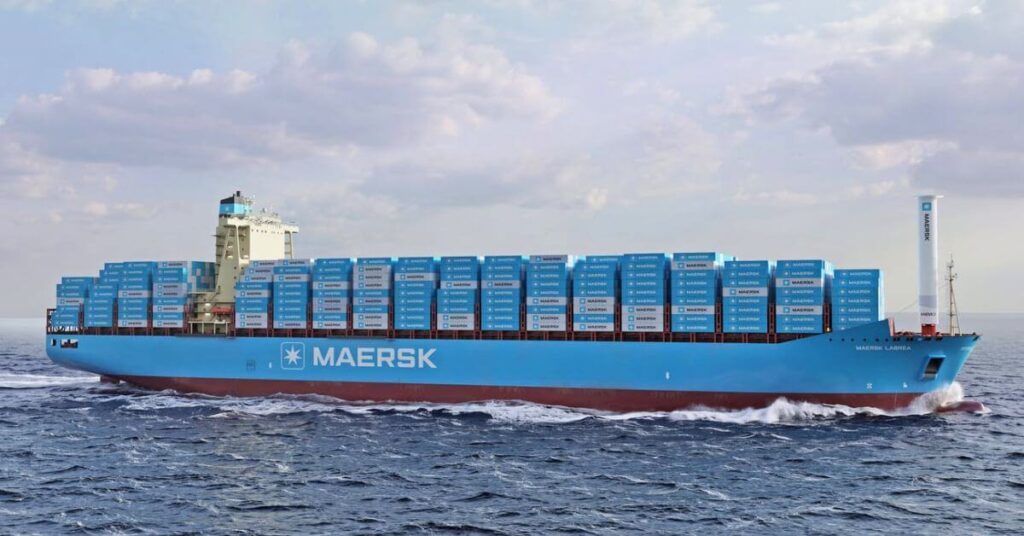

rotor sail
The 35-metre rotor sail will be installed on a Maersk Lima-class container vessel by mid-2027.

Maersk is set to become the first shipping line to install a rotor sail on a container vessel, marking a significant step in the industry’s push towards decarbonisation. The Danish giant has selected British firm Anemoi Marine Technologies to supply a 35-metre-high, 5-metre-diameter rotor sail for one of its 8,700 TEU Maersk Lima-class ships, with installation scheduled for mid-2027.

The technology has already been proven on bulk carriers, but this will be its first application on a container ship, a sector that transports a vast range of goods critical to global trade.

Why Maersk is betting on wind-assisted propulsion for container shipping

The decision to pilot rotor sails on a container vessel comes as the shipping industry faces increasing pressure to reduce its carbon footprint. The International Maritime Organization (IMO) has set a target for zero greenhouse gas emissions from ships by or around 2050, and wind-assisted propulsion is seen as one of the most promising solutions to help achieve this goal.

Container Lines▲ +2.94% today

A.P. Møller-Maersk

AMKBY · USD · last 6 months · tap for the full page
Source: CAMAL AI

Ole Graa Jakobsen, Head of Fleet Technology at Maersk, emphasised the importance of practical experience in assessing the viability of wind-assisted propulsion for container shipping. “Wind-assisted propulsion is one of several promising maritime solutions with the potential to improve vessel efficiency and reduce emissions,” he said. “It has already been tested in other parts of the shipping sector, and we see this pilot with Anemoi as a valuable opportunity to build practical experience and assess its relevance for our fleet and for container shipping more broadly.”

“Wind-assisted propulsion is one of several promising maritime solutions with the potential to improve vessel efficiency and reduce emissions. It has already been tested in other parts of the shipping sector, and we see this pilot with Anemoi as a valuable opportunity to build practical experience and assess its relevance for our fleet and for container shipping more broadly.”

Ole Graa Jakobsen·Head of Fleet Technology, Maersk

How the rotor sail works and what it means for the industry

This lift provides additional thrust, reducing the need for engine power and, consequently, fuel consumption.

The rotor sail selected for the Maersk Lima-class vessel will be a fixed type, measuring 35 metres in height and 5 metres in diameter. Anemoi will provide full support throughout the engineering and installation process, ensuring seamless integration with the ship’s existing systems. The vessel is expected to operate on North and South Atlantic routes during the pilot phase, allowing Maersk to gather real-world data on the technology’s performance.

Clare Urmston, CEO of Anemoi, expressed enthusiasm for the collaboration, highlighting the role of partnerships in driving the adoption of wind-assisted propulsion. “We’re delighted to be working with Maersk on this pioneering project,” she said. “It’s a strong example of how collaboration can support the adoption of wind-assisted propulsion, and we look forward to carrying out the installation and working together as the project progresses.”

“We’re delighted to be working with Maersk on this pioneering project. It’s a strong example of how collaboration can support the adoption of wind-assisted propulsion, and we look forward to carrying out the installation and working together as the project progresses.”

Clare Urmston·CEO of Anemoi Marine Technologies

Anemoi, which was incorporated in 2015, has previously installed rotor sails on bulk carriers and other vessel types, but this marks the first time the technology will be deployed on a container ship. The company’s expansion into container shipping comes at a critical juncture, as the industry grapples with the IMO’s decarbonisation targets and the need to reduce emissions across global trade routes.

While rotor sails are not a silver bullet for decarbonisation, they represent a practical and scalable solution that can complement other initiatives, such as the adoption of alternative fuels. Maersk’s pilot project with Anemoi will provide valuable insights into the feasibility of wind-assisted propulsion for container shipping, potentially paving the way for wider adoption across the industry.

For now, the focus remains on the mid-2027 installation and the vessel’s performance during its North and South Atlantic voyages. If successful, the pilot could mark a turning point in the industry’s efforts to reduce its environmental impact, proving that wind power, one of the oldest forms of propulsion, still has a role to play in the future of shipping.

CAMAL AI
Maritime artificial intelligence Go deeper with:

Sign up free to ask CAMAL AI for a summary, the key points or anything else about this story.

Related stories

CAMAL AI CAMAL AI

Financial Ports Newsletter Financial Ports Newsletter The maritime economy, every morning Ports, shipping and freight markets in one short email. Free.

Financial Ports newsletters

Pick the ones you want. Free, and you can unsubscribe in one click.