

Roll Damping Tanks: The $2.2m TEU Secret to Safer Container Ships
ONE and ClassNK launch first full-scale study to quantify roll damping tank effectiveness on 2.2 million TEU fleet.
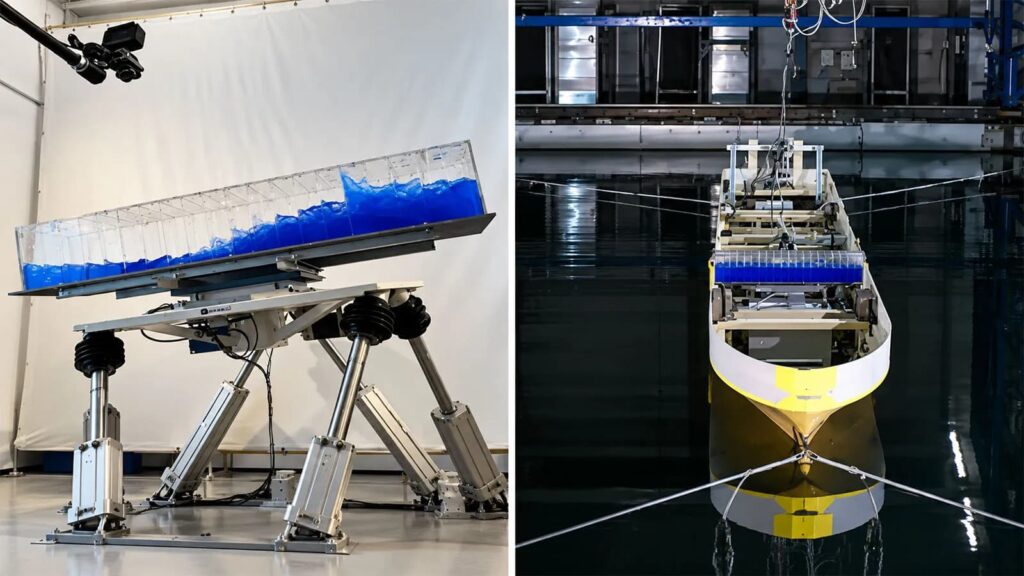
Roll damping tanks are not new, passenger ferries and research vessels have used them for decades. When a ship rolls violently in rough seas, the forces on container stacks and securing systems spike, increasing the risk of lost or damaged cargo.
Yet until now, the performance of RDTs on large container ships has been evaluated primarily through model tests and computer simulations. Full-scale verification using onboard measurements from actual voyages has been rare, leaving operators with limited data on how these systems perform in real-world conditions.
The research aims to fill this gap. ONE will provide operational data from its vessels, while ClassNK will apply its expertise in numerical simulation and technical analysis to assess how well RDTs reduce rolling motions. The goal is not just to measure performance but to establish a reliable methodology for evaluating RDTs under actual sea conditions, which could set a new standard for the industry.
How Roll Damping Tanks Work, and Why They’re Hard to Measure
Roll damping tanks operate on a simple principle: liquid inside a tank moves in opposition to the ship’s rolling motion, creating a counterforce that stabilizes the vessel. The challenge lies in fine-tuning the system.
“Model tests are useful, but they can’t capture the full complexity of real-world operations,” said Kumi Miyashita, Corporate Officer at ClassNK. “By combining full-scale measurement data with our numerical analysis, we aim to establish a reliable basis for evaluating RDT performance under actual operating and sea conditions.”
“We are pleased to work with ONE to verify the effectiveness of RDTs based on data obtained from actual vessel operations. Through the combination of full-scale measurement data and numerical analysis, we aim to contribute to safer and more efficient vessel operations by establishing a reliable basis for evaluating RDT performance under actual operating and sea conditions.”
Kumi Miyashita·Corporate Officer, ClassNK
Masaharu Urabe, Vice President of Global Vessel Operations at ONE, echoed this sentiment, emphasizing the practical benefits of the research. “By combining ONE’s onboard operational data with ClassNK’s advanced technical analysis, we aim to establish a practical methodology for quantifying the effectiveness of RDTs under actual operating conditions,” he said. “We believe that the knowledge gained through this research will further enhance the safety of our vessel operations while contributing to improved container stowage efficiency and loading capability.”
“We are pleased to collaborate with ClassNK on this important research initiative. By combining ONE’s onboard operational data with ClassNK’s advanced technical analysis, we aim to establish a practical methodology for quantifying the effectiveness of RDTs under actual operating conditions. We believe that the knowledge gained through this research will further enhance the safety of our vessel operations while contributing to improved container stowage efficiency and loading capability.”
Masaharu Urabe·Vice President of Global Vessel Operations, Ocean Network Express
What’s Next for the Research, and the Industry
The research is still in its early stages, but the implications are far-reaching. If successful, it could lead to wider adoption of RDTs across the container shipping industry, particularly as carriers face increasing pressure to improve safety and reduce cargo losses. The International Maritime Organization (IMO) has already flagged container losses as a growing concern, with incidents rising in recent years due to larger ships and more extreme weather patterns.
For ONE, the research is part of a broader strategy to enhance operational safety and efficiency. The company, formed in 2017 through the merger of three Japanese carriers, has quickly grown into one of the world’s largest liner shipping companies, with a fleet of over 280 vessels. Its commitment to innovation, including this RDT study, reflects a recognition that safety and efficiency are increasingly intertwined in the modern maritime industry.
ClassNK, meanwhile, brings decades of experience in ship classification and technical analysis. As a leading classification society, it plays a critical role in setting safety standards for the industry. Its involvement in this research underscores the importance of the project and the potential for its findings to influence future regulations and best practices.
The research also comes at a time when the maritime industry is under growing scrutiny over its environmental and safety record. Container losses, in particular, have drawn attention from regulators and insurers, who are pushing for stricter measures to prevent incidents. If RDTs prove effective in reducing rolling motions, they could become a key tool in addressing these concerns, offering a relatively low-cost solution to a persistent problem.
For shippers and cargo owners, the research could bring welcome reassurance. Container losses not only result in financial losses but can also disrupt supply chains, leading to delays and higher costs. A proven method for reducing rolling motions could help mitigate these risks, making voyages safer and more predictable.
As the research progresses, ONE and ClassNK plan to share their findings with the broader maritime community. While the initial focus is on ONE’s fleet, the insights gained could benefit the entire industry, helping to shape a safer and more efficient future for container shipping.
The next phase of the research will involve collecting and analyzing data from a subset of ONE’s vessels over the coming months. The results are expected to be published in a technical report, which could serve as a benchmark for future studies and industry standards. For now, the maritime world will be watching closely, eager to see whether roll damping tanks can live up to their promise.


Sign up free to ask CAMAL AI for a summary, the key points or anything else about this story.
Related stories
CAMAL AI
 Financial Ports Newsletter
The maritime economy, every morning
Ports, shipping and freight markets in one short email. Free.
Financial Ports Newsletter
The maritime economy, every morning
Ports, shipping and freight markets in one short email. Free.



