

Red Sea escort shortage leaves 140 boxships stranded in Houthi crosshairs
EU’s Aspides mission admits it lacks frigates to protect merchant vessels queuing at Bab el-Mandeb
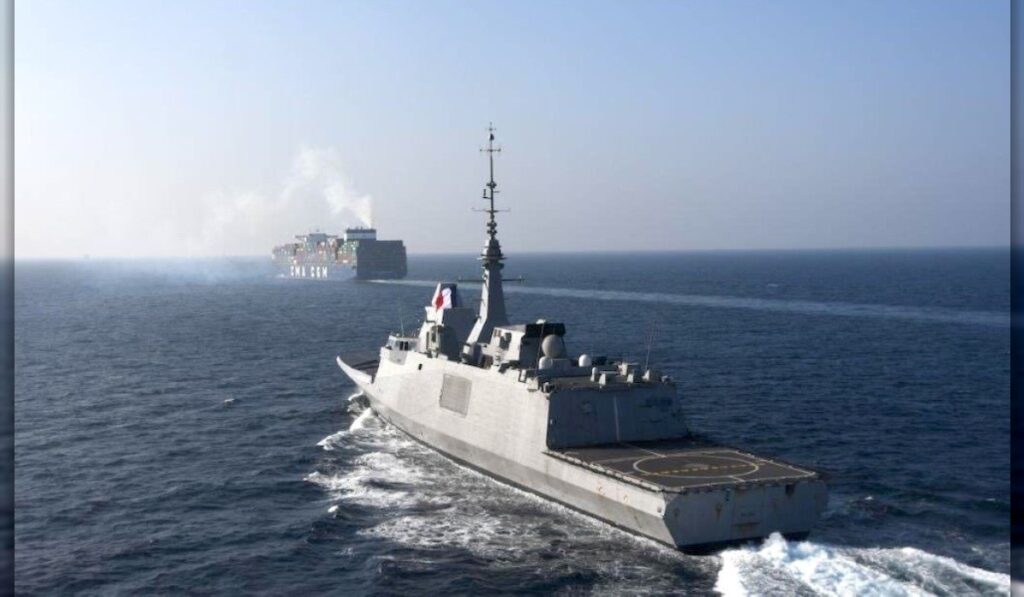
The European Union’s naval mission in the Red Sea is struggling to keep pace with demand for merchant vessel escorts, as Houthi attacks intensify and available warships fall short of requirements.
EU foreign policy chief Kaja Kallas acknowledged the shortfall during a meeting of European defence ministers in Brussels on Monday, stating that commercial ships are now queuing for protected passage through the southern Red Sea. The Aspides mission, launched in February 2024 to defend shipping from Houthi strikes, was initially assessed as needing at least 10 frigates—but current deployments remain well below that number.
“There are commercial ships waiting in the queue to receive the escort,” Kallas said, confirming that the EU lacks sufficient vessels to meet the demand. The situation has worsened since July, when Houthi forces resumed attacks on Saudi-linked ships and seized Perim Island, a strategic position overlooking the Bab el-Mandeb strait.
Containerships have increasingly returned to the Suez route, with consultancy Linerlytica reporting that more than 140 boxships, carrying over 2 million TEU in total capacity, have transited the canal since May. Last week marked the busiest period for Suez transits in 2024, with 30 vessels exceeding 4,000 TEU passing through.
Strained resources and unilateral action: Red Sea
The Aspides mission relies primarily on contributions from Italy and Greece, with periodic support from Germany, France, Spain, the Netherlands, and Belgium. However, the escalating security threat has exposed gaps in the operation’s capacity.
Italy, a key contributor, has already taken independent steps to secure its flagged vessels. Earlier this month, Rome prepared to act unilaterally rather than wait for Aspides to arrange escorts for Italian-linked ships. At the time, around 10 Italian-controlled or flagged vessels were reported to be awaiting protected passage.
Italian Defence Minister Guido Crosetto announced this week that two minehunters deployed in Djibouti—ITS Crotone and ITS Rimini—would return to Italy for maintenance and crew rotation. The vessels, part of the Aspides mission to reduce mine-clearance response times in the Strait of Hormuz, will be replaced by similar ships. Crosetto framed the move as a necessary rotation to “ensure the long-term efficiency, maintenance, and operational availability of our ships, without interruption in the activities carried out by Italy as part of the European mission.”
Kallas indicated that two unnamed EU countries may provide additional ships, though Brussels is specifically seeking frigates with enhanced air-defence capabilities, rather than merely increasing the number of vessels. The EU’s call for reinforcements reflects the growing challenges in securing one of the world’s most critical maritime chokepoints.
For now, shipowners face a difficult choice: wait for an escort and endure delays, or attempt the transit unprotected and risk Houthi attacks.


Sign up free to ask CAMAL AI for a summary, the key points or anything else about this story.
Related stories
CAMAL AI
 Financial Ports Newsletter
The maritime economy, every morning
Ports, shipping and freight markets in one short email. Free.
Financial Ports Newsletter
The maritime economy, every morning
Ports, shipping and freight markets in one short email. Free.



