

US Navy Eyes Foreign Frigates to Slash Warship Build Time
Washington considers South Korean, Japanese and Turkish designs to accelerate fleet modernisation.
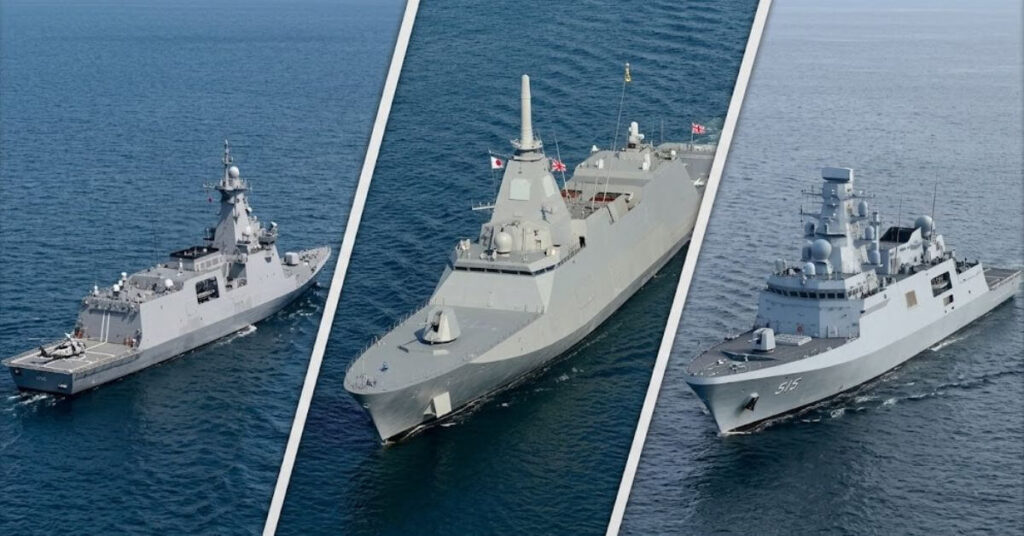
The U.S. defence procurement and could see the first vessels built overseas before production shifts to American yards.
The designs under review include South Korea’s Chungnam-class, Japan’s export version of Mitsubishi Heavy Industries’ FFM Mogami-class, and Türkiye’s Istanbul-class guided-missile frigates. Turkish leaders option gained traction after leaders from Ankara discussed it with President Donald Trump during the NATO summit in July. The White House subsequently issued a memorandum invoking a “national security interest” waiver, allowing the Pentagon to consider foreign designs despite laws restricting foreign-built warships from U.S. naval service.
The Navy’s current Arleigh Burke-class destroyers, designed for high-end naval warfare, are often deployed for routine missions that could be handled by less sophisticated frigates.
HD Hyundai Heavy
Acting Secretary of the Navy Hung Cao has directed a study, overseen by Assistant Secretary of the Navy for Research, Development and Acquisition William Mahan, to evaluate international combatants, ro/ro cargo vessels, and replenishment tankers. The study, due on Nov. 12, 2026, could pave the way for a hybrid procurement model known as the “Finland model”.
Under this approach, the first one or two ships would be built at a foreign shipyard, with foreign companies investing in U.S. shipbuilding facilities before production moves stateside. The U.S. Coast Guard is already using a similar strategy for its Arctic Security Cutter programme, where Finnish shipyards are building the first hulls based on Canadian designs.
South Korea’s $150bn Bet on U.S. Shipbuilding: Navy
South Korea’s Chungnam-class frigate is one of the frontrunners in the Navy’s review. The country is currently building six of these vessels, with HD Hyundai Heavy Industries constructing the lead ship, while SK Oceanplant and Hanwha Ocean are building three and two respectively.
Seoul’s involvement in the U.S. Navy’s plans extends beyond design. Last year, South Korea committed $150bn to the U.S. shipbuilding sector as part of a $350bn bilateral trade and investment deal. The pledge underscores the deepening ties between the two nations’ defence industries, with U.S. officials from both the Biden and Trump administrations visiting South Korean shipyards to explore collaboration opportunities.
Both designs have been tailored for export markets, making them strong candidates for the U.S. Navy’s requirements.
The Constellation-class, based on the Italian-French FREMM multi-purpose frigate, was being built by Fincantieri Marinette Marine in Wisconsin.
However, political hurdles remain. The Senate Armed Services Committee’s draft defence policy bill for fiscal 2027 removed the national-security waiver, while the House Armed Services Committee included an amendment to block funds for contracts to buy a U.S. warship built at a foreign shipyard.
The debate over foreign-built warships reflects broader tensions in U.S. defence procurement. Proponents argue that leveraging foreign designs and shipyards could reduce costs and accelerate delivery, while critics warn of risks to domestic shipbuilding jobs and technological sovereignty. The outcome of the study, due in November, will be closely watched by industry stakeholders and lawmakers alike.
For the U.S. Navy, the stakes are high. The service needs a frigate that can handle routine missions, freeing up larger destroyers for high-end warfare. Whether the solution comes from South Korea, Japan, Türkiye, or a hybrid approach, the decision will shape the future of U.S. naval power for decades to come.


Sign up free to ask CAMAL AI for a summary, the key points or anything else about this story.
Related stories
CAMAL AI
 Financial Ports Newsletter
The maritime economy, every morning
Ports, shipping and freight markets in one short email. Free.
Financial Ports Newsletter
The maritime economy, every morning
Ports, shipping and freight markets in one short email. Free.



