

Ancient Blockades Echo in Modern Naval Warfare
Four Mediterranean sieges from antiquity reveal enduring challenges of maintaining sea control and supply lines.
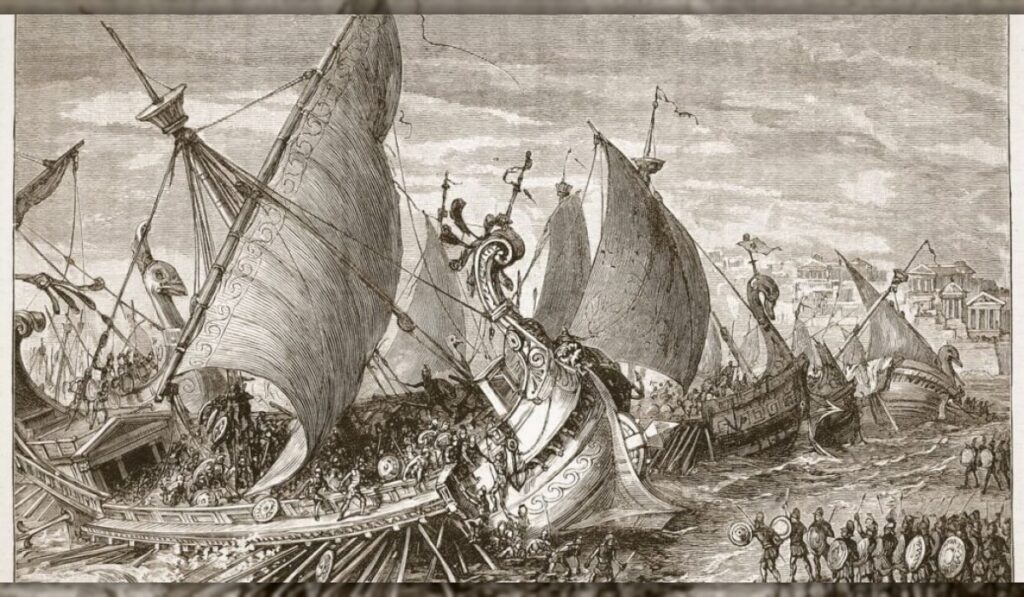
Nearly a century after Rear Admiral William A. Moffett highlighted the parallels between ancient and modern sea power, naval strategists continue to dissect historical blockades for lessons applicable to today’s conflicts. From the U.S.
The British naval theorist Julian Corbett drew a critical distinction between two types of blockade: commercial and naval. The former aims to strangle an enemy’s maritime trade, while the latter targets the adversary’s fleet, either confining it to port or luring it into battle. Though Corbett’s framework emerged from more recent naval history, its principles were already evident in antiquity. Ancient fleets, like their modern counterparts, sought to disrupt supply lines, contain hostile forces, or force engagements at sea.
The Theory Behind Naval Blockades
Dr. Stephen DeCasien, Dr. Stephen DeCasien at CIMSEC, underscores this continuity in a recent analysis for the Center for International Maritime Security (CIMSEC). “Establishing control of the sea is one thing,” DeCasien writes, “but maintaining that control long enough to achieve a political or military objective is another.” His examination of four ancient Mediterranean blockades, Samos (440, 439 BCE), Syracuse (413 BCE), Rhodes (305, 304 BCE), and Lilybaeum/Drepana (250, 249 BCE), reveals recurring vulnerabilities that persist in contemporary naval operations.
The Athenian blockade of Samos in 440, 439 BCE serves as a stark reminder of how quickly maritime dominance can unravel. After Samian exiles overthrew the Athenian-backed government and revolted, Athens dispatched a fleet of 60 ships under the command of Pericles. Reinforced by vessels from allies Chios and Lesbos, the Athenians encircled Samos by land and sea, constructing three walls to isolate the city.
Yet the operation’s success hinged on the Athenians’ ability to maintain their force on station. When reports surfaced of a Phoenician fleet approaching to assist the Samians, Pericles diverted 60 ships, 60 ships, to intercept the threat near Caunus and Caria. The move left the blockade critically weakened. Seizing the opportunity, the Samians attacked the Athenian naval station, destroyed guard ships, and defeated the remaining vessels.
For 14 days, they “controlled the sea in their area” (τ?ς θαλ?σσης τ?ς καθ?αυτο?ς?κρ?τησαν) and “brought in and carried out whatever they wished” (?σεκομ?σαντο κα?ξεκομ?σαντο?βο?λοντο), as Thucydides records. The episode underscores a timeless dilemma: blockades demand sustained force projection, but fleets are often stretched thin by competing priorities.
Samos: The Fragility of Force Projection
Ultimately, the Athenians reasserted control, and after a prolonged blockade, Samos surrendered.
Initially, the Athenians blockaded Syracuse by land and sea, occupying the strategic position of Plemmyrium at the entrance to the city’s Great Harbor.
Deprived of room to maneuver, the Athenians were systematically destroyed. Today, similar dynamics play out in discussions of a Chinese blockade of Taiwan, where the island’s proximity to the mainland and its dense coastal geography could complicate traditional naval operations.
The year-long blockade of Rhodes by Demetrius Poliorcetes in 305, 304 BCE illustrates how external support can sustain a besieged city. Demetrius, commanding Antigonid forces, sought to isolate Rhodes, a key maritime power described by Diodorus Siculus as “possessing considerable naval strength” (?σχ?ουσα ναυτικα?ς δυν?μεσι). Yet Rhodes was far from alone. Ptolemy I of Egypt, along with the outside powers Cassander and Lysimachus, supplied the city with food, reinforcements, and military aid.
Despite Demetrius’ efforts, the blockade failed to fully strangle Rhodes. After a year, he settled for terms that preserved the city’s autonomy and its relationship with Ptolemy. The episode highlights a critical vulnerability in blockade strategy: even the most robust naval cordon can be undermined by external alliances. In the modern Indo-Pacific, Taiwan’s reliance on U.S. and allied support mirrors Rhodes’ dependence on its benefactors, raising questions about the long-term viability of a Chinese blockade.
The Roman blockade of Lilybaeum and Drepana during the First Punic War (250, 249 BCE) reveals the challenges of sustaining a siege in the face of determined resistance. Rome’s initial strategy was straightforward: blockade Lilybaeum, a Carthaginian stronghold on Sicily’s western coast, and starve it into submission.
Yet Carthage repeatedly ran supplies and troops into the city, exploiting gaps in the Roman cordon. The Romans’ fortunes took a dramatic turn at Drepana, where the Carthaginian commander Adherbal outmaneuvered the Roman consul Publius Claudius Pulcher. In a disastrous engagement, the Carthaginians captured 93 Roman vessels, with only ~30 escaping alongside Claudius.
The defeat forced Rome to abandon its blockade strategy and shift focus to North Africa. The campaign’s failure underscored the difficulty of maintaining a blockade against a determined adversary with access to external supply lines, a lesson that remains relevant in contemporary discussions of maritime choke points like the Strait of Hormuz or the Taiwan Strait.
The ancient Mediterranean blockades offer more than historical curiosities; they provide a framework for understanding modern naval challenges. The U.S. blockade of Iran, for instance, mirrors the Athenian struggle to maintain force projection over extended periods, while the potential Chinese blockade of Taiwan echoes the Syracusan adaptation to confined waters. Meanwhile, Rhodes’ reliance on external allies and Carthage’s ability to run supplies into Lilybaeum highlight the enduring importance of supply chains and international support in sustaining, or breaking, a siege.
As Rear Admiral Moffett observed nearly a century ago, the problems of sea power in antiquity bear a striking resemblance to those of today. The tools and technologies may have evolved, but the fundamental challenges, maintaining control, adapting to local conditions, and sustaining supply lines, remain as pressing as ever. For naval strategists, the past is not merely prologue; it is a blueprint for the future.


Sign up free to ask CAMAL AI for a summary, the key points or anything else about this story.
Related stories
CAMAL AI
 Financial Ports Newsletter
The maritime economy, every morning
Ports, shipping and freight markets in one short email. Free.



