

140-Ton Lift Gone Wrong: Mumbai Port Fire Injures Two Crane Operators
A failed cargo strap during a 140-metric-ton lift caused a truck crane to topple.
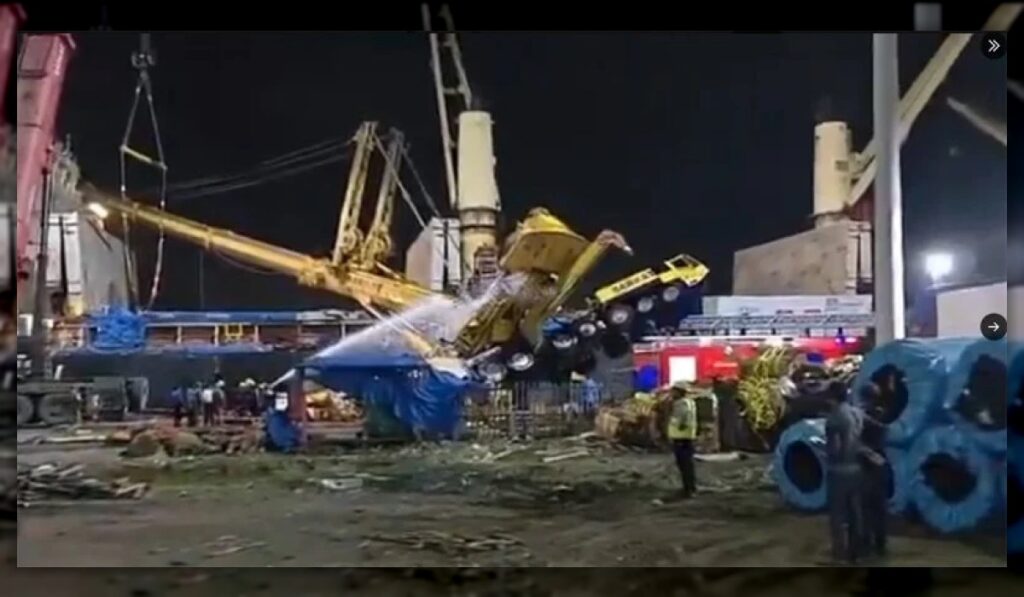
A routine heavy-lift operation at Mumbai Port turned into a dangerous fire after a cargo strap failed, sending a 140-metric-ton load crashing into a truck crane and injuring two operators. The incident, which occurred at 7:30 p.m.:30 p.m.
The accident unfolded during the unloading of the Barbados-flagged bulker Vienna, a 52,224-dwt vessel that had arrived from China several days earlier. Two mobile cranes operated by Barkat Company were engaged in lifting the 140-tonne cargo when one of the securing straps slipped or failed, destabilising the load. The sudden shift in weight caused one crane to lose balance, toppling onto its side and colliding with the second crane.
Images from the scene showed the crane’s boom striking the Vienna’s hull, though the extent of damage to the vessel remains unclear. The Mumbai Port fire brigade responded swiftly, bringing the blaze under control within minutes, but not before two workers, Ranjit Singh and Nishant Singh, both employed by Barkat Crane, suffered injuries.
How the Mumbai Port Crane Collapse Unfolded
The sequence of events highlights the risks inherent in heavy-lift operations, particularly when multiple cranes are involved. According to officials, the cargo was being transferred from the Vienna to the dock when the strap securing the load on one crane became unbalanced. As the weight shifted, the crane’s telescopic boom swung violently, lifting the entire vehicle off the ground before it crashed onto the pier. The second crane, unable to compensate for the sudden load transfer, was dragged into the collision.
The resulting fire, though brief, posed an immediate threat to both personnel and infrastructure. Witnesses reported seeing one operator lying on the ground while colleagues rushed to assist the second, who was later escorted away. Both men were transported to St.
Safety Protocols Under Scrutiny After Mumbai Port Incident
The accident has prompted a review of safety measures governing heavy-lift operations at Mumbai Port. Mumbai Police have launched an investigation into whether existing protocols were followed and whether any breaches contributed to the failure.
Barkat Company, the firm responsible for the cranes, has not issued a public statement regarding the incident.
The Vienna, a Chinese-owned bulker, remained alongside the pier while authorities assessed the damage to both the vessel and the dock.
For Mumbai Port, the accident comes at a time of increasing scrutiny over safety standards in India’s maritime sector. The port, which handles over 60 million tonnes of cargo annually, has invested heavily in modernisation in recent years, but incidents like this one highlight the need for ongoing vigilance. The Mumbai Port Trust, the statutory body overseeing the port’s operations, is expected to release a preliminary report on the incident in the coming days, though a full investigation could take weeks.
In the meantime, the focus remains on the injured workers and the recovery of normal operations. The port’s fire brigade has been praised for its rapid response, which prevented the fire from spreading to nearby fuel storage or cargo. However, the incident has reignited calls for stricter enforcement of safety regulations, particularly in high-risk areas like heavy-lift operations. For the families of Ranjit Singh and Nishant Singh, the coming days will be critical as they await updates on their loved ones’ conditions.
The broader implications of the accident extend beyond Mumbai Port. Heavy-lift operations are a common feature of global shipping, particularly in ports handling bulk cargo. The failure of a single component, a cargo strap, a crane stabiliser, or a load-bearing mechanism, can disrupt operations, damage vessels, and, in the worst cases, endanger lives. As the investigation progresses, industry stakeholders will be watching closely to determine whether the incident was an isolated failure or a symptom of systemic issues in port safety management.
For now, cargo operators and shipping companies using Mumbai Port are advised to review their own safety protocols and ensure that all lifting equipment is inspected regularly. The port’s authorities have not indicated whether additional safety measures will be implemented in the wake of the accident, but the incident is likely to prompt a broader conversation about risk management in India’s maritime sector. As one industry insider noted, “In an environment where margins are tight and turnaround times are critical, safety cannot be an afterthought.”


Sign up free to ask CAMAL AI for a summary, the key points or anything else about this story.
Related stories
CAMAL AI
 Financial Ports Newsletter
The maritime economy, every morning
Ports, shipping and freight markets in one short email. Free.
Financial Ports Newsletter
The maritime economy, every morning
Ports, shipping and freight markets in one short email. Free.