

55 Deaths in a Decade: Why US Ports Still Can’t Tame Marine Fires
A GAO report reveals 886 nearshore fires in a decade, with a quarter classified as serious.
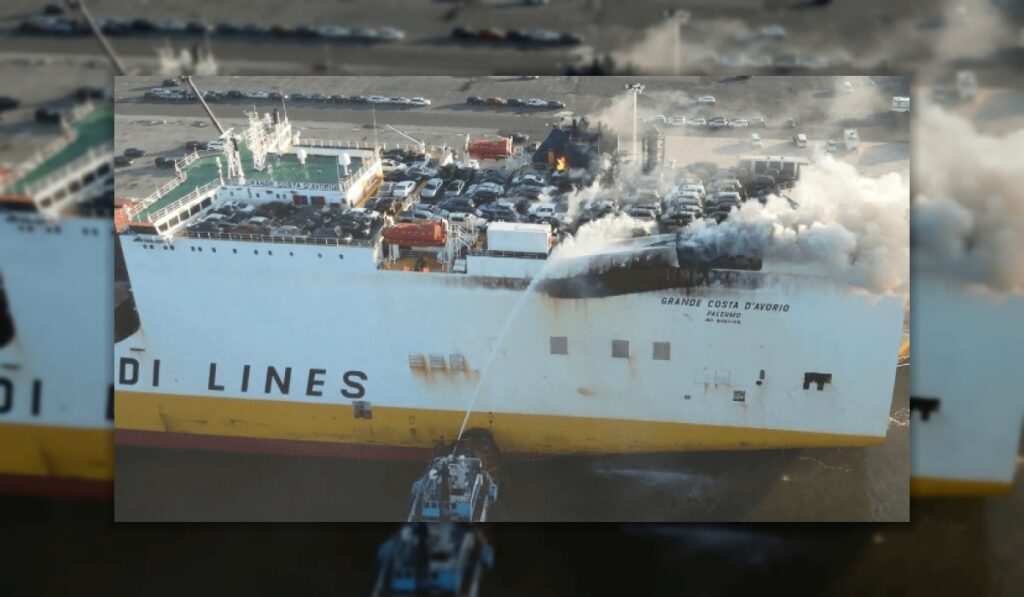
The U.S. Coast Guard has made progress in addressing marine firefighting challenges, but critical gaps remain, leaving ports and crews vulnerable to deadly blazes. A new report by the Government Accountability Office (GAO) reveals that 886 nearshore marine fires occurred between 2015 and 2025, with about a quarter classified as serious, resulting in 55 deaths, including land-based firefighters.
Marine fires pose unique hazards, from vessel instability to tight onboard spaces, requiring specialised resources that many ports lack. The GAO report highlights systemic issues, including limited training for firefighters, funding constraints, and delayed activation of vessel response plans. These challenges were starkly illustrated in 2023 when two Newark firefighters died responding to a fire on a large vehicle cargo vessel, prompting the Coast Guard to establish a task force.
Training Gaps Leave Firefighters Ill-Prepared for Marine Blazes: Marine Fires
The Coast Guard has taken steps to standardise marine firefighting plans and develop tools for rapid information sharing. However, training remains a significant hurdle. While the agency partnered with an emergency response organisation to create online training videos, Coast Guard officials and fire chiefs agree that hands-on training, such as vessel tours and exercises with “boots on boats”, is essential for preparing firefighters to tackle complex marine fires.
It is responsible for maritime safety, security, and environmental stewardship, including responding to marine fires.
Budget constraints further exacerbate the problem. Fire chiefs in four ports told the GAO that justifying the cost of formal marine firefighting training is difficult. Tuition for a 5-day course may be $500 per firefighter, but the total cost, including lodging and overtime, can reach $6,000. Additionally, some fire departments lack critical resources, such as fireboats and water pumps, to mount effective responses. While federal Port Security Grant funds have been used to address these issues in the past, the GAO made recommendations in September 2025 to improve the program.
Vessel Response Plans Fall Short for Alternative-Fuel Ships
Another critical gap lies in vessel response plans. The Coast Guard found that vessel owners or operators often delay activating these plans, adopting a “wait and see” approach until situations deteriorate. Yet, the agency has not provided more detailed guidance on when to activate these plans, such as specifying fire scenarios that warrant immediate action.
The rise of vessels using alternative fuels, such as lithium-ion batteries or ammonia, adds another layer of complexity. The GAO report warns that the Coast Guard’s existing regulations do not require response plans for certain alternative-fuel vessels, leaving firefighters unprepared. Representatives of resource providers said they could not respond to fires on such vessels for 3 to 4 days while contract details were finalised. One fire chief cautioned that land-based firefighters may not be trained for these hazards, risking career-ending injuries.
“Land-based firefighters may not be trained for the hazards associated with vessels using alternative fuels, which could lead to career-ending injuries.”
Unnamed Fire Chief·Fire Department Leader
The GAO has recommended that the Coast Guard engage with fire departments and maritime stakeholders to coordinate shipboard training opportunities. It has also urged Congress to amend the law to ensure vessels using alternative fuels prepare vessel response plans. Until these gaps are addressed, the risks to crews, passengers, and firefighters will persist.
For port operators, shipping companies, and firefighters, the implications are clear: without updated training and response protocols, the maritime industry faces heightened risks. The Coast Guard’s task force, formed after the 2023 Newark incident, has developed guidance for standardising marine firefighting plans, but implementation remains uneven across U.S. ports. Fire departments in major hubs like four ports GAO spoke with have begun integrating marine-specific drills into their training regimens, but smaller ports often lack the resources to follow suit.
Stakeholders can track updates on the Coast Guard’s initiatives through its official website, www.uscg.mil, which provides guidance on vessel response plans and training resources. The GAO’s full report, including its recommendations to Congress, is available on the agency’s website, www.gao.gov. For fire departments seeking funding, FEMA’s Port Security Grant Program details can be found at www.fema.gov/grants/preparedness/port-security.


Sign up free to ask CAMAL AI for a summary, the key points or anything else about this story.
Related stories
CAMAL AI
 Financial Ports Newsletter
The maritime economy, every morning
Ports, shipping and freight markets in one short email. Free.
Financial Ports Newsletter
The maritime economy, every morning
Ports, shipping and freight markets in one short email. Free.



