

Logistics AI Hits a Wall: Why 55% Accuracy Isn’t Good Enough
General AI models struggle with spatial reasoning, leaving truck routing and real-world execution in the lurch.
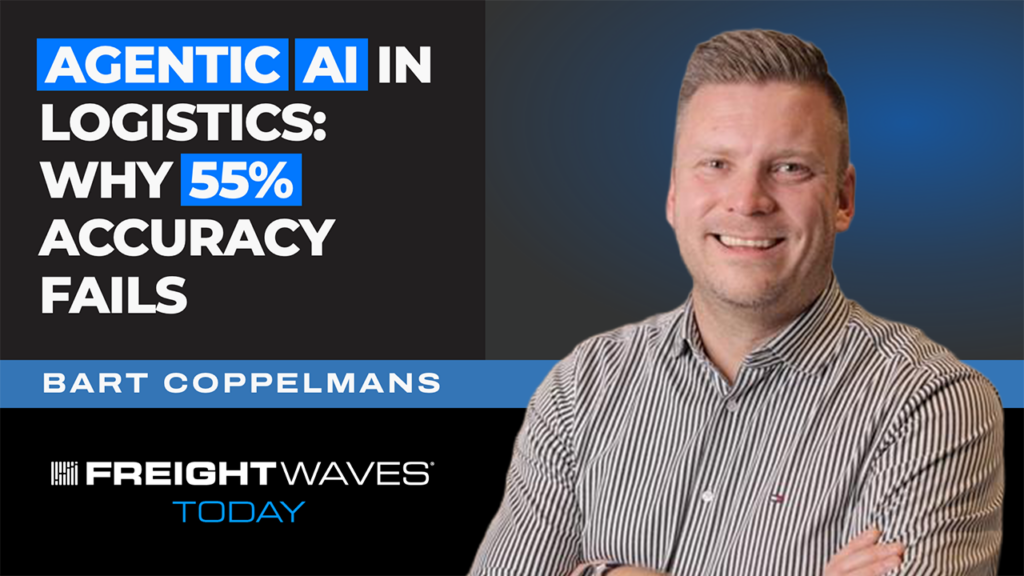
HERE Technologies’ Bart Coppelmans warns that without embedded location intelligence, agentic AI in freight will remain a liability rather than a solution.
Coppelmans, Head of Enterprise Product at HERE Technologies, highlights a fundamental flaw in frontier AI models: while they excel at processing language, they lack the spatial reasoning required for real-world logistics. Tasks as routine as rerouting low-clearance trucks around bridge restrictions or identifying available truck parking become insurmountable challenges without a dense web of location-specific data.
HERE’s own datasets, built over decades, include more than 800,000 truck-specific data points, covering tolls, road restrictions, and permitted routes, details that general AI models simply do not carry.
Why General AI Fails in Logistics: Logistics AI
The disconnect between AI’s language capabilities and its spatial limitations is stark. Coppelmans explains that while a model might generate a seemingly optimal route based on text-based instructions, it will fail to account for real-world constraints like port congestion, traffic bottlenecks, or low-clearance bridges. “If you haven’t connected the model and the graph of the location and geospatial model underneath, then it starts really hallucinating dramatically across your responses and outcomes,” he warns.
HERE Technologies’ solution is to embed location intelligence at the foundation of AI-driven logistics workflows. The company’s approach goes beyond static mapping, creating a feedback loop that captures real-time driver input from the field. This data is then routed back to planners, enabling dynamic adjustments to routes and schedules. “We see it also not as an automation journey.
From Static Planning to Dynamic Orchestration
The shift from static planning to dynamic orchestration is critical for modern logistics. Traditional transport management systems rely on pre-set routes and schedules, which often collapse when faced with real-time disruptions like accidents, weather, or unexpected congestion. HERE’s system aims to bridge this gap by integrating driver feedback, live traffic data, and geospatial constraints into a single “transportation intelligence” engine.
This engine doesn’t just optimize for cost, it balances compliance, risk, safety, and sustainability. For example, a fleet manager might prioritize routes that avoid high-risk areas or reduce carbon emissions, while still meeting delivery deadlines. The system’s ability to adapt in real time ensures that plans remain viable even as conditions change.
For logistics operators, the benefits of dynamic orchestration extend beyond efficiency. The system also enhances driver safety by avoiding high-risk routes and ensuring compliance with hours-of-service regulations, which are critical for preventing fatigue-related accidents.
Coppelmans also points to the next frontier for logistics AI: multi-agent collaboration. This involves connecting AI agents across organizational boundaries, such as between dispatchers, warehouse operators, and drivers, to create a seamless, end-to-end logistics network.
The goal is to eliminate silos and enable faster, more informed decision-making. For instance, if a warehouse experiences a delay in loading, the system can automatically adjust the driver’s schedule and reroute other shipments to minimize disruptions. This level of coordination is essential for industries like retail and manufacturing, where just-in-time delivery is a cornerstone of operations.
HERE Technologies’ vision for multi-agent collaboration goes beyond internal logistics. The company is exploring ways to integrate its platform with external partners, such as ports, customs agencies, and third-party logistics providers, to create a truly interconnected supply chain.
This would allow for real-time updates on port congestion, customs delays, or even geopolitical disruptions, enabling operators to proactively adjust their plans. Such a system could prove invaluable in scenarios like the Suez Canal blockage or the COVID-19 pandemic, where global supply chains faced unprecedented challenges.
For logistics operators, the message is clear: general AI models alone are not enough. To unlock the full potential of agentic AI, location intelligence must be woven into the fabric of logistics workflows. Without it, fleets will continue to grapple with inefficiencies, delays, and avoidable costs, all while competitors leverage smarter, more adaptive systems.
As the industry moves toward this future, logistics providers must consider how to integrate location intelligence into their existing workflows. HERE Technologies offers a range of solutions, from APIs that can be embedded into transport management systems to full-scale platform integrations.
Operators can start by identifying pain points in their current routing processes, such as frequent delays or compliance violations, and then explore how location-based AI can address these challenges. Training for dispatchers and drivers will also be critical, as the shift to dynamic orchestration requires a new way of thinking about route planning and execution.
For those looking to stay ahead of the curve, HERE Technologies provides resources and support through its official website, including case studies, white papers, and pilot programs. The company also hosts industry events and webinars to showcase the latest advancements in logistics AI, offering operators a chance to see the technology in action and connect with peers facing similar challenges.
As the industry evolves, one thing is certain: the role of human expertise will remain indispensable. AI may handle the data, but it will be up to operators to ensure that every decision aligns with the realities of the road, the vehicle, and the customer. The future of logistics lies in the seamless integration of technology and human judgment, where AI assists rather than replaces, and location intelligence forms the backbone of every decision.


Sign up free to ask CAMAL AI for a summary, the key points or anything else about this story.
Related stories
CAMAL AI
 Financial Ports Newsletter
The maritime economy, every morning
Ports, shipping and freight markets in one short email. Free.
Financial Ports Newsletter
The maritime economy, every morning
Ports, shipping and freight markets in one short email. Free.