

US-Mexico trade hits $94.8bn record—why Laredo can’t keep up
July’s $94.8bn two-way trade surged 27.5% year-on-year, but trucking bottlenecks at Laredo threaten the supply chain.
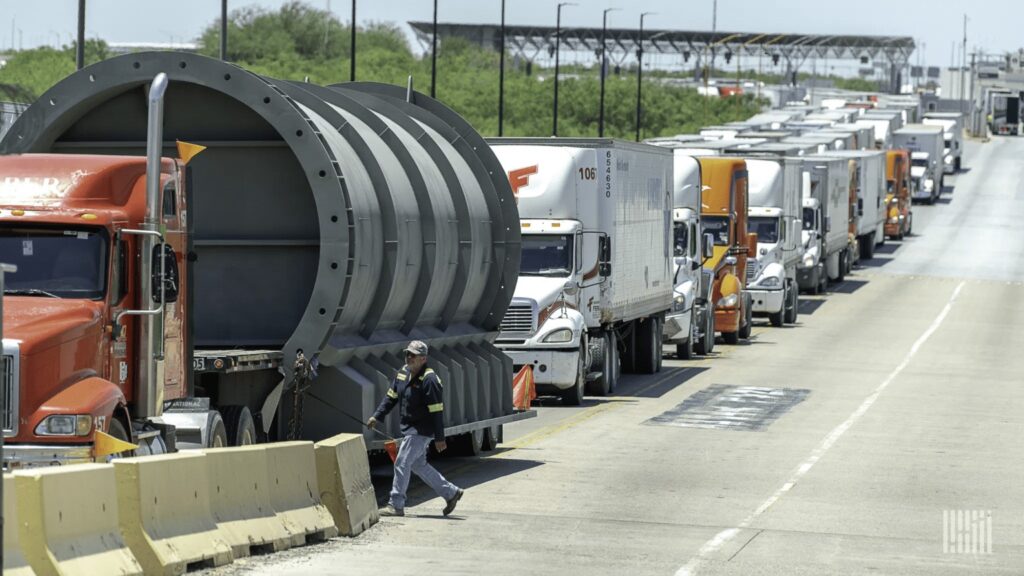
US-Mexico trade shattered records in July, surging to $94.8 billion, a 27.5% year-on-year increase, yet the boom is exposing critical bottlenecks at the nation’s busiest land port, Laredo, Texas.
The latest figures from the US Census Bureau, analysed by WorldCity, reveal Mexico’s dominance in US trade, now accounting for nearly 18% of America’s $530.37 billion in total international commerce for the month. The two-way trade total of $94.8 billion eclipses Canada’s $62.8 billion and China’s $36.8 billion, cementing Mexico’s position as the US’s top trading partner.
US exports to Mexico climbed 18.1% to $34.24 billion, while imports from Mexico soared 33.5% to $60.55 billion.
Laredo’s capacity crisis: the choke point in US-Mexico trade
Laredo, Texas, remained the busiest US trade gateway in July, handling $36.95 billion in two-way commerce, a 22% increase from the same month last year. South Texas hub processed $35.9 billion in US-Mexico trade alone, its strongest July on record since WorldCity began tracking data in 2013.
However, the surge is straining Laredo’s infrastructure. Laredo Van Outbound Tender Rejection Index, a measure of trucking capacity tightness, stood at 11.18% as of Wednesday.
Automotive freight dominates Laredo’s outbound traffic. Motor vehicle parts were the top export commodity in July at $1.31 billion, up 19.2% year-on-year. Diesel engine exports surged nearly 85% to $$433.8 millionlion, while motor vehicle engine exports rose 21% to $284.7 million.
The automotive sector’s reliance on Laredo underscores the port’s importance to regional supply chains.
Supply chain risks: tariffs, demand, and the road ahead
The record trade figures arrive as US supply chains face broader disruptions. Mexico benefits from nearshoring trends, driven by tariffs on Chinese goods and geopolitical tensions, analysts warn that infrastructure constraints could undermine growth. The US’s total international trade through July 2026 reached $3.51 trillion, up 6.2% year-on-year, with Mexico, Canada, and China retaining the top three spots.
The US-Mexico-Canada Agreement (USMCA), which replaced NAFTA in 2020, has further integrated the three economies, reducing trade barriers and fostering cross-border investment. However, the agreement’s rules of origin requirements, particularly for automotive products, have accelerated nearshoring as manufacturers seek to comply with stricter North American content rules.
Through the first seven months of 2026, US-Mexico commerce totalled $588.52 billion, a 16.1% increase from the same period last year. US exports to Mexico rose 16.6% to $229.82 billion, while imports climbed 15.8% to $358.71 billion. The figures reflect Mexico’s strategic advantage as a low-cost, high-efficiency manufacturing base for US industries, particularly in electronics, aerospace, and automotive sectors.
Yet, the concentration of trade through Laredo poses risks. Chicago O’Chicago O’Hare International Airport, the second-ranked US trade gateway in July, handled $36 billion, while the Port of Los Angeles, the third-ranked, processed $26.5 billion. While air and sea routes offer alternatives, land crossings like Laredo remain the backbone of US-Mexico commerce, handling over 60% of bilateral trade.
For businesses reliant on cross-border supply chains, the tight capacity at Laredo presents operational challenges. Shippers may need to adjust lead times, diversify routes, or increase inventory buffers to mitigate delays. The situation also highlights the need for long-term investments in infrastructure, including expanded bridge capacity, improved customs facilities, and upgraded rail connections.
The tight trucking capacity at Laredo could have ripple effects across industries. Shippers may face higher costs, delayed deliveries, and reduced flexibility, challenges that could dampen the benefits of nearshoring. As US-Mexico trade continues to grow, addressing infrastructure bottlenecks will be critical to sustaining the momentum.
For now, the record figures underscore Mexico’s pivotal role in US trade. But without investment in capacity, whether through expanded trucking fleets, improved port infrastructure, or streamlined customs processes, the supply chain risks becoming a victim of its own success. Stakeholders, including federal and local governments, as well as private sector players, must collaborate to ensure that Laredo’s infrastructure keeps pace with demand.
Looking ahead, the US Census Bureau will release August trade figures in early October, offering further insight into whether the July surge was a one-off or part of a sustained trend. For industries dependent on cross-border trade, the data will be closely watched, as it shapes expectations for the remainder of 2026 and beyond.


Sign up free to ask CAMAL AI for a summary, the key points or anything else about this story.
Related stories
CAMAL AI
 Financial Ports Newsletter
The maritime economy, every morning
Ports, shipping and freight markets in one short email. Free.
Financial Ports Newsletter
The maritime economy, every morning
Ports, shipping and freight markets in one short email. Free.