
Diesel surcharge benchmark smashes $6 barrier—what it means for shipping
US retail diesel prices hit an all-time high of $5.967/gallon, pushing freight costs to unprecedented levels.
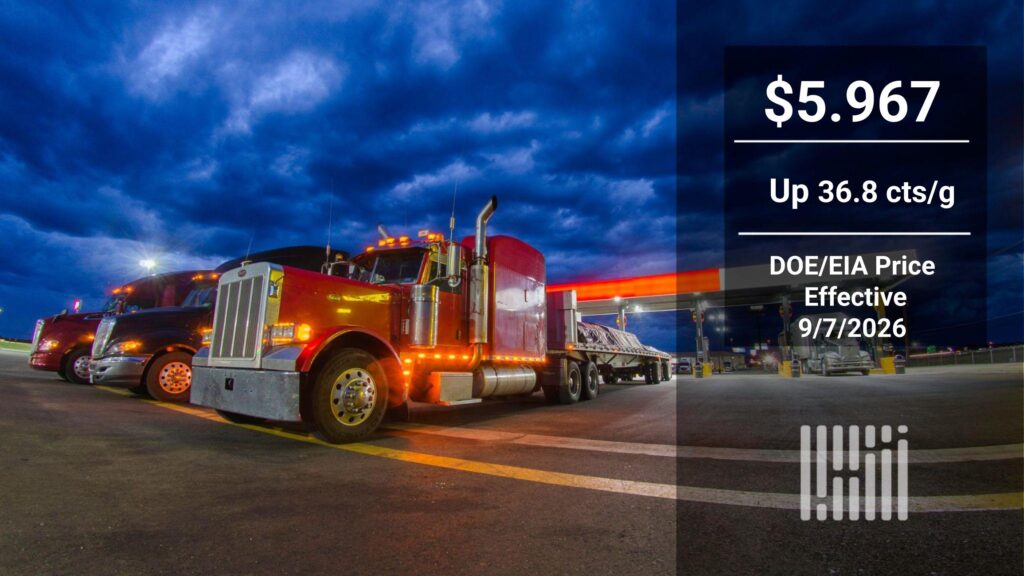
The benchmark for most freight fuel surcharges in the US has shattered records, with retail diesel prices hitting an all-time high of $5.967 per gallon, just cents away from the psychological $6 barrier. The surge, driven by tightening global supplies and geopolitical tensions, threatens to inflate shipping costs across the maritime and logistics sectors.
The latest figures from the Department of Energy (DOE) and Energy Information Administration (EIA), published on Wednesday but effective from Monday, show a 36.8-cent increase in the weekly average retail diesel price. This benchmark, used by carriers to calculate fuel surcharges, now stands at levels not seen since the aftermath of Russia’s invasion of Ukraine in June 2022, when prices peaked at $5.82/gallon.
Why the diesel market is spiralling out of control
The rally in diesel prices is not an isolated event. The DTS.USA data series, compiled by truckstop.com, recorded a near-identical price of $5.94/gallon on Wednesday, while the American Automobile Association (AAA) reported a daily average of $5.9424/gallon, another record. The trend has been relentless, with the AAA’s daily benchmark first surpassing its 2022 high on Friday, when it reached $5.85/gallon.
Brent Crude
The futures market for ultra-low sulphur diesel (ULSD) on the CME commodity exchange has mirrored this volatility. After a brief dip of around 15 cents late last week, ULSD settled at $4.8010/gallon on Wednesday, a 5.11% increase in a single day. Analysts warn that, barring a sudden reversal, the national average retail diesel price will breach $6/gallon within days.
The last time ULSD futures came close to these levels was in April 2022, when a short-covering rally pushed the settlement price to $5.1354/gallon, with intraday highs touching $5.85/gallon. That surge, however, was short-lived. This time, the fundamentals suggest the market may not be so forgiving.
Goldman Sachs sounds the alarm on oil and diesel
A recent report from Goldman Sachs has added fuel to the fire. The investment bank raised its year-end forecast for Brent crude to $85/barrel (up from $80) and its 2024 projection to $80/barrel (up from $75), citing persistent supply constraints. The report also highlighted potential upside risks, including the possibility of Brent hitting $120/barrel if Gulf output remains 4 million barrels per day (b/d) below pre-war levels, a scenario that now appears increasingly likely.
“You don’t have the insurance policies left anymore, and there’s no sign in sight that when you’re going to see a reopening of the Strait, whether it is 20 million b/d, or 15 going out.”
Jeffrey Currie·Former head of Goldman Sachs commodities research
Currie, now a senior advisor at Goldman, told CNBC that military action in the Arab Gulf has taken out 4 million b/d, with total production losses estimated at 4 million b/d. “All I care about is six to seven million barrels per day of production is shut in there,” he said. “That’s not going to change anytime in the near future.”
The drawdown of strategic petroleum reserves, particularly from the US Strategic Petroleum Reserve, has masked the severity of the supply crunch. Goldman’s report noted that commercial land inventories in OECD western economies have “barely drawn since the war began,” with most stock reductions coming from floating storage, strategic reserves, and China.
The implications for the shipping industry are stark. Fuel surcharges, already a significant cost for carriers, are poised to rise further, squeezing margins in an already competitive market. For container lines and bulk operators, the timing could not be worse, as peak season demand collides with soaring fuel costs.
The Environmental Protection Agency (EPA)’s push for cleaner fuels, including the transition to ultra-low sulphur diesel, has added another layer of complexity. While the shift reduces emissions, it also tightens supply, as refiners adjust to new standards. The result is a market where every barrel counts, and prices reflect that scarcity.
For now, the question is not whether diesel prices will hit $6/gallon, but how quickly. With Goldman Sachs warning of further upside risks and no immediate relief in sight, the maritime sector faces a challenging winter, one where fuel costs could dictate the fate of routes, charters, and even entire fleets.


Sign up free to ask CAMAL AI for a summary, the key points or anything else about this story.
Related stories
CAMAL AI
 Financial Ports Newsletter
The maritime economy, every morning
Ports, shipping and freight markets in one short email. Free.
Financial Ports Newsletter
The maritime economy, every morning
Ports, shipping and freight markets in one short email. Free.