

COSCO’s hidden spy gear claim: US officials allege China’s ships snoop
Washington officials accuse the world’s largest shipowner of concealing signals-intelligence equipment on commercial.
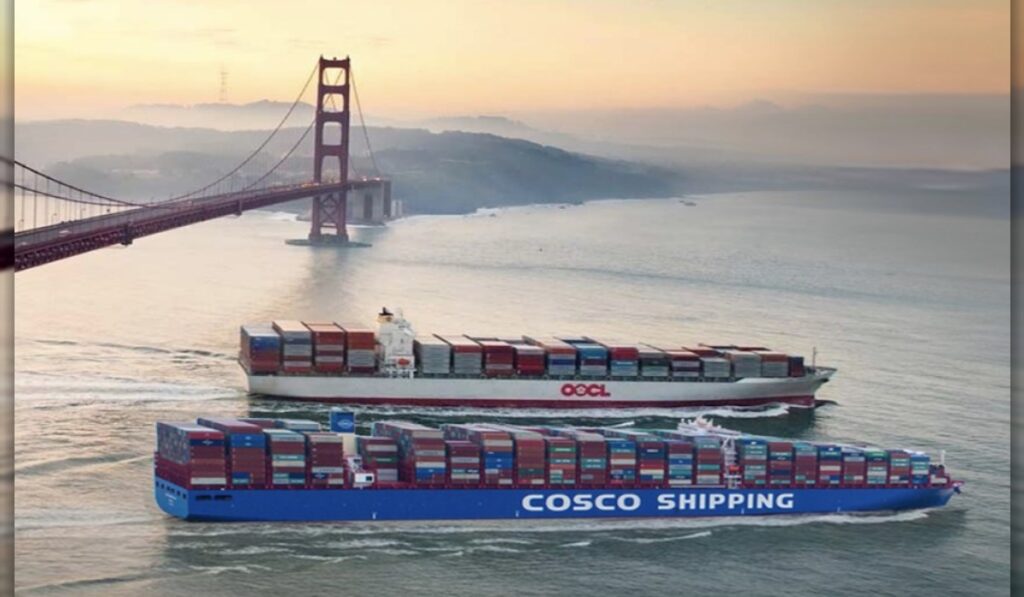
The world’s largest shipowner, COSCO, has dismissed as “totally unfounded” claims by US officials that its commercial vessels carry concealed signals-intelligence equipment to spy on military communications near coastlines in North America, Europe, and Asia.
The allegations, reported by Reuters, come from two senior US administration officials who spoke on condition of anonymity. The company, which is state-controlled, issued a sharp rebuttal, stating that all onboard systems are used solely for legitimate commercial purposes, including navigation safety and emergency response.
COSCO’s response: no spy gear, only commercial tools
In a statement, COSCO categorically denied the accusations, calling them “false” and emphasising that none of its equipment is designed to intercept military communications.
COSCO Shipping Holdings
“All communication, navigation, safety and operational equipment installed on our vessels is used solely for legitimate commercial purposes, including navigation safety, ship-to-shore communications and emergency response.”
COSCO·Company statement
The denial follows a pattern of heightened scrutiny from Washington. In 2019, US authorities forced the sale of the Long Beach Container Terminal after COSCO’s acquisition of Hong Kong’s OOIL, citing national security risks. The divestment, valued at $1.78bn, was completed under a national security agreement. The same year, Washington sanctioned two COSCO tanker units over their involvement in Iranian oil trades, triggering a spike in very large crude carrier (VLCC) rates before the measures were partly lifted.
COSCO’s position as the world’s largest shipowner by fleet size amplifies the geopolitical implications of these allegations. The company operates a vast network of vessels that traverse critical maritime chokepoints, including the Strait of Hormuz and the Red Sea, where military and commercial traffic often intersect.
Washington’s long-standing suspicions over COSCO’s ties to Beijing
Concerns over COSCO’s potential military links are not new. In the late 1990s, members of Congress raised alarms over the company’s proposed lease of a terminal at the former Long Beach Naval Station, arguing it posed intelligence risks. the Clinton administration administration, however, concluded the project did not threaten national security.
More recently, the Pentagon added COSCO to its list of companies with alleged ties to China’s military. Last year, the US USTR (USTR) targeted Chinese shipping and shipbuilding with port fee measures, a policy that could resurface this autumn.
The officials who spoke to Reuters did not provide evidence to support their claims, and COSCO has not been formally accused of wrongdoing. However, the accusations underscore the growing mistrust between the two superpowers, particularly in sectors where commercial and military interests overlap. The Pentagon’s designation of COSCO as a company linked to China’s military further complicates its operations, as it subjects the firm to additional scrutiny from US regulators and allies.
For shipping companies and port operators, the implications of these allegations are significant. COSCO’s vessels call at ports across North America, Europe, and Asia, and any restrictions or additional inspections could lead to delays and increased costs. The company’s denial of the allegations may not be enough to assuage concerns among its partners, particularly those in industries with sensitive supply chains, such as defence and technology.
What this means for the maritime industry is a heightened risk of regulatory intervention. The US has already demonstrated its willingness to act against COSCO, as seen in the 2019 sanctions and the forced divestment of the Long Beach Container Terminal. If the current allegations gain traction, further measures could follow, including expanded sanctions or restrictions on COSCO’s access to US ports. Such actions would not only impact COSCO but also its global partners, who may face pressure to distance themselves from the company.
For now, COSCO’s denial stands, but the episode is unlikely to be the last chapter in Washington’s scrutiny of Chinese maritime activities. The company’s next steps will be closely watched, particularly as it navigates an increasingly complex regulatory landscape. Stakeholders in the shipping industry should monitor developments closely, as any escalation could have far-reaching consequences for global trade and security.
Those seeking official updates on US policy towards Chinese shipping firms can refer to the US USTR’s website or the US Department of Defense for further information. Meanwhile, COSCO’s own communications channels will likely address any new developments as they arise.


Sign up free to ask CAMAL AI for a summary, the key points or anything else about this story.
Related stories
CAMAL AI
 Financial Ports Newsletter
The maritime economy, every morning
Ports, shipping and freight markets in one short email. Free.
Financial Ports Newsletter
The maritime economy, every morning
Ports, shipping and freight markets in one short email. Free.



