Corpus Christi Bets on Nuclear to Revive US Maritime Dominance
The Texas energy hub partners with DOT to test small modular reactors.
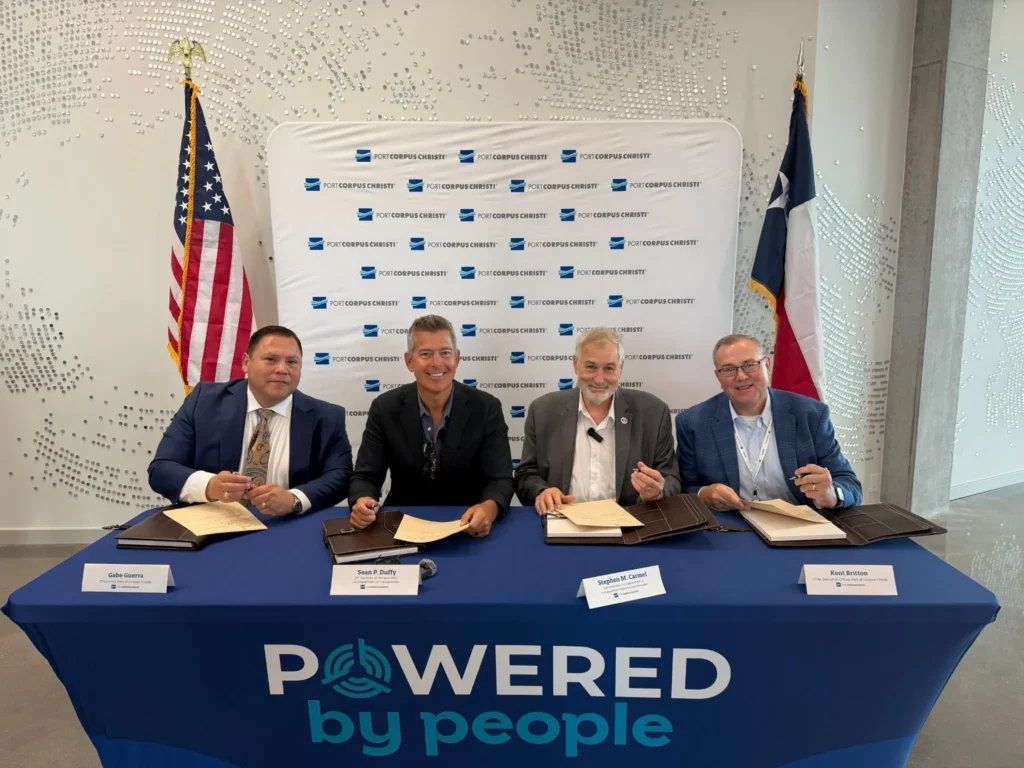
The Port of Corpus Christi, the United States’ undisputed king of petroleum exports, has doubled down on its energy dominance, this time with a nuclear twist. In a memorandum of understanding signed Tuesday, the Texas port joined forces with the Department of Transportation (DOT) to test small modular reactors (SMRs) for maritime applications, a move framed as both a decarbonisation play and a bid to ‘restore America’s maritime dominance’.
The deal, inked by Transportation Secretary Sean P. Duffy and MARAD Administrator Stephen M. Carmel, positions Corpus Christi, as the nation’s top LNG exporter, with an 81% export surge since 2022, as the guinea pig for a technology the Trump administration claims could slash shipping costs and revive US shipbuilding. Whether SMRs can outmanoeuvre the inertia of a fossil-fuel-driven port remains the $64,000 question.
‘Maritime Dominance’ by Reactor: Corpus Christi
Duffy’s pitch was unabashed: SMRs could ‘reshape America’s maritime sector’, offering a lifeline to a fleet starved of innovation, and, conveniently, a political win for an administration keen to marry energy exports with tech nationalism. Carmel, meanwhile, leaned into supply chain resilience, arguing that nuclear-powered vessels could shield Gulf Coast trade from grid failures and hurricanes, a not-so-subtle nod to Texas’ recent blackout woes.
The port’s CEO, Kent Britton, and Commission Chairman Gabe Guerra signed alongside Rep. Michael Cloud (TX-27), a rare moment of alignment in a state where oil and gas typically call the shots. The MOU follows a May 2026 DOT initiative to fast-track SMR adoption, though details on timelines, funding, or specific reactor models were, predictably, absent.
The LNG Elephant in the Room
Corpus Christi’s LNG boom, 81% growth in three years, makes it an odd poster child for nuclear experimentation. The port’s bread and butter remains hydrocarbons, and while SMRs might trim operational costs for auxiliary power, they’re hardly a silver bullet for the heavy fuel oil that powers global shipping. Still, with the DOT framing this as a ‘second agreement’ in its SMR push, the message is clear: the US is betting on nuclear to outflank rivals in both energy and shipbuilding, even if the maths (and the physics) are still on the drawing board.
Small modular reactors have the potential to reshape America’s maritime sector, lower shipping costs, and bolster our supply chains. I’m thrilled that the Port of Corpus Christi is embracing this exciting partnership to ensure the United States leads the way in innovation.
Sean P. Duffy·US Secretary of Transportation
This agreement demonstrates that the leading energy port in the nation understands the significance of this technology. SMR integration has the potential to drive down costs and guarantee that our critical Gulf Coast maritime supply chains remain resilient against any contingency.
Stephen M. Carmel·MARAD Administrator
Sign up free to ask CAMAL AI for a summary, the key points or anything else about this story.
Related stories
Financial Ports Newsletter
The maritime economy, every morning
Ports, shipping and freight markets in one short email. Free.