

Nighttime TSS Collision: How Miscommunication Sank Two Ships
A bulk carrier and tanker collided in a Traffic Separation Scheme after ambiguous VHF exchanges and poor radar checks.
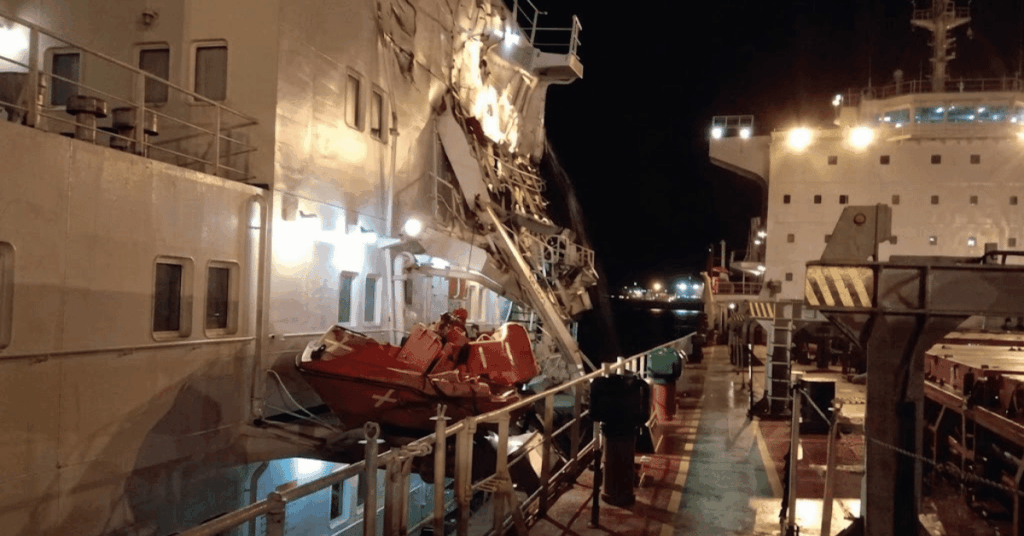
A bulk carrier and an oil tanker collided in a Traffic Separation Scheme (TSS) after a breakdown in communication, poor situational awareness, and a series of small but critical errors on both bridges. The incident, which occurred at night in good visibility, left both vessels with significant structural damage, but no injuries or pollution.
The bulk carrier, travelling at over 16 knots, was overtaking the slower tanker when the range between the two vessels closed to under a mile. Concerned about the tightening closest point of approach (CPA), the bulk carrier’s Master instructed the Officer of the Watch (OOW) to contact the tanker via VHF to clarify intentions. The conversation, conducted in English by non-native speakers, proved disastrously ambiguous.
The tanker’s Master interpreted the exchange as an agreement to ease slightly to port while the bulk carrier passed to starboard. However, the bulk carrier’s OOW relayed the opposite understanding to his Master: that the tanker did not want to be overtaken on its starboard side. Without verifying the call directly, the bulk carrier’s Master ordered a gradual series of small helm movements to port, intending to pass down the tanker’s port side. No sound signals were made, and the manoeuvre went unnoticed by the tanker’s bridge team.
The tanker’s Master, who had been on the bridge continuously for over 14 hours, was preoccupied with a separate crossing vessel on the port bow and a narrowing turn in the TSS ahead. Believing the bulk carrier would pass safely to starboard, he ordered a hard-to-port turn to increase sea room, without conducting a visual check astern or sounding a signal. It was only when the tanker’s lookout spotted the bulk carrier dangerously close on the port quarter that the bridge team realised the impending collision.
Both vessels attempted last-minute avoiding action, but the damage was already done. The collision underscored the dangers of over-reliance on VHF communication, particularly when language barriers and second-hand reporting distort intentions. The bulk carrier’s incremental helm adjustments, rather than a decisive course change, further masked its movements, while the tanker’s fatigue likely impaired its situational awareness.
Lessons from the Collision: Why the Rules of the Road Matter
The incident serves as a stark reminder that VHF communication is no substitute for compliance with the Collision Regulations for Preventing Collisions at Sea (COLREGs). The rules require vessels to maintain long-range radar and ECDIS scanning, not just short-range collision avoidance. In this case, earlier, more decisive action, such as a wider alteration of course, could have prevented the collision entirely.
Bridge teams must also be wary of second-hand information. The bulk carrier’s Master acted on a relayed understanding of the VHF call, rather than listening to the exchange directly. This layer of interpretation, combined with language differences, proved catastrophic. Meanwhile, the tanker’s failure to check astern before a major course alteration violated a fundamental principle of safe navigation. The collision also highlights the risks of fatigue in watchkeeping.
In the aftermath, both vessels sustained significant structural damage, though no crew members were injured, and no pollution was reported.


Sign up free to ask CAMAL AI for a summary, the key points or anything else about this story.
Related stories
CAMAL AI
 Financial Ports Newsletter
The maritime economy, every morning
Ports, shipping and freight markets in one short email. Free.



