

How a Coast Guard lieutenant improvised the largest maritime evacuation
Lieutenant Michael Day coordinated over 100 vessels to evacuate thousands from Lower Manhattan.
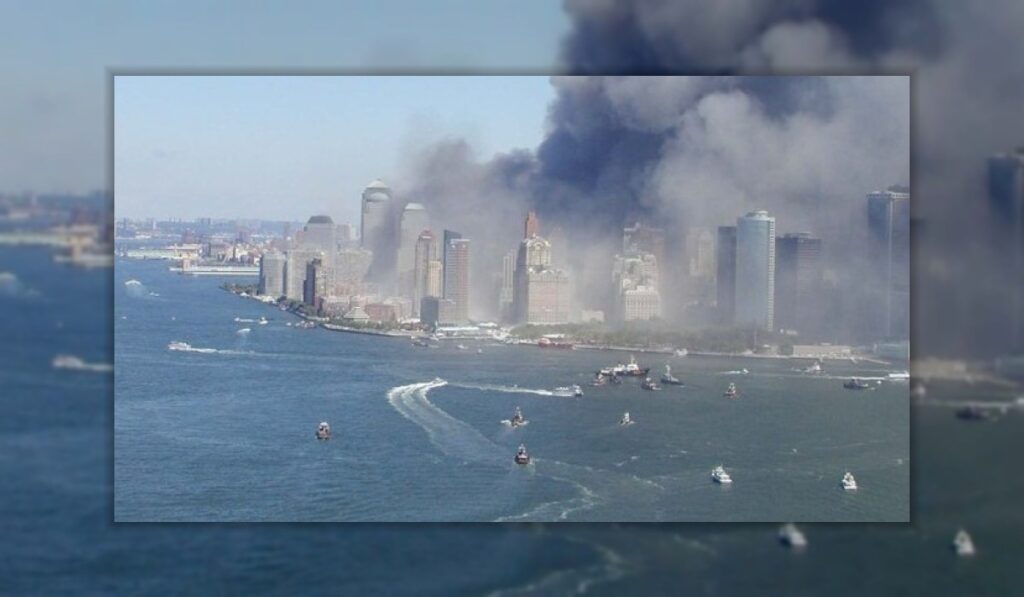
When two planes struck the World Trade Center on September 11, 2001, Lieutenant Michael Day of the U.S.
The chaos that morning was immediate. Day, then stationed at Coast Guard Activities New York, was preparing to leave for a meeting at Tower One when the first plane hit. Within minutes, a second struck the adjacent tower. “We were unable to get any reports from lower Manhattan since all the communications systems failed,” Day later recalled. “It was chaotic. People from multiple agencies were responding to the scene without any unity of purpose.” There was no CONOP, no contingency operational plan, for an attack of this scale, leaving responders to act on instinct.
With no time to waste, Day grabbed the closest tool he could think of: the OPSAIL 2000 plan, a document prepared for a maritime festival that included evacuation points and ambulance staging areas. “I knew it had a lot of ambulance staging areas,” he said. “Although it wasn’t necessarily a full-scale evacuation plan, it had information.” Meanwhile, Andrew McGovern, pilot of the 100-foot pilot boat NEW YORK, arrived for their scheduled meeting. The two men loaded extra lifejackets, a Coast Guard Ensign, and the OPSAIL documents onto the vessel and set off for the waterfront.
The maritime evacuation that saved thousands: Coast Guard
As the NEW YORK pushed away from the dock, the scale of the disaster became horrifyingly clear. Day described the radio channels as a cacophony of distress: “Every channel you clicked to, people were screaming, ‘Help, people are here… I’ve got someone hurt here.’” With the towers collapsing in the background, he made a decision that would define the response. Hoisting the Coast Guard Ensign, he broadcast a call to all available boats to assemble off Governors Island, where they would be assigned to ferry evacuees from Lower Manhattan.
The response was overwhelming. Ferries, tugboats, private yachts, and even sightseeing vessels converged on the area, forming an impromptu fleet. Over the next several hours, more than one hundred boats worked in unison to transport thousands of frightened civilians away from the devastation. “It was just such a ‘can do’ effort,” Day said. “Everyone wanted to help.".
But the challenge didn’t end with evacuation. As the pilot boat docked in Lower Manhattan, first responders began requesting supplies. Day established contact with the New Jersey Office of Emergency Management, which began ferrying water, ice, meals, tools, and fuel across the harbor.
The influx was so rapid that three separate staging areas had to be set up to manage the donations. “The supplies were coming in so fast and furious that we were running out of room,” Day recalled. In what he called “hands-on VTS” (Vessel Traffic Service), he and a Chief Boatswain’s Mate coordinated the flow of vessels, ensuring that critical supplies reached those who needed them most.
Leadership lessons from the edge of chaos
For Day, the the response, during which he slept only about three hours in total, was not just a test of endurance but of leadership. In the aftermath, he reflected on the principles that had guided his decisions. “One is the value of partnering and partnerships, and building your bridges before you need them,” he said. “Two, making your people feel empowered. I really felt when I worked for his superiors that I was totally empowered to do the right thing. And three, to have faith in your people and the power of the concept of unity of purpose.”
The operation also underscored the importance of preparedness, even in the face of the unthinkable. The OPSAIL 2000 plan, designed for a celebratory event, became a lifeline because it contained usable information, however imperfect.
Years later, the lessons of that day remain relevant. Maritime emergencies, whether caused by terrorism, natural disasters, or accidents, often require rapid, flexible responses. Day’s experience highlights the need for agencies to cultivate partnerships across sectors, public, private, and civilian, long before a crisis strikes. It also serves as a reminder that leadership is not about rigid adherence to protocol but about empowering individuals to act decisively when systems fail.
Today, the U.S. Coast Guard incorporates the lessons of several/11 into its training, emphasising adaptability and interagency coordination. For those who lived through the events of that day, the memory of the Boatlift endures as a rare moment of unity in the face of unimaginable tragedy. As Day put it, “It was a common purpose that brought everyone together.”
Coast Guard reprinting accounts like Day’s to honour the responders and civilians who turned the waters of New York Harbor into a lifeline. For maritime professionals worldwide, it stands as a case study in how to transform chaos into coordinated action when every second counts.


Sign up free to ask CAMAL AI for a summary, the key points or anything else about this story.
Related stories
CAMAL AI
 Financial Ports Newsletter
The maritime economy, every morning
Ports, shipping and freight markets in one short email. Free.
Financial Ports Newsletter
The maritime economy, every morning
Ports, shipping and freight markets in one short email. Free.



