

$226m Cocaine Haul: How One US Coast Guard Cutter Broke Cartel Supply Lines
USCGC Tampa offloaded 13 metric tonnes of cocaine in Port Everglades.
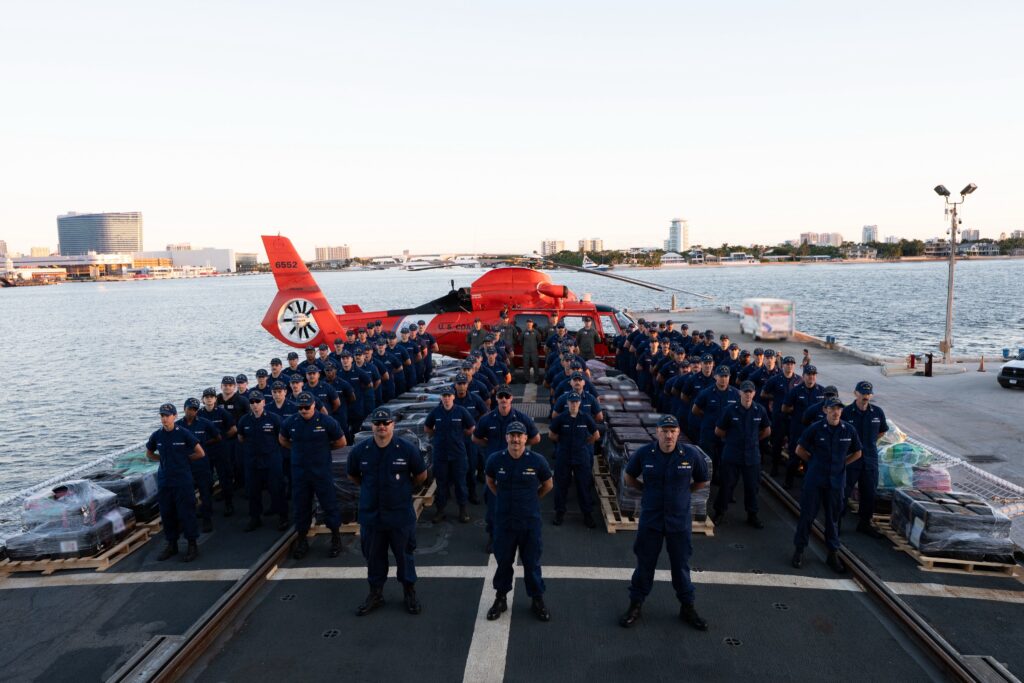
The haul, valued at $226.7 million, was intercepted during six high-risk interdictions in the Eastern Pacific, where smugglers deployed faster, more powerful vessels than ever before. USCGC Tampa’s commanding officer, Capt. Joshua DiPietro, described the operations as “back-to-back” challenges that tested the crew’s endurance and tactical skills.
The smuggling vessels encountered by Tampa’s crew were no ordinary boats. Averaging 1,000 horsepower and equipped with three to four high-power outboard engines, they ranged from 35 to 45 feet in length, far larger and more capable than those seen in previous years. “Most of them held much larger loads than we’ve seen in the past,” DiPietro told reporters, highlighting the cartels’ evolving tactics.
The agency works closely with Joint Interagency Task Force South, a multi-national effort that pools intelligence and resources to track and disrupt drug trafficking routes.
Royal Caribbean
In just six days in September, Tampa’s crew intercepted four suspect boats carrying a combined 25,200 pounds (6,800 + 15,000 + 3,400) of cocaine. The first bust netted 6,800 pounds, followed by two vessels with a combined 15,000 pounds, and a fourth with 3,400 pounds.
The operations were not without risk. DiPietro detailed the hazards: “High-speed pursuits in total darkness, engaging multiple go-fast vessels simultaneously, and navigating aggressive cartel countermeasures.” Helicopter crews from the Coast Guard’s Helicopter Interdiction Tactical Squadron played a critical role, stopping speeding vessels from the air, a feat that demands “extraordinary aviation skill, tactical judgment, and absolute discipline,” according to Capt.
Kent Reinhold. These aerial interventions are often the difference between a successful interdiction and a lost opportunity, particularly in the vast expanse of the Eastern Pacific, where smugglers exploit the lack of immediate law enforcement presence.
The Human Cost of the Drug Trade: Coast Guard
Vice Adm. Jo-Ann Burdian, commander of the U.S. Coast Guard Atlantic Area, framed the operation as life-saving work. “Thirteen metric tons of cocaine is enough to deliver 10 million potentially fatal doses to American communities,” she said.
“Our goal is to dismantle these violent criminal networks that challenge our safety at home and the sovereignty of our partners in the region.”
Jo-Ann Burdian·Commander, U.S. Coast Guard Atlantic Area
The Coast Guard detained 15 smugglers during the operation, though under recent maritime laws, they will be repatriated rather than prosecuted using federal resources. An anonymous source involved in the investigation revealed that one of the detained smugglers had been caught in a previous seizure, underscoring the persistent nature of transnational criminal organisations. Many smugglers are low-level operatives, often coerced or financially desperate, while the cartels themselves remain elusive, operating across borders with impunity.
The Tampa’s success in this operation also highlights the broader challenges facing the U.S. Coast Guard’s fleet. As the agency awaits the delivery of the new Offshore Patrol Cutter (OPC), older vessels like the Tampa are being pushed to their operational limits. The OPC programme, currently being executed by Austal, aims to replace the ageing WMEC fleet with modern, more capable ships designed to meet the demands of 21st-century maritime security. However, delays in the programme have left the Coast Guard reliant on vessels that, in some cases, are more than six decades old.
The Future of Maritime Interdiction
The USCGC Tampa, built in 1984 in Tacoma, Washington, is a testament to the durability of the Coast Guard’s medium endurance cutters. After undergoing a life-extension refit in 2005 to serve through 2015-2020, the vessel continues to operate as a critical asset in the fight against drug trafficking.
Its home port in Portsmouth, Virginia, serves as a strategic hub for Atlantic operations, enabling rapid deployment to high-risk areas in the Caribbean and Eastern Pacific. Despite its age, the Tampa’s recent successes demonstrate the importance of crew training and adaptability in maintaining operational effectiveness.
The Offshore Patrol Cutter (OPC) programme represents the Coast Guard’s long-term solution to modernising its fleet. Designed to replace the WMEC vessels, the OPCs will feature enhanced surveillance capabilities, greater endurance, and improved crew accommodations. Austal, the contractor for the programme, is currently constructing the first of these cutters, with delivery expected in the coming years.
For the public, the implications of these operations are clear. The disruption of cartel supply lines directly impacts the availability and price of illicit drugs in U.S. markets, potentially reducing the flow of narcotics into communities. However, the Coast Guard’s work is far from finished. As smuggling networks adapt to law enforcement tactics, the agency must continue to innovate, leveraging technology, intelligence-sharing, and international partnerships to stay ahead. The recent seizure in Port Everglades is a reminder of both the progress made and the challenges that lie ahead.
Those interested in following the Coast Guard’s ongoing efforts can monitor updates from the agency’s official channels, including its website and social media platforms. The U.S. Coast Guard’s official site provides real-time information on interdiction operations, fleet modernisation, and public safety initiatives. Meanwhile, the Austal website offers insights into the construction and capabilities of the new Offshore Patrol Cutters, which will play a pivotal role in shaping the future of maritime law enforcement.
DiPietro praised his team’s tenacity, stating, “Their resounding teamwork during complex operations is astounding. I commend them on their tremendous tenacity and true camaraderie as they worked through long days and nights to successfully complete difficult cases.” The offload at Port Everglades marks a significant blow to cartel operations, but the Coast Guard’s work is far from over. With smuggling networks continually evolving, the agency’s ability to adapt and respond remains critical to protecting both domestic security and regional stability.


Sign up free to ask CAMAL AI for a summary, the key points or anything else about this story.
Related stories
CAMAL AI
 Financial Ports Newsletter
The maritime economy, every morning
Ports, shipping and freight markets in one short email. Free.



