

17th-Century Ship’s 650-Tonne Move: The Batavia’s Final Voyage Ashore
The 56.6-metre replica of the 1628 Dutch East Indiaman enters dry dock ahead of its permanent museum display in.
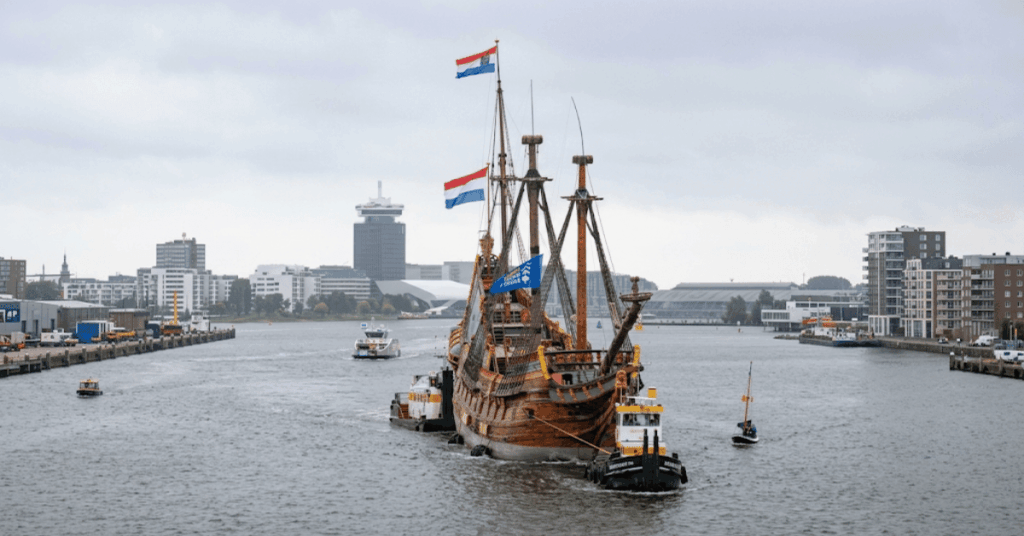
A meticulously planned operation is underway to prepare the Batavia, a full-scale reconstruction of a 1628 Dutch East India Company vessel, for its permanent move to Museum Batavialand in Lelystad. The 56.6-meter wooden ship arrived at Damen Shiprepair Amsterdam on 19 September after a carefully managed six-hour tow.
The historic replica, which has remained afloat for 31 years, was transported with its masts intact and an air draught of 30.5 meters. Engineers opted for a tow rather than a pontoon transfer to avoid placing undue stress on the fragile timber hull. In the 17th century, similar ships typically lasted between 15 to 25 years, making the Batavia’s preservation a complex challenge. To ensure stability during the operation, temporary steel supports were installed in the hold and on the decks, while most of the ballast and all guns were removed beforehand.
Precision Engineering for a Fragile Hull: Batavia
The dry-docking process, developed over 14 months, required a custom-built cradle weighing over 100 tonnes—comprising 87.2 tonnes of steel and 14 tonnes of wood. The operation began with the preparation of dry dock 4, where crane mats were placed on a Van der Wees pontoon to distribute the load. Support pots were then positioned, and the cradle was lifted into place using a crane.
Once the pontoon was submerged in the dock, two small tugs maneuvered the Batavia over the cradle. As the dock was drained, the ship settled onto its supports under controlled conditions. Workers then spent two days packing timber into the gaps between the hull and cradle to ensure a secure fit. The next phase involves reflooding the dock to lift the pontoon, allowing the Batavia to be towed to the quay for final preparations before its journey to Lelystad.
Paul van de Craats, Commercial Manager at Damen Shiprepair Amsterdam, highlighted the project’s significance: “I witnessed the ship’s construction during my training years, when traditional carpentry skills were passed down to new generations. This project resonates with us because we follow the same hands-on approach in our work. The Batavia first entered this dock in 1995, and now it returns—full circle. We’re proud to contribute to preserving this piece of Dutch maritime history.”
A Final Voyage to Its New Home
The Batavia will depart Amsterdam at a hull weight of nearly 650 tonnes, with all remaining ballast removed. The cradle, designed by Q3 Heavy Lift and built by Damen’s sister company Niron Staal, was engineered over 10 months to account for the ship’s dimensions and structural vulnerabilities. Specialists from FaraFlash, Kuperus & Gardenier, and other firms collaborated to ensure the hull’s safe transition from water to land.
Once the dry-docking is complete, the ship will be transported to Museum Batavialand, where it will be displayed permanently ashore—a rare opportunity to preserve a wooden vessel of this scale for future generations.


Sign up free to ask CAMAL AI for a summary, the key points or anything else about this story.
Related stories
CAMAL AI
 Financial Ports Newsletter
The maritime economy, every morning
Ports, shipping and freight markets in one short email. Free.
Financial Ports Newsletter
The maritime economy, every morning
Ports, shipping and freight markets in one short email. Free.



