

646-Tonne 17th Century Ship Moved Ashore: How Engineers Saved the Batavia
The 30-year-old wooden replica of the 1628 VOC ship Batavia was lifted onto land in a 646-tonne operation.
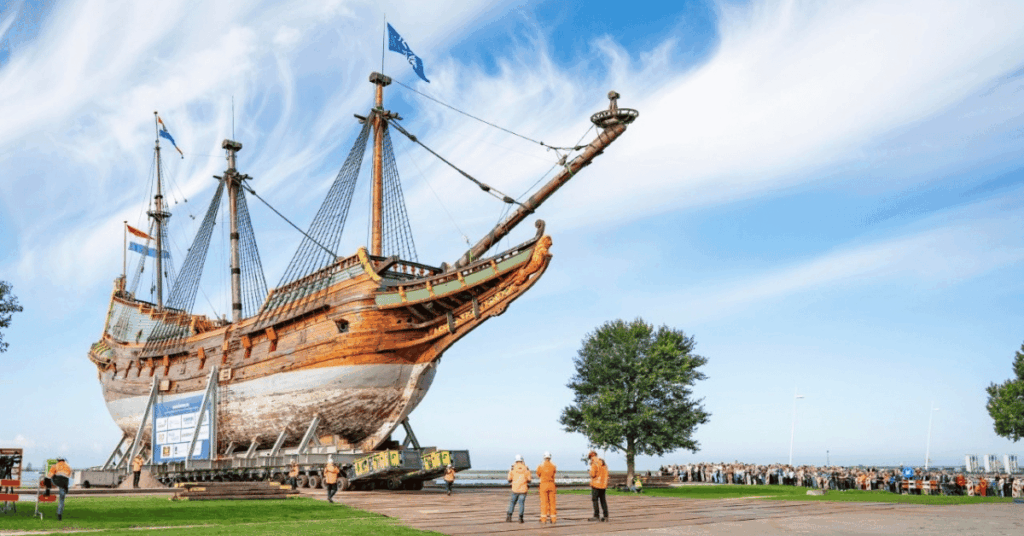
The replica, painstakingly rebuilt using 17th-century techniques, serves as both an educational tool and a tribute to the craftsmanship of the era.
The 646-tonne Batavia and its 101.2-tonne cradle were lifted onto a pontoon at Damen Shiprepair Amsterdam before being driven ashore. Two SPMT trains, each with 28 axle lines, were used to distribute the load evenly and prevent damage to the ship’s fragile hull.
The logistical challenges were compounded by the ship’s age and material. Engineers had to account for the ship’s uneven weight distribution, as well as the delicate balance required to keep the hull intact. The 250-metre route, which crossed the Markermeer dike, was surveyed metre by metre to ensure the stability of the subsoil and avoid buried services. Lamp posts and street furniture along the path were temporarily removed to facilitate the transport.
How Engineers Overcame the Challenges of Moving a 30-Year-Old Wooden Ship
“It is only 250 metres, but if you drive over a pipeline you didn’t know was there, you have a problem. That groundwork is what makes the difference on a job like this,” said Ard Suvaal, Project Manager at Trans Global Projects. The ramp used for the operation was deliberately built long to maintain a shallow approach angle and even ground pressure, a critical factor given the ship’s approximately 650-tonne weight.
The technical partners, including Q3 Heavy Lift, the Directorate-General for Public Works, and the Water Authority Zuiderzeeland, collaborated closely with local authorities to ensure the move adhered to strict safety and environmental standards.
The Batavia’s new foundation, a permanent concrete structure, was designed to support the ship’s weight while allowing for natural ventilation. This is essential for preserving the timber, which had spent over three decades exposed to the elements. The elevated position, more than 8 metres higher than its previous berth, also protects the hull from future water damage, ensuring its longevity as a cultural artefact.
The Batavia is not just a replica; it is a testament to 17th-century shipbuilding and the golden age of Dutch maritime trade. It has also appeared in films, television programmes, and documentaries, cementing its place in cultural history.
Why the Batavia’s Move Matters for Maritime Heritage
The relocation is part of a broader effort to preserve the ship for future generations. By moving it ashore, conservators aim to protect the timber from further weathering and allow it to dry naturally. The redeveloped Museum Batavialand, expected to open in late 2028, will provide a state-of-the-art facility for visitors to explore the Batavia and its historical significance. The museum’s redevelopment includes expanded exhibition spaces, interactive displays, and enhanced visitor amenities, all designed to immerse guests in the story of the VOC and its global impact.
The Batavia’s new home will also serve as an educational hub, offering workshops and programmes for schools and maritime enthusiasts. Its elevated position ensures better visibility, making it a landmark for Lelystad and a draw for tourists. The ship’s preservation is not just about maintaining a physical structure; it is about keeping alive the skills, stories, and legacy of the Dutch maritime tradition.
“We move large steel structures for a living, transformers, oil and gas, offshore. Usually, almost nobody sees those projects and it usually just inconveniences local people along the route. This time we have a reconstruction of a 17th-century VOC ship standing on the trailers, in full public view and with a lot of guests and media watching the operation. I am proud of that, and even more of how this team worked: all the partners put their calculations, ideas, second thoughts and solutions on the table and solved things together rather than waiting on each other,” Suvaal added.
While the Batavia will not be accessible to visitors until early 2027, the wait promises to be worth it. The ship’s new position, elevated and protected, ensures that it will remain a landmark of maritime heritage for decades to come. Once reopened, guests will be able to board the Batavia and explore its decks, cabins, and cargo holds, gaining a firsthand understanding of life aboard a 17th-century trading vessel.
The redeveloped Museum Batavialand, scheduled to open in late 2028, will offer a comprehensive experience, combining the Batavia with other exhibits on Dutch maritime history. The museum’s expansion includes new galleries dedicated to the VOC’s global trade network, the science of navigation, and the daily lives of sailors. Interactive displays will allow visitors to engage with the ship’s history in innovative ways, from virtual reality tours to hands-on workshops on traditional shipbuilding techniques.
For those planning a visit, the museum’s official website (www.batavialand.nl) provides updates on the reopening timeline and ticketing information. The Batavia’s relocation is not just a logistical triumph; it is a step toward ensuring that this iconic ship continues to inspire and educate for generations to come.


Sign up free to ask CAMAL AI for a summary, the key points or anything else about this story.
Related stories
CAMAL AI
 Financial Ports Newsletter
The maritime economy, every morning
Ports, shipping and freight markets in one short email. Free.
Financial Ports Newsletter
The maritime economy, every morning
Ports, shipping and freight markets in one short email. Free.



