

Amazon cargo jet crash: 32,000 pounds of contact lenses lost
NTSB reveals the Boeing 767-300 freighter failed to deploy braking systems before overshooting Runway 8, killing five.
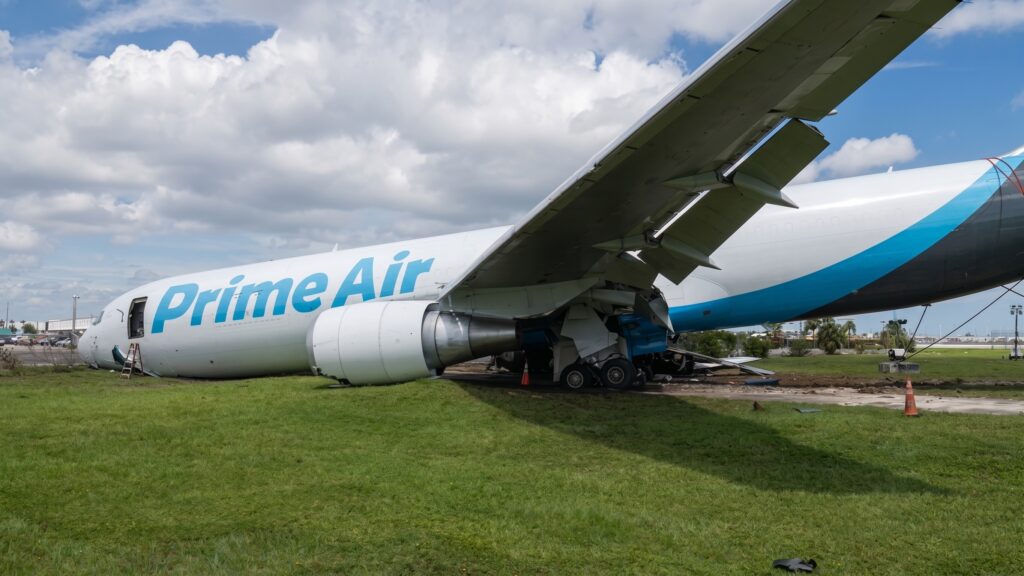
A Boeing 767-300 freighter carrying 32,000 pounds of contact lenses crashed at Miami International Airport after failing to slow down during landing, killing five people and injuring several others. National Transportation Safety Board Board (NTSB) confirmed the aircraft, operated by Amazon contractor 21 Air, did not deploy critical braking systems and instead accelerated to full power seconds before coming to a halt in a grassy area beyond the runway.
The incident occurred two days before the NTSB’s Tuesday evening briefing, where investigator Chihoon Shin revealed the plane’s ground speed was 181 mph when its nose and right main landing gear first touched down. Despite braking attempts, the aircraft’s speed only dropped to 168 mph before the left landing gear made contact. Seconds later, the pilots released the brakes and increased thrust, a manoeuvre consistent with attempting a go-around, though the aircraft ultimately overran the runway, colliding with two vehicles and fences before stopping across a public road.
According to flight data, the pilots applied the brakes seven seconds after initial touchdown, reducing the speed to 154 mph. However, they abruptly released the brakes four seconds later, increasing engine thrust to levels typically used for takeoff. The aircraft’s final recorded speed was 75 mph when it came to rest in the grassy area.
“The pilots did not deploy critical systems meant to slow an aircraft upon landing and, in fact, seconds before coming to rest the throttles were set to full power,” Shin stated during the briefing. The NTSB has prioritised analysing the cockpit voice recorder and flight data recorder, which were transported to Washington, D.C., for examination. NTSB Chairwoman Jennifer Homandy indicated that crew accounts would help clarify whether actions were verbalised during the flight or if mechanical failure played a role.
The aircraft, a converted freighter, was en route from Puerto Rico, where numerous contact lens manufacturers operate.
Pilots’ experience and next steps in the investigation: amazon cargo jet crash
The two pilots involved in the crash, Captain Joseph Carol, 55, and First Officer Jaime Felipe Silva, 37, are scheduled to be interviewed by investigators on Wednesday. Carol, who received his Boeing 767-300 type rating in May, has 7,145 hours of flight experience, while Silva Molina, who earned his rating in April, has 2,655 hours.
In addition to the pilots, 21 Air’s chief pilot, assistant chief pilot, and flight dispatcher will also be interviewed. The dispatcher, responsible for preflight planning, weather monitoring, and in-flight tracking, was questioned on Tuesday. Investigators have already collected perishable evidence from the scene, including photographs, videos, drone footage, and tyre marks, which may provide further insight into the aircraft’s trajectory and braking attempts.
The agency anticipates releasing a preliminary report on the cockpit voice recorder’s findings on Wednesday, which could shed light on the pilots’ decision-making in the critical moments before the crash.
“Investigators hope to learn lessons that can prevent other accidents, such as whether the pilots made any mistakes and did 21 Air follow proper safety procedures,” Homandy emphasised.
“The pilots did not deploy critical systems meant to slow an aircraft upon landing and, in fact, seconds before coming to rest the throttles were set to full power.”
Chihoon Shin·NTSB Investigator in Investigator in Charge
The crash has reignited debates about the safety of converted freighter aircraft, particularly those operated by third-party contractors for major logistics companies. While the Boeing 767-300 has a strong safety record, the incident raises questions about whether additional oversight is needed for cargo flights, which often operate under different regulatory standards than passenger airlines.


Sign up free to ask CAMAL AI for a summary, the key points or anything else about this story.
Related stories
CAMAL AI
 Financial Ports Newsletter
The maritime economy, every morning
Ports, shipping and freight markets in one short email. Free.
Financial Ports Newsletter
The maritime economy, every morning
Ports, shipping and freight markets in one short email. Free.