

500-Tonne Flood Nearly Sank Ferry After Jetty Collision—MAIB Report
Stena Estrid’s hull was holed during berthing at Holyhead Port, flooding its engine room with 500 tonnes of water.
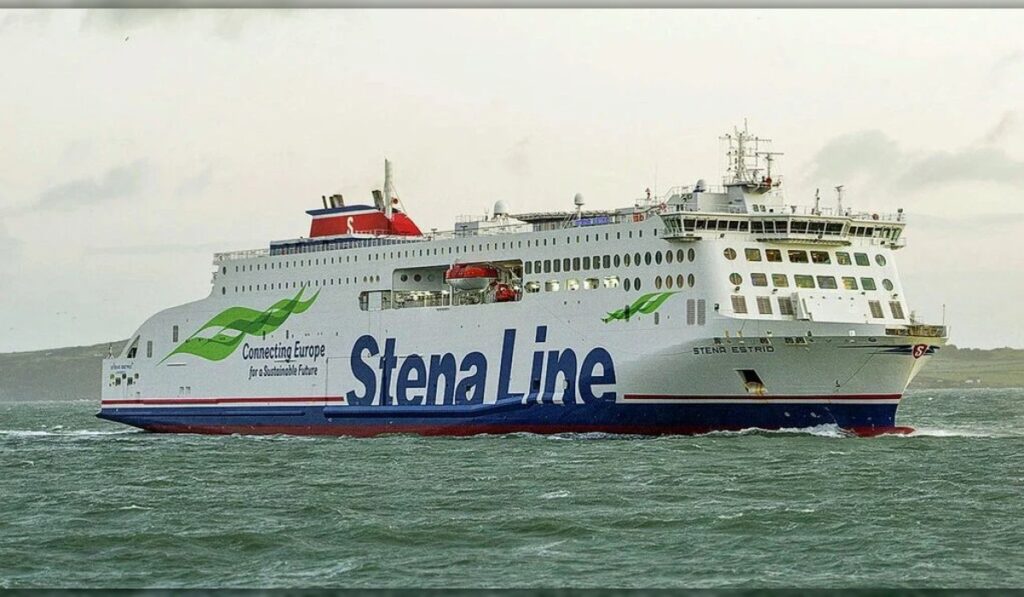
The UK’s Marine Accident Investigation Branch (MAIB) has released its findings on a January incident involving the RoPax ferry Stena Estrid, which suffered severe hull damage after colliding with a jetty during a routine berthing maneuver at Holyhead Port.
The 41,600-gross-tonnage vessel, carrying 95 vehicles, 91 passengers, and 66 crew members, struck the jetty on January 7 while docking at Terminal 3. The impact punctured the hull, allowing approximately 500 tonnes of seawater to flood the engine room and an adjacent compartment. The ferry, part of Stena Line’s E-Flexer class and operating on the Holyhead-Dublin route, was built in 2019 and sails under the Cypriot flag.
Unseen hazards worsened the damage: Ferry
Investigators determined that a combination of factors contributed to the collision. A tugboat assisting the berthing was positioned on the ferry’s port aft quarter, limiting its ability to correct the vessel’s trajectory. Conflicting communications between the ferry’s master and the tug crew further reduced the tug’s effectiveness. Additionally, strong westerly winds pushed the ferry toward the jetty faster than anticipated, despite the master’s awareness of the need to avoid the turning fender.
A post-incident inspection revealed that the jetty’s turning fender had sharp protrusions on its face plate and lacked a rubber fender structure. The ferry’s crew had no prior knowledge of these hazards, which significantly increased the severity of the hull breach upon contact. The MAIB report emphasized that this lack of awareness was a critical factor in the incident’s outcome.
Port upgrades planned after repeated incidents
Despite the flooding, the crew’s rapid response—including reinforcing the hull below the waterline, pumping out flooded compartments, and adjusting ballast to raise the damaged section—prevented a full-scale disaster. The ferry completed its berthing, allowing all passengers and vehicles to disembark safely. However, Holyhead Port, the UK’s second-busiest passenger ferry hub, was closed for several hours, disrupting operations.
This was not the first berthing incident at Holyhead. Terminal 5 has remained closed since December following a separate collision caused by severe weather. In response, Stena Line and Stena Line Ports are investing in upgrades to improve the resilience of Terminals 3 and 5. The planned measures include removing protruding brackets from the turning fender, installing new anodes, replacing damaged fenders, and renewing two mooring dolphins.


Sign up free to ask CAMAL AI for a summary, the key points or anything else about this story.
Related stories
CAMAL AI
 Financial Ports Newsletter
The maritime economy, every morning
Ports, shipping and freight markets in one short email. Free.
Financial Ports Newsletter
The maritime economy, every morning
Ports, shipping and freight markets in one short email. Free.