

27 Crew Saved in 11 Hours: How a Burning Ship Off Galapagos Became a Race
A fishing vessel ablaze 527 miles southwest of the Galapagos triggered a rapid international rescue operation.
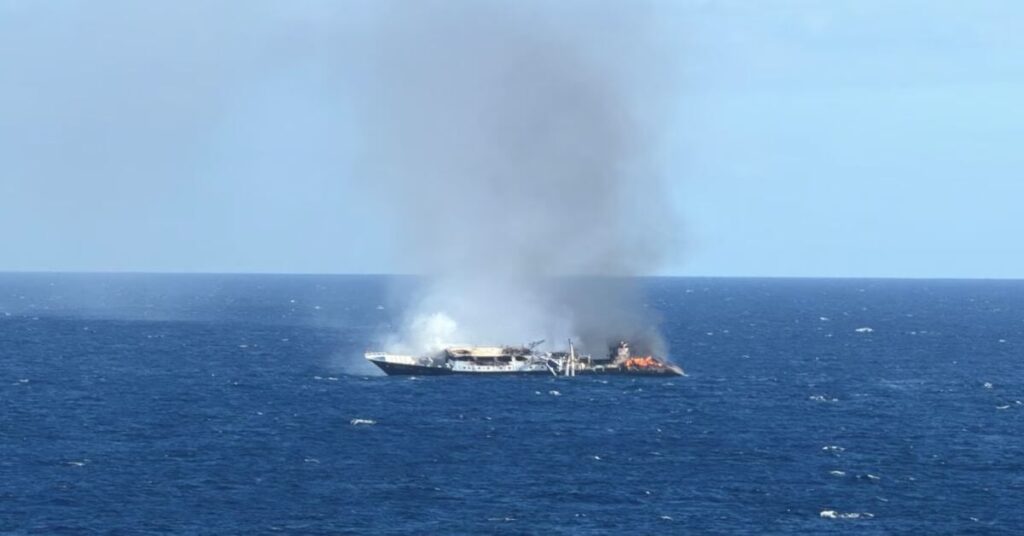
The U.S. Coast Guard successfully coordinated the rescue of 27 crew members from a burning fishing vessel nearly 530 miles southwest of the Galapagos Islands. The incident unfolded after distress signals alerted authorities to the emergency late on August 20.
At approximately 8 p.m., Coast Guard watchstanders in the Southwest District received multiple alerts from the Ecuadorian-flagged vessel Drennec. The signals included an emergency beacon transmission and an Iridium alert sent through a Garmin inReach device. Garmin Response confirmed the vessel was on fire and that all 27 crew members had abandoned ship for a life raft.
Rapid Response Saves Crew: galapagos rescue operation
The Coast Guard activated the Automated Mutual-Assistance Vessel Rescue System (AMVER) to locate nearby vessels capable of assisting. Within hours, two ships—the fishing vessel Ricky A and the container ship Oluf Maersk—altered their courses to respond. The Ricky A recovered all 27 crew members from the life raft by 10:15 a.m. on August 21, while the Oluf Maersk remained on standby to provide additional support.
A.P. Møller-Maersk
Doug Samp, the Coast Guard’s search and rescue mission coordinator, stated that the entire operation took just 11 hours from the first distress alert. He credited the successful rescue to the crew’s emergency devices and the coordination between the U.S. Coast Guard, Ecuador’s Maritime Rescue Coordination Center, and the responding vessels. The Ricky A will transport the rescued crew to Guayaquil, Ecuador.
The Role of AMVER in Maritime Safety
AMVER, a voluntary ship-reporting system operated by the U.S. Coast Guard, played a critical role in the rescue. The system allows search and rescue teams to identify and contact commercial vessels near distressed ships. Merchant vessels worldwide participate in AMVER, often diverting to assist in emergencies when they are in proximity.
Since its inception in 1958, AMVER has facilitated thousands of rescues, demonstrating how global cooperation can turn the vast expanse of the ocean into a network of potential lifesavers. For the crew of the Drennec, the system functioned precisely as designed, ensuring their safe recovery despite the remote location of the incident.


Sign up free to ask CAMAL AI for a summary, the key points or anything else about this story.
Related stories
CAMAL AI
 Financial Ports Newsletter
The maritime economy, every morning
Ports, shipping and freight markets in one short email. Free.
Financial Ports Newsletter
The maritime economy, every morning
Ports, shipping and freight markets in one short email. Free.



